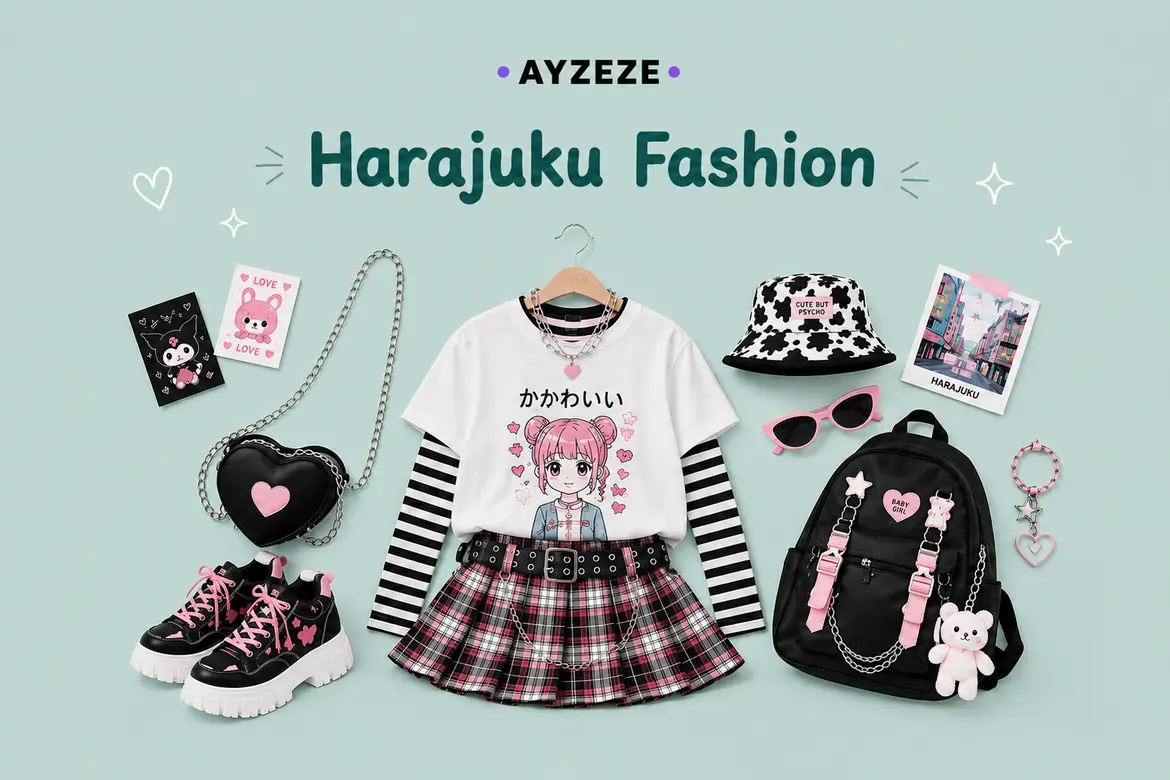
The first time you see real Harajuku fashion in person, not on a Pinterest board, not in a music video, but walking down Takeshita Street on a Saturday afternoon, it rearranges something in your brain. A pastel wig next to a head-to-toe black lace dress next to a denim jacket covered in hand-painted patches. No one is dressed like anyone else, and somehow it all works.
That’s the whole point of Harajuku fashion. It was never about following one look. It was about permission, permission to make an outfit out of whatever made you feel most like yourself, rules be damned. And if you’re not able to fly to Tokyo to build that wardrobe piece by piece, the brand, Ayzeze, now brings a curated take on these substyles straight to you online.
If you’ve been searching “what is Harajuku fashion” and you have seen a dozen different answers, you’re not imagining things. Harajuku fashion isn’t a single style, and treating it as one is where most beginner guides go wrong. It’s an umbrella term for a cluster of Japanese streets splitting into new substyles and then circling back around decades later. This guide goes through where it came from, the major styles you will actually see today, and how to dress Harajuku fashion in a way that is authentic instead of costumey.
What Is Harajuku Fashion, Really?
At its core, Harajuku fashion is Japanese street fashion that originated in and around Harajuku, a district in Shibuya, Tokyo, particularly the stretch of shops around Takeshita Street and Omotesando. It’s less a dress code and more a philosophy: individuality first, trends second, rules optional.
What separates Harajuku street fashion from mainstream trend cycles is the source. It didn’t just come from runways to the street. It had grown from street-level, teenagers and young adults mixing thrifted pieces, handmade accessories, and small-label Japanese designs into looks that magazines and eventually global fashion houses began to pay attention to. That bottom-up energy is still the heartbeat of the scene, even now that it’s a recognizable global aesthetic with its own hashtags and dedicated online shops, including labels on Ayzeze that are keeping the DIY, mix-and-match spirit alive for a new generation.
If you take anything out of this section, it’s this: Japanese Harajuku fashion is about self-expression, not just checking things off a list. A person in soft pastel Fairy Kei and a person in stark monochrome Gothic Lolitas are both clearly doing Harajuku fashion; they’re just using different dialects of the same language.
A Short History of Harajuku Fashion
The Postwar Roots
Harajuku’s fashion identity started forming in the years after World War II when the area around Yoyogi Park became associated with American GIs and, through them, Western goods and culture. Boutiques selling imported clothing opened nearby, giving young Tokyoites early access to Western silhouettes long before they were mainstream elsewhere in Japan.
The 1980s: Takenoko-zoku and the Street Becomes a Runway
By the late 1970s and into the ‘80s, groups of young dancers known as Takenoko-zoku began gathering on Sundays near Yoyogi Park in flamboyant, colorful outfits, performing choreographed routines for crowds. This is often cited as the moment Harajuku’s streets themselves became a kind of informal stage, a tradition of public self-display that never really went away.
The 1990s–2000s: The Golden Era
This is the period most people picture when they hear “Harajuku fashion.” Magazines like FRUITS, founded by photographer Shoichi Aoki in 1997, documented street style outfits directly from the sidewalks of Harajuku, turning anonymous teenagers into style icons almost overnight. This era produced most of the styles Westerners now recognize: Lolita in its many forms, Decora, Gyaru, and Visual Kei-inspired looks, and the early DIY punk mixes that defined the neighborhood’s reputation abroad.
Gwen Stefani’s early-2000s fascination with Harajuku (for better or worse, the “Harajuku Girls” era is genuinely controversial and worth understanding critically rather than romanticizing) is a big part of why the term became a household word in the West, even if it flattened a wildly diverse scene into one exportable image.
The 2010s Onward: Fragmentation and Global Reach
FRUiTS magazine famously paused print publication in 2017, and Aoki noted at the time that he was struggling to find enough interesting street style to photograph, a statement that sparked genuine debate about whether Harajuku fashion was fading. The more accurate read, most stylists and longtime observers agree, is that it didn’t disappear so much as scatter. Rents rose, chain stores moved in, and a lot of the boldest self-expression migrated online, into niche shops, and into smaller pockets of the district that still exist if you know where to look.
Today, Japanese Harajuku fashion lives in a hybrid space, still visible on the actual streets of the neighborhood but also thriving through independent designers, resale platforms, conventions, and a massive international online community that keeps reinterpreting the classic substyles for new audiences. This is exactly the space Ayzeze operates in, translating the neighborhood’s substyles into pieces you can shop from anywhere.
The Major Styles Within Harajuku Fashion
This is usually the part people are actually looking for, so let’s get specific. Harajuku street fashion isn’t one look; it’s a family tree of substyles, each with its own rules, color palette, and attitude. You’ll find versions of each of these represented in the Ayzeze catalog, so as you read through them it’s worth thinking about which one speaks to you.
1. Lolita Fashion
Inspired loosely by Victorian and Rococo children’s wear, Lolita fashion centers on modesty, structure, and craftsmanship, with knee-length bell-shaped skirts, blouses with high necklines, petticoats for volume, and elaborate headwear.
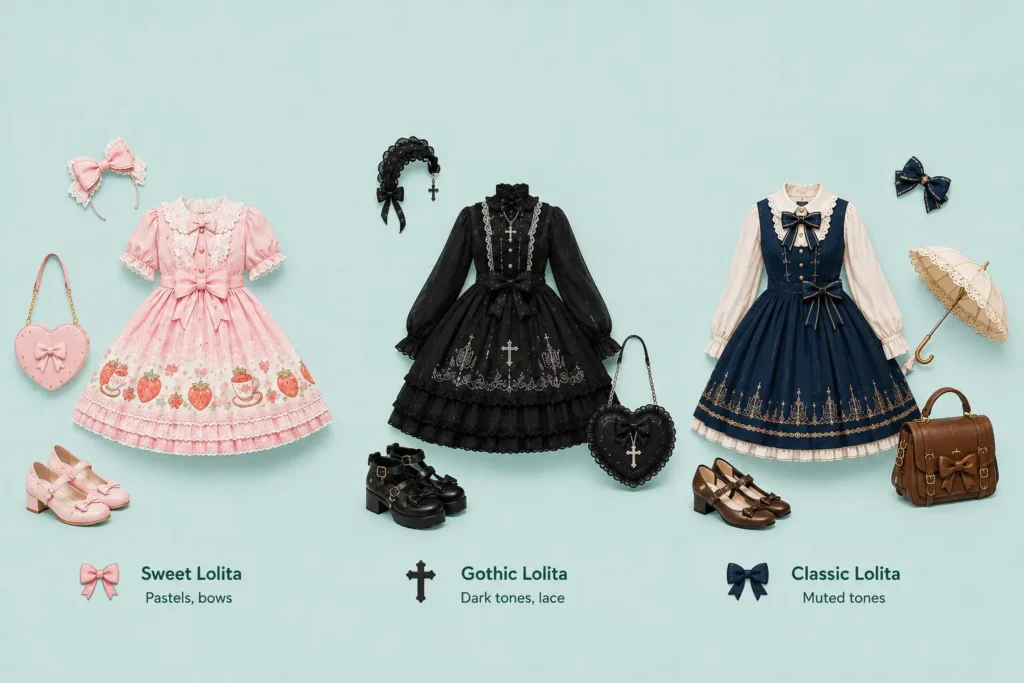
- Sweet Lolita: Pastels, bows, and motifs like strawberries or teacups.
- Gothic Lolita: Black and deep jewel tones, crosses, lace, and a moodier silhouette.
- Classic Lolita: Muted, more mature color palettes with an emphasis on tailoring over cuteness.
Despite the name, Lolita fashion has nothing to do with the Nabokov novel and everything to do with reclaiming an idealized, doll-like elegance on the wearer’s own terms.
2. Decora
Decora is maximalism as a lifestyle. Layers of plastic hair clips, stacked bracelets, colorful leg warmers, stickers, charms, and toys pinned directly onto clothing. The goal isn’t restraint; it’s joyful, glittery excess. If Lolita is about structure, Decora is about sensory overload in the best possible way.
3. Fairy Kei
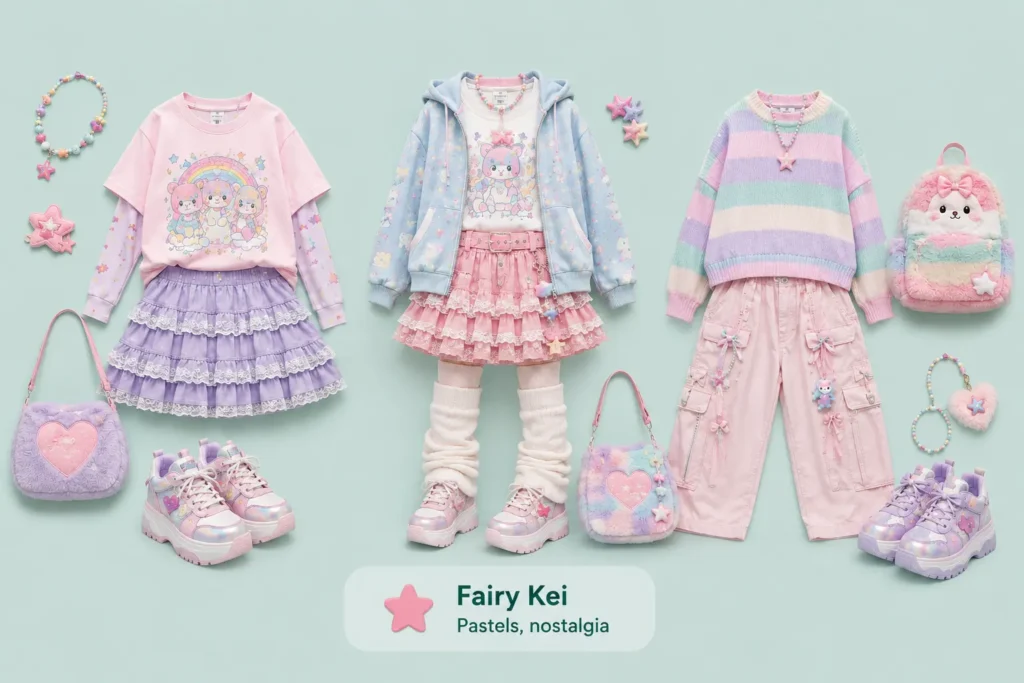
Fairy Kei leans into pastel 1980s nostalgia, thinking of old cartoon character tees, cotton-candy hair, and soft, dreamy color combinations. It shares Decora’s love of cuteness but with a lighter, less cluttered hand.
4. Gyaru
Gyaru flips the script entirely: tanned skin, dramatic makeup, bleached or brightly dyed hair, and glamorous, body-conscious silhouettes. It’s bold, confident, and unapologetically maximalist in a completely different direction from the cute-coded styles above. Sub-branches like Ganguro pushed the tanned, high-contrast look to its most extreme form in the late ’90s and early 2000s.
5. Visual Kei-Inspired Street Style
Born out of the Japanese rock and metal music scene, Visual Kei style bled into Harajuku fashion through androgynous silhouettes, dramatic eye makeup, teased or elaborately styled hair, and a mix of glam-rock and gothic elements.
6. Mori Kei (“Forest Style”)
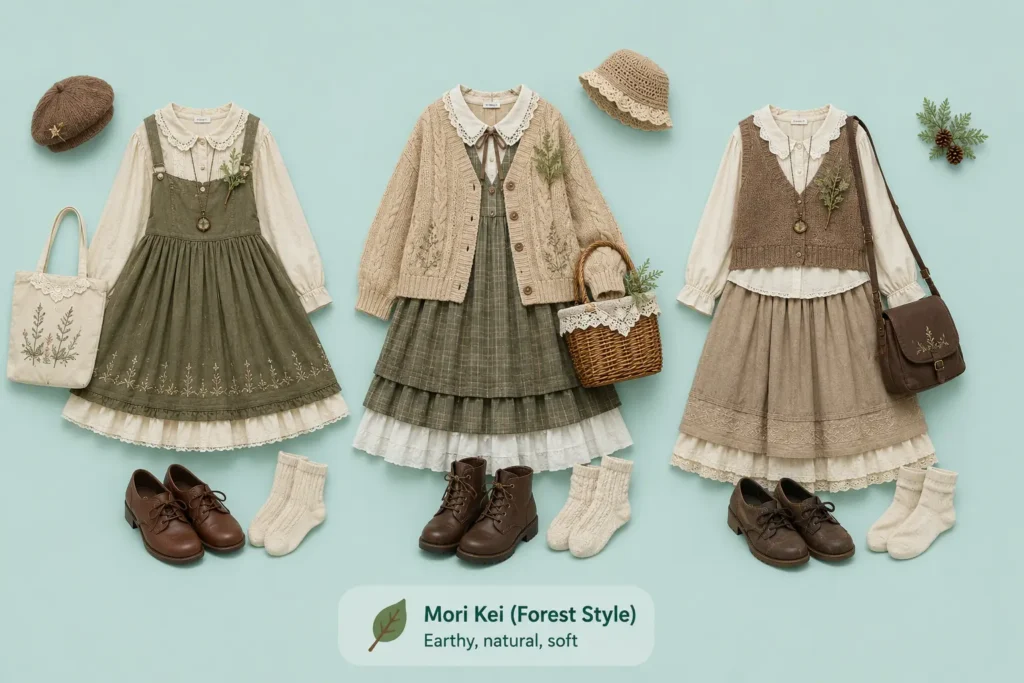
A quieter entry on this list, Mori Kei draws on earthy tones, natural fabrics, loose layering, and a woodland-cottage aesthetic. It’s proof that not everything under the Harajuku umbrella is loud—some of it is deliberately soft and understated.
7. Genderless Kei
A more recent development, Genderless Kei blurs traditionally masculine and feminine dressing, often built around slim silhouettes, soft makeup on all genders, and pastel or monochrome palettes. It reflects how Harajuku fashion keeps evolving alongside broader conversations about identity.
Comparing the Core Styles at a Glance
| Style | Color Palette | Mood | Key Pieces |
| Lolita | Pastels, black, and jewel tones | Elegant, structured | Petticoat skirts, blouses, headdresses |
| Decora | Rainbow, neon | Playful, maximalist | Hair clips, stacked accessories, toys |
| Fairy Kei | Soft pastels | Dreamy, nostalgic | Retro cartoon tees, pastel hair |
| Gyaru | Tan, bronze, bold colors | Glamorous, confident | Dramatic makeup, fitted silhouettes |
| Visual Kei | Black, silver, deep tones | Dramatic, androgynous | Teased hair, gothic-glam pieces |
| Mori Kei | Earth tones, cream, brown | Soft, natural | Layered linen, oversized knits |
| Genderless Kei | Pastel, monochrome | Fluid, minimal-cute | Slim silhouettes, soft makeup |
How to Wear Harajuku Fashion (Without It Feeling Like a Costume)
This is where a lot of beginner attempts go sideways, piling on every trend at once, which reads as a costume rather than a considered outfit. How do people living near the fashion district approach it?
1. Pick One Style to Anchor Your Outfit
You don’t need to know every substyle by name, but pick a lane, Decora, Fairy Kei, Gothic Lolita, or whatever draws you in, and let that be your foundation. Little elements from other styles might be borrowed later, but starting with one anchor keeps the outfit intentional instead of chaotic.
2. Build Around One Statement Piece
A structured Lolita skirt, a heavily decorated denim jacket, and dramatic platform boots—pick one piece that does the heavy lifting, and then let everything else support it rather than compete with it.
3. Layer With Purpose
Layering is central to Japanese Harajuku fashion, but the best outfits layer for texture and silhouette, not just volume. Mix fabrics, lace over denim, knit over structured cotton, rather than stacking similar textures on top of each other.
4. Accessories Are Not an Afterthought
In Harajuku street fashion, accessories often carry as much visual weight as the clothing itself. Hair clips, chokers, leg warmers, plush charms, statement bags, these are load-bearing style choices, not garnish.
5. Makeup and Hair Are Part of the Outfit
Whether it is Gyaru’s bronzed glam, Lolita’s soft doll-like makeup, or Genderless Kei’s minimal glow, hair and makeup aren’t separate from the clothes; they’re the finishing 20% that makes the whole look click into place.
6. Shop Second-Hand and Small-Label First
Some of the best Harajuku fashion pieces come from resale platforms, small independent Japanese labels, and vintage shops rather than fast fashion. It’s more sustainable, more original, and closer to how the style actually developed on the street in the first place. Ayzeze fits into this small-label category, offering ready-to-wear takes on Harajuku substyles for people who want an authentic entry point without having to piece together a whole wardrobe from scratch.
7. Confidence Is the Actual Uniform
Every stylist who has worked in this scene will tell you the same thing: the outfit only works if you wear it like it’s completely normal. Harajuku fashion rewards commitment over perfection.
Where to Experience Harajuku Fashion in Tokyo
If you are in a travel planning mode, a few places should always be the real thing and not the tourist-driven one:
Takeshita Street: the most famous strip, filled with Decora and youth-oriented shops, but increasingly commercialized.
Cat Street: a quiet, boutique-heavy trail that links Harajuku to Shibuya and is better for finding independent designers.
Laforet Harajuku: a department store that is almost entirely built on alternative Japanese fashion labels, from floor to floor.
Yoyogi Park (Sundays): historically where street performers and dressed-up groups gathered; still worth a wander on weekend afternoons.
Not heading to Tokyo any time soon? You can browse Ayzeze’s full range of Harajuku-inspired outfits online at ayzeze.com and get pieces across several of the substyles above shipped to you directly.
Common Misconceptions About Harajuku Fashion
It is worth clearing a few things up because a lot of what circulates online blurs the picture.
- It’s not “cosplay”; cosplay is a recreation of a specific fictional character. Harajuku fashion is personal style, even when it’s dramatic.
- It’s not one outfit. As discussed above, it’s an umbrella of substyles, some of which look nothing alike.
- It’s not frozen in the 2000s. The scene has kept evolving; genderless Kei and modern minimalist takes are proof it’s still moving.
- You don’t have to be Japanese, or in Japan, to respect the craft behind it, but it’s worth getting to know the culture a little to identify with the origins and support the actual Japanese designers and small shops as well as brands like Ayzeze that draw directly on this heritage, that created the movement rather than just the imitation of it.
Final Thoughts
Harajuku fashion has never been about the matter of getting it right. It’s about a neighborhood in Tokyo that decided, decades ago, that clothing could be a loud, unapologetic expression of oneself and then kept reinventing what that looks like every few years since. Whether you’re attracted to the softness of Fairy Kei, the drama of Gothic Lolita, or the bold confidence of Gyaru, the throughline is the same: dress like yourself, turned up.
That is the definition that we should remember, long after the specific trends change again. And if you want to start building that wardrobe today, outfits across these Harajuku styles are available now at Ayzeze.
Frequently Asked Questions (FAQs)
1. What is Harajuku fashion in the most simple terms?
Harajuku fashion is a broad term for the individualistic Japanese street style of people (from elaborate Lolita dresses to maximalist Decora accessories to glamorous Gyaru looks) that originated in Tokyo’s Harajuku district.
2. Is Harajuku fashion still popular today?
Yes, but it looks different than it did in the 2000s. Most of the scene has been relocated to independent shops, resale clubs, and online places, and newer substyles like Genderless Kei, too.
3. What is the difference between Lolita fashion and Harajuku fashion?
Lolita fashion is one subgenre in the larger Harajuku fashion family that is characterized by its Victorian-inspired look. Harajuku fashion is a larger category of Lolita, Decora, Gyaru and others in the fashion universe.
4. Where can I buy real Harajuku fashion pieces?
Independent Japanese labels, secondhand and resale shops, and boutiques around Takeshita Street, Cat Street, and Laforet Harajuku are the most authentic sources, and reputable online resale platforms and brands like Ayzeze for those shopping from outside Japan.
5. Can anyone wear Harajuku fashion?
Yes, it was founded on the idea of individual self-expression, not exclusivity. The only real expectation is to respect its roots: to know the story, to recognize the origins of the culture it comes from, to believe in the community and designers who created it, and to support the community and designers who made it.