That $400 LED mask in your cart and the glowing wrap your running buddy straps to a sore knee use the same idea. Both shine red and near-infrared light on your body, a treatment researchers call photobiomodulation. So is red light therapy worth it? For fine lines, breakouts, thinning hair and stiff knees, studies point to real but modest gains, as long as you use a device several times a week for at least a month.
The money side is clearer than you’d think. A $399 home device used four times a week for three months works out to about $8 a session, while a clinic visit often costs $80 or more.
Disclosure: Nimble Journal may earn a commission if you buy through the Kineon link on this page, at no extra cost to you. Our disclaimer page explains how affiliate links work here.
This guide covers what the research says for each goal, what each device type costs, who should skip it, and a close look at one joint device, the Kineon MOVE+.
Quick answer: Red light therapy can be worth it if you have realistic goals and use it consistently. Research is most encouraging for skin, acne, thinning hair and some knee pain, with modest, gradual results. It won’t replace medical care, and quality at-home devices cost hundreds of dollars.
Is Red Light Therapy Worth It? The Short Verdict
Yes, red light therapy is worth it for a handful of goals, provided you’ll stick with it for weeks. The best-studied uses show small, steady improvement, and the people who feel it paid off are usually the ones who used it most days.
Dr. Jennifer Lucas, a Cleveland Clinic dermatologist, put it this way in a September 2026 interview: “When done consistently, research suggests it may help with things like wrinkles and redness.”
The money worry is fair, since good devices cost hundreds of dollars. The ones that pay off are the ones you use, so buy for the one goal you care about most and skip the extras.
Owners on forums say much the same. In a 140-comment r/40and45PlusSkinCare thread, one mask owner called it worth every penny after using it almost daily, 10 minutes a session, for two months.
It’s a good buy if you:
- Want gradual help with texture, fine lines, mild acne or pattern hair thinning
- Have a sore knee, shoulder or elbow and like the idea of a drug-free extra at home
- Can commit to 3 to 5 sessions a week
Save your money if you:
- Want fast or dramatic change, like you’d get from filler or a chemical peel
- Are buying it to lose weight or “detox”
- Know you’ll use it twice and leave it in a drawer
What Is Red Light Therapy and How Does It Work?
Red light therapy is a treatment that shines low-energy red or near-infrared light onto your skin to support the cells underneath. You’ll also see it sold as LED light therapy, in masks, panels, wands and wraps you can use at home.
Researchers think the light is absorbed by mitochondria, the tiny parts of each cell that make energy. The idea is that this helps cells make more ATP (the fuel they run on), which may support collagen and calm inflammation. Stanford dermatologist Dr. Zakia Rahman told Stanford Medicine in 2025: “There’s real evidence that shows red light can change biology.”
Red Light vs Near-Infrared Light
Red light works closer to the surface, and near-infrared light reaches deeper tissue. A widely cited review on low-level light (Chung et al., 2012) says wavelengths of 600 to 700 nm are used for superficial tissue, while 780 to 950 nm penetrate further. Skin devices usually use red around 630 to 660 nm, and near-infrared around 830 to 850 nm, according to a 2026 product guide in Cureus.
LED vs Laser Devices
LEDs spread light over a wide patch, which is why masks and panels use them. Low-power lasers, the tool behind low-level laser therapy (LLLT), send a tighter beam to one spot. Some joint devices, like MOVE+, put both in each module, pairing 660 nm red LEDs with 808 nm near-infrared laser diodes.
Does Red Light Therapy Actually Work? What the Research Says
Red light therapy shows real but modest results in studies for skin, acne, hair thinning and knee pain. The catch is that many trials are small, use different devices and doses, and measure results in different ways.
| Use | Evidence so far | Source |
|---|---|---|
| Skin and wrinkles | Controlled trial of 136 people: better skin feel and collagen density after 30 sessions. A 2026 systematic review of at-home LED devices (8 studies, 365 people) found better wrinkles and texture | Wunsch 2014, Das 2026 |
| Acne | Meta-analysis of 6 trials (216 people) using at-home devices: about 45% more improvement in red, inflamed spots than control | JAMA Dermatology 2025 |
| Hair loss | Meta-analysis of 11 double-blind trials: higher hair density in pattern hair loss | Liu 2019 |
| Joint and knee pain | Review of 22 placebo-controlled trials (1,063 people): less pain and disability in knee osteoarthritis. A 2024 review rated the certainty very low | Stausholm 2019, Oliveira 2024 |
| Muscle recovery | Meta-analysis of 37 studies: small gains in endurance, no benefit for strength or sprinting | Dutra 2022 |
The American Academy of Dermatology describes one study where 90 patients had 8 red-light treatments over 4 weeks, and more than 90% said they noticed some improvement. Those were patients’ own reports, and AAD adds that not everyone sees results.
Hair is the use where time counts most. Dr. Rahman told Stanford Medicine that “used over multiple months consistently, red light has been shown to regrow thinning hair,” and that results fade when you stop.
Where the Evidence Is Thin
Weight loss and cellulite claims don’t have solid science behind them. Cleveland Clinic says there’s no scientific evidence to support red light for weight loss, and it lists cellulite removal among the unproven uses too. Treat “detox” promises the same way.
Full-body beds get big claims as well, yet a 2025 review found they may help sleep but showed no evidence of benefit for exercise recovery.
Dose is the other weak spot. The 2026 Cureus guide gives a typical skin range of 20 to 60 mW/cm² (a measure of light strength called irradiance) and notes there’s no standard protocol for how long or how often to use it.
Is Red Light Therapy Worth It for Your Face or Your Joints?
Red light therapy is easier to justify for your face if you want slow, steady help with texture, fine lines or breakouts. For joints, it makes the most sense as a targeted extra for a specific sore spot, alongside the care your doctor or physical therapist recommends.
| Device type | Best for | Typical use |
|---|---|---|
| LED face mask | Fine lines, texture, mild acne | About 10 to 12 minutes, twice a week in skin studies (Cureus 2026) |
| Panel | Face, chest or larger areas | Several times a week, per the maker’s guide |
| Targeted wrap | One joint, like a knee, shoulder or elbow | 5 to 15 minutes a session for MOVE+ (Kineon) |
Before you buy any device, run it through a quick three-part check. We call it the Dose, Spot, Spend check:
- Dose: Does the brand list its wavelengths and its irradiance in mW/cm²? The Cureus guide says reputable companies list wavelengths clearly, and that devices hiding their strength may work outside the useful range.
- Spot: Is it built for the area you want to treat? A mask can’t reach a knee, and a joint wrap won’t cover your cheeks.
- Spend: Divide the price by the sessions you’ll realistically do in three months. That number is your true cost per session.
For your face, think of red light as a top layer on a steady routine. It pairs well with a skin cycling routine, and if you’re still choosing between retinol vs vitamin C, settle that first, because your actives will do more of the heavy lifting.
For joints, a wrap puts the light right on the sore spot while you read or answer emails. Build quality counts here, because the wrap bends with every move. One r/Kneereplacement user loved their knee wrap but found the wires wore out fast from bending, so check the warranty before you buy.
Kineon MOVE+ at a Glance
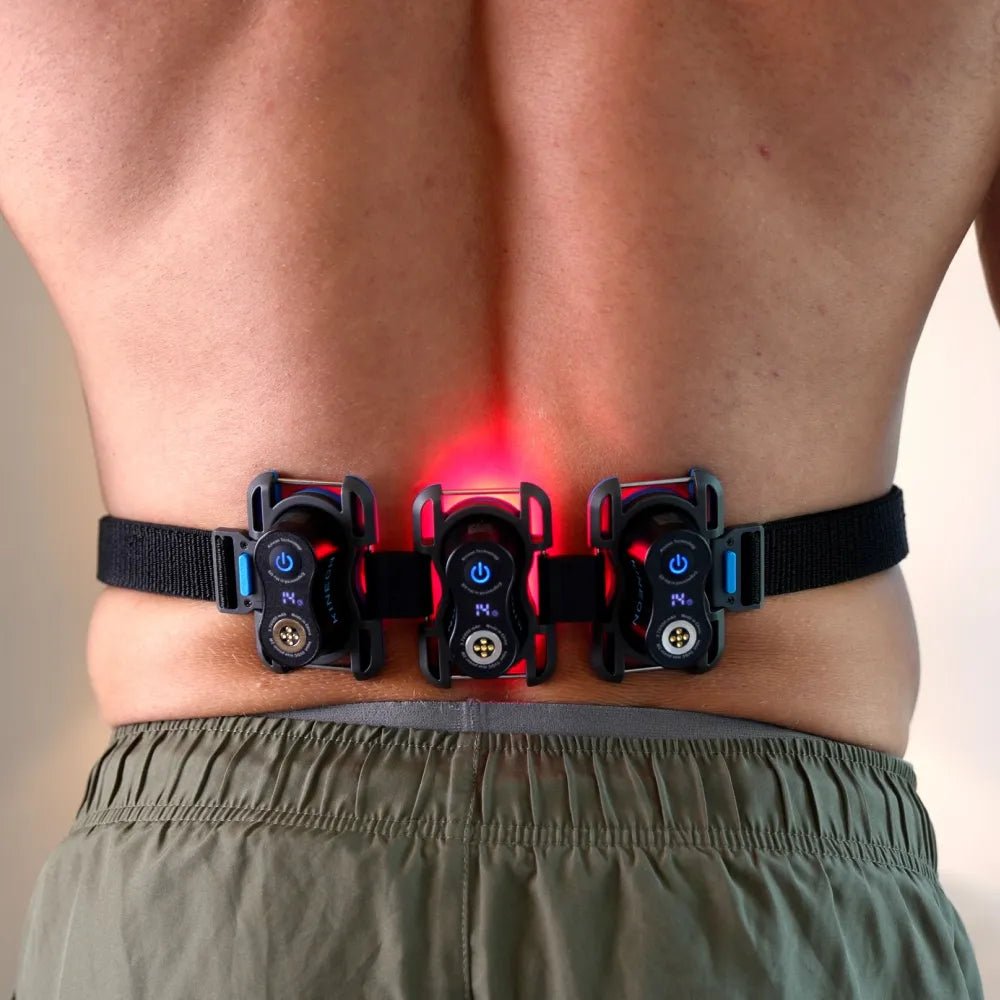
Kineon MOVE+ is a wearable red light and laser wrap made for knee, shoulder, back and other joint pain. It suits active people, like runners, Pilates fans and weekend tennis players, who want targeted sessions at home without booking clinic visits.
| Feature | Details (checked November 6, 2026) |
|---|---|
| Price | $399 sale price, down from $699 (Kineon), or 4 × $99.75 with Affirm |
| Light | 8 × 660 nm red LEDs and 10 × 808 nm near-infrared Class 1 laser diodes per module |
| Modules | 3, with an adjustable strap, 2 bridge clips, charging dock and travel case |
| Session time | 5 to 15 minutes, per Kineon |
| Battery | About 4 hours per module, or 24 ten-minute sessions |
| Warranty | 1 year, per the badge on Kineon’s product page |
| Returns | 30-day money-back guarantee, minus shipping (refund policy) |
How You Use It
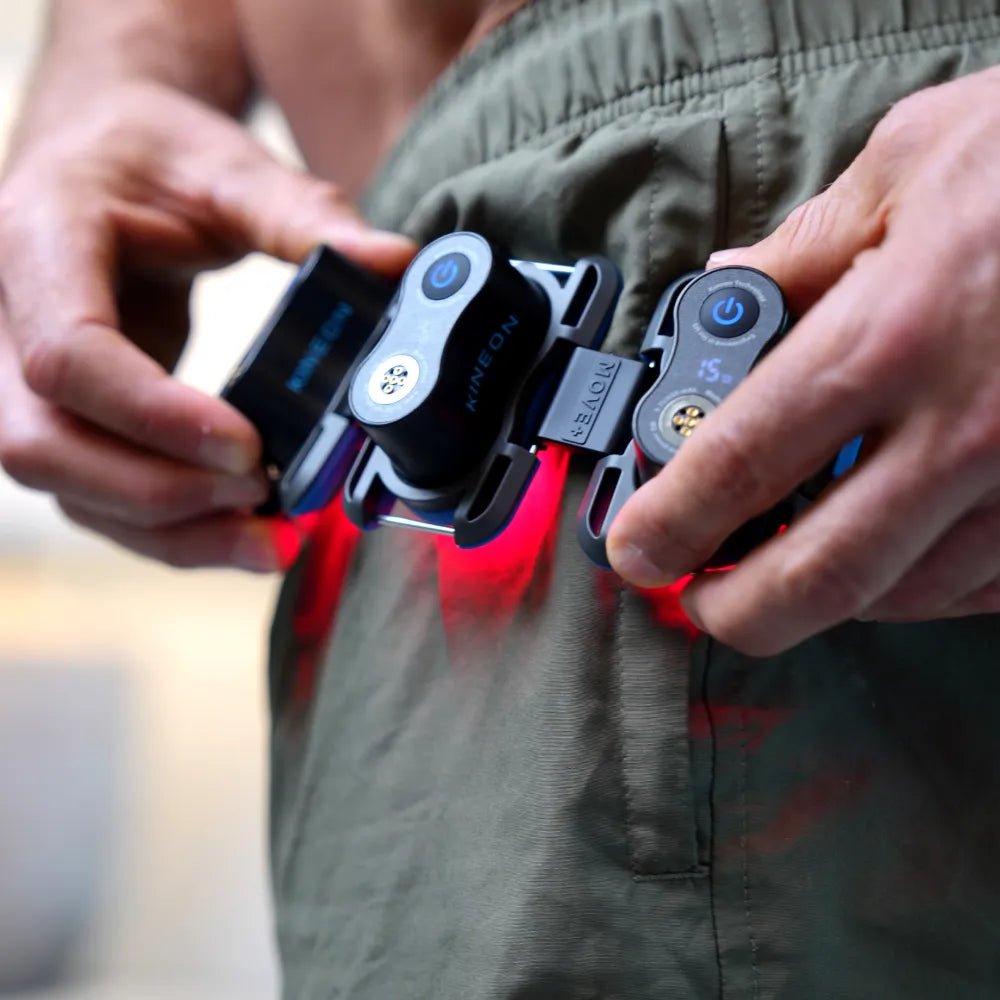
You clip the three modules onto the strap, wrap it around the joint and run a session. Kineon’s homepage recommends “5 – 15 minutes per day,” and its 30-day trial asks for use “3-5 times per week” over 4 weeks. A full charge takes about 3.5 hours, and the travel case makes it easy to pack for a race weekend.
Kineon markets it for the knee, shoulder, back, elbow, hip, neck, wrist, ankle and foot. Because the modules clip on separately, you can spread them around a knee or line them up along a shoulder. An extender strap for larger joints is sold separately. US orders ship by UPS in 3 to 7 days, depending on the shipping option (shipping policy).
What We Like and What Gives Us Pause
MOVE+ gets a lot right for joint users: it’s wearable, it combines two wavelengths, and it comes with a 30-day trial. The points that give us pause are mostly about price, missing dose data and support.
What we like:
- Wearable design: Owners in r/golf and r/redlighttherapy like that they can strap it on after a long session on the course or court.
- Red plus near-infrared: Its 808 nm lasers fall inside the 785 to 860 nm range that the knee osteoarthritis review linked with less pain.
- 30-day guarantee: You get a month of regular use to judge it, per Kineon’s refund policy.
- HSA/FSA eligible: Kineon says you can use those funds through its partner Flex, but only when buying on kineon.io (HSA/FSA page).
- Travel-ready: Each module runs about 24 ten-minute sessions on a charge.
What gives us pause:
- Price: $399 is a sale price, and the list price is $699.
- Brand-only results: Kineon says customers see an average 80% drop in pain within 1 to 4 weeks. That’s the brand’s own figure, with no study attached.
- No published irradiance: The Cureus guide warns that devices that don’t share irradiance may work outside the useful range, and Kineon doesn’t list it.
- Two names: Kineon sells the same device as MOVE+ and, on some pages, MOVE+ Pro.
- Support complaints: Trustpilot shows 4.7 from 695 reviews (as of November 6, 2026), but low-star reviewers mention slow replies, no one answering the phone and some battery or part faults.
How Much Does Red Light Therapy Cost? At-Home vs Clinic
At home, red-light therapy costs a few hundred dollars upfront and next to nothing per session after that. In a clinic, you pay every visit, and CareCredit puts the national range at $43 to $243 a session.
| Option | Upfront cost | Ongoing cost | Notes |
|---|---|---|---|
| At-home LED mask | About $395 to $570 for well-known brand masks | Charging only | Face only (brand stores, November 6, 2026) |
| At-home panel | About $250 for small panels, $1,000+ for larger ones | Charging only | Covers more area |
| Kineon MOVE+ | $399 sale price as of November 6, 2026 | Charging only | One joint at a time, HSA/FSA eligible on kineon.io |
| In-clinic session | None | $43 to $243 a visit; WebMD says $80 or more | Usually not covered by insurance |
The per-session math favors home use. Run a $399 device four times a week for 12 weeks and that’s 48 sessions, or about $8.30 each. Cleveland Clinic says clinic patients are seen one to three times a week “for weeks or even months,” so two $80 visits a week for 8 weeks comes to $1,280. A $395 mask used twice a week for the same 12 weeks lands at about $16 a session, and the cost per use keeps dropping the longer you stick with it.
Paying with HSA or FSA funds can stretch your budget further, since that money goes in before tax. Check your plan’s rules first, because coverage for wellness devices varies.
Home users in r/redlighttherapy make the same point: results depend on frequent sessions, which is why many skip clinic memberships.
Who Should Skip Red Light Therapy?
Skip red light therapy, or check with a doctor first, if you’re pregnant, take medicines that make your skin light-sensitive, have a history of skin cancer, or have a lump or joint problem that hasn’t been diagnosed. For most other healthy adults, dermatologists see it as low risk. Case Western dermatologist Dr. Elma Baron told NPR in April 2026 that red light has “a pretty high safety margin.” A 2025 expert consensus in the Journal of the American Academy of Dermatology also found red light photobiomodulation safe for adults, with no DNA damage.
- Pregnancy: Ask your OB or midwife before you start. AAD and Cleveland Clinic don’t give pregnancy-specific guidance.
- Light-sensitive medicines: Cleveland Clinic names isotretinoin and lithium among them.
- Your eyes: Wear the goggles or eye shield your device comes with.
- Skin cancer: Red light alone doesn’t treat it. Photodynamic therapy, which pairs light with a light-activated drug, is a separate treatment that the FDA approved for superficial basal cell carcinoma in September 2026 (ASCO Post).
- Darker skin: Harvard dermatologist Dr. Rachel Reynolds told Harvard Health that “folks with darker skin types should start with lower doses.”
- Implants or ongoing joint conditions: Get your doctor or physical therapist to sign off first.
If your face stings or flakes, calm a damaged skin barrier before adding anything new. Talk to your doctor before using red light therapy for pain or any health condition. This article is general information, and our disclaimer explains more.
How to Get More Out of an At-Home Device
Consistency gives you the best shot at seeing results from an at-home device. A few habits help:
- Book it like a workout: Pair sessions with something daily, like your evening skincare or post-run stretch.
- Follow the maker’s timing: Longer sessions aren’t automatically better, and the Chung review notes lower doses are often more beneficial than high ones.
- Start short and on clean skin: UPMC advises beginning with shorter sessions to see how your skin reacts (UPMC HealthBeat).
- Track it: Take photos in the same light every two weeks, or keep a pain diary. One r/Osteoarthritis user said a small change showed up around weeks 3 to 4 and “crept up more than it hit me.”
- Use the whole return window: Judge it near day 25, once you’ve logged enough sessions to tell.
Final Thoughts: Is Red Light Therapy Worth It for You?
Red light therapy is worth it if your goal matches what the studies support and you’ll use it most days. Expect slow, real progress for skin, hair thinning and achy joints, and leave the fat-loss promises to the ads. Pick the device for the spot you want to treat, and give it at least a month.
MOVE+ fits best if one joint keeps bugging you, you’re active, and you’d rather have a wearable you can use at home than book clinic sessions. If your main goal is smoother skin, a face mask is the better match for your money.
Frequently Asked Questions (FAQs)
Q. Is red light therapy worth it for face and wrinkles?
It can be, if you’re patient. A 2026 review of at-home LED devices found better wrinkles and texture across 8 studies, and a controlled trial saw gains after 30 sessions over about 15 weeks. Results are modest, and the benefits fade once you stop using it.
Q. Does red light therapy really work, according to Reddit?
Reddit users are divided. Many in skincare and arthritis groups say their skin looks smoother or their knees ache less after a few weeks, while others notice nothing. The difference usually traces back to device strength and how often people used it.
Q. Can I use red light therapy in pregnancy?
Ask your OB or midwife before you start. Major dermatology and hospital guides, including those from AAD and Cleveland Clinic, don’t offer pregnancy-specific advice, so your own care team is the right place to get a yes or no for your situation.
Q. What are the key differences between a red light therapy mask and a red light therapy panel?
A mask covers only your face and works hands-free, so you can relax during a session. A panel treats a larger area, like your face, chest or back, while you stand or relax in front of it. A wrap like MOVE+ targets one joint.
Q. Do red light masks help with rosacea?
The evidence is limited. A 2025 literature review suggests light may ease rosacea redness by lowering inflammation, but its authors say few studies exist. Rosacea triggers vary a lot, so see a dermatologist before trying a mask.
Q. How long does red light therapy take to work?
Most skin studies see results in 4 to 12 weeks of regular sessions, according to the 2026 Cureus guide, and a dermatologist quoted by Harvard Health says home devices need four to six months of use several times a week. Kineon’s 30-day guarantee gives you about a month to judge MOVE+.
Q. Can red light therapy help knee pain?
It may help. A review of 22 placebo-controlled trials found less pain and disability in knee osteoarthritis, though a 2024 review rated the certainty very low. Use it alongside the plan your doctor or physical therapist gives you.
Q. Is Kineon MOVE+ FDA cleared?
Kineon’s website doesn’t say MOVE+ is FDA cleared, and a search of the FDA 510(k) database on November 6, 2026 found no clearance under Kineon’s name. Kineon does say MOVE+ is HSA/FSA eligible when bought on its site.