If your skincare shelf is overflowing but your skin still looks tired, congested, or irritated, you’re not alone. Most people aren’t using too few products. They’re using too many, too often, in the wrong order. That’s where skin cycling comes in, and truthfully, it may be the reset your skin has been quietly begging for.
Skin cycling is a structured skincare plan that rotates active ingredients across a multi-night period and gives your skin room to breathe, absorb, and recover. It’s not a trend that fizzled out after its first viral moment; it’s a dermatologist-backed method that stuck around for a reason: it actually works.
Here’s the full breakdown, from the science behind it to exactly what to put on your skin each night.
What Is Skin Cycling?
At its core, skin cycling is a nighttime skincare routine that alternates between exfoliation, retinoid application, and recovery nights on a set schedule. The term was coined by New York-based board-certified dermatologist Dr. Whitney Bowe, who introduced it on TikTok in 2022 and sparked a worldwide skincare conversation that’s still running strong.
The idea is simple: instead of piling on actives every night and overwhelming your skin barrier, you give your skin a predictable rhythm—hard work, then rest.
A standard skin cycling routine looks like this:
| Night | Focus |
|---|---|
| Night 1 | Exfoliation |
| Night 2 | Retinoid |
| Night 3 | Recovery |
| Night 4 | Recovery |
| Then repeat | — |
The four-night cycle became the gold standard for a reason. It limits overexposure to harsh ingredients while still producing visible results over time.
The Science Behind Why Skin Cycling Works
Skin cycling isn’t just a catchy structure; it’s built around how skin actually behaves at a cellular level.
Your skin naturally sheds and regenerates on a cycle of roughly four weeks in younger skin, slowing to six weeks or longer as you age. Retinoids speed up this cell turnover, which is exactly why they’re so effective for texture, tone, and fine lines. But that same acceleration is what makes skin sensitive to overuse: new skin cells are less mature and more vulnerable to irritation than fully developed ones.
Exfoliants work differently but compound the same risk. Alpha and beta hydroxy acids dissolve the bonds between dead skin cells on the surface, which is great for texture and clarity, but it also temporarily thins the outermost protective layer of skin. Layer a retinoid directly on top of that thinned layer, every single night, and you’re asking your skin barrier to do double duty with no recovery time.
This is where the recovery nights earn their place. Barrier-supporting ingredients like ceramides, cholesterol, and fatty acids replenish what actives temporarily strip away. If your barrier is already compromised going in, our guide on how to repair a damaged skin barrier is worth reading before you start cycling actives at all. Giving your skin two nights to rebuild before the next active night means you get the benefits of exfoliation and retinoids without stacking their side effects on top of each other night after night.
Why Is Skin Cycling Having Such a Moment?
Skincare culture has had a habit of rewarding excess. More steps, more products, and more serums lined up on the counter—the more complex your routine, the more “dedicated” you appear. But skin science doesn’t really back that up. Trends like the glass skin routine have shown that simpler, more consistent layering often outperforms a crowded shelf, and skin cycling takes that same principle a step further by scheduling rest directly into the routine.
Using retinoids every night in combination with acids is a recipe for inflammation, redness, and a compromised barrier. Skin cycling flips the script. Strategic rest is treated as just as important as active nights, not as a step you skip when you’re tired.
- Dermatologists love it because it minimizes the risk of irritation while still delivering results from proven active ingredients.
- Skincare beginners love it because it removes the decision fatigue of figuring out what to layer, when, and in what order.
- Busy people love it because the routine only asks for one deliberate step at a time instead of a ten-product regimen every night.
- People with sensitive or reactive skin love it because the built-in rest days work with their skin instead of constantly pushing past its limits.
Skin Cycling Routine Benefits You’ll Actually Notice
The benefits of a skin cycling skincare routine aren’t just theoretical. People who stick with it consistently report real, measurable changes in their skin over four to six weeks.

1. Reduced irritation and redness:
Retinoids and exfoliants don’t sit on top of each other, so your skin stays less reactive overall. Recovery nights let your barrier rebuild before the next active phase begins.
2. Smoother texture and brighter tone:
The exfoliation night sloughs away dead skin cells and promotes cell turnover. Paired with retinoid nights over time, this combination creates a noticeably more refined, luminous complexion.
3. Fewer breakouts:
Consistent chemical exfoliation keeps pores clear without the aggressive daily scrubbing that can trigger inflammation and, ironically, more breakouts. Combined with retinoid nights, it’s a genuinely useful combination for acne-prone skin.
4. A stronger skin barrier:
The two recovery nights are what set skin cycling apart from most routines built purely around actives. Focused recovery with barrier-supporting ingredients like ceramides, peptides, and hyaluronic acid means your skin actually gets to repair itself, not just survive your routine.
5. Better product absorption:
When your skin barrier isn’t compromised or inflamed, ingredients absorb more effectively across the board. That means less product waste and more of what you’re paying for actually doing its job.
6. More sustainable long-term than reactive skincare:
Because the schedule is fixed and predictable, skin cycling tends to survive busy weeks and travel better than routines that depend on remembering exactly which serum goes with which. You always know what tonight calls for.
How to Build Your Skin Cycling Routine, Step by Step
Night 1: Exfoliation Night
Start with a gentle cleanser, then apply a chemical exfoliant, glycolic acid, lactic acid, or a BHA like salicylic acid, based on your skin type. Follow with a non-active moisturizer. No vitamin C, no niacinamide, no additional actives layered on top. Let the exfoliant do its work without competition.
Night 2: Retinoid Night
Cleanse, then apply your retinoid: retinol, tretinoin, or a gentler retinaldehyde if you’re new to it. Let it fully absorb, then layer a hydrating moisturizer on top. If you’re new to retinoids, try the “sandwich method”: moisturizer, retinoid, moisturizer. It cushions the experience without meaningfully reducing efficacy. If you’re deciding which active to prioritize first, our comparison of retinol vs. vitamin C breaks down how the two actually differ.
Nights 3 & 4: Recovery Nights
These are your skin’s spa nights. Cleanse gently, then layer up with hydrating, barrier-rebuilding products. Hyaluronic acid serums, ceramide moisturizers, peptide creams, and nourishing oils are your best friends here. Think of these nights as investing in the foundation so your active nights can actually land properly instead of fighting an already-depleted barrier.
Skin Cycling for Dry Skin vs. Oily Skin
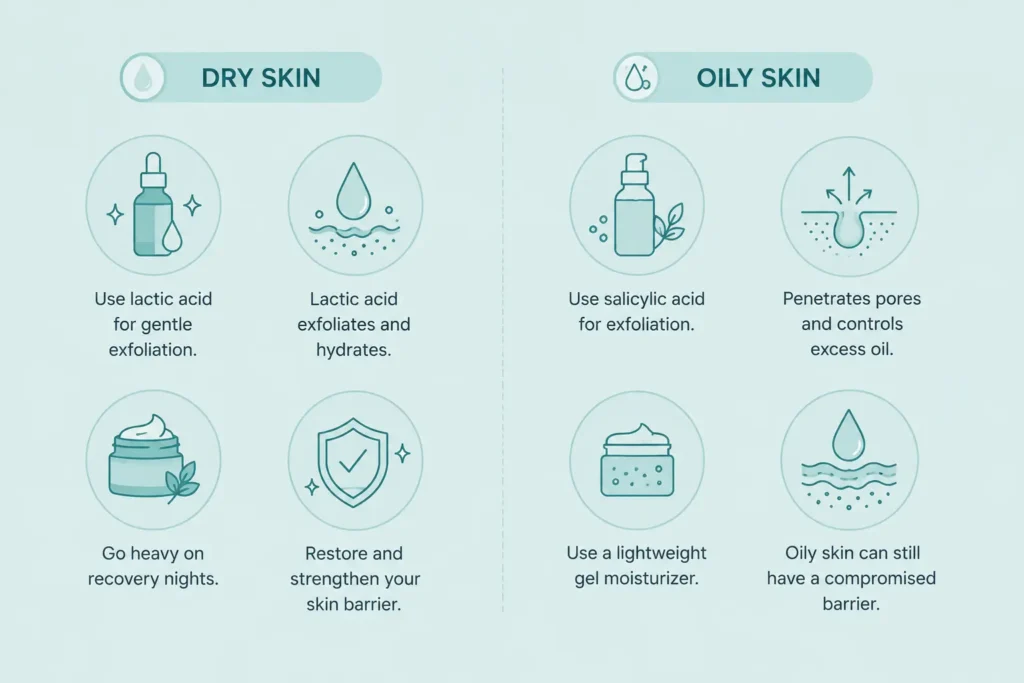
One of the most common questions about skin cycling for dry skin is whether the exfoliation step is too harsh. The answer depends entirely on product choice. For dry skin types, lactic acid is your best friend; it exfoliates gently while also drawing in moisture. Avoid high-percentage glycolic acids until your barrier is genuinely strong and adjusted.
On recovery nights, go heavier than you think you need to. Thick creams, occlusives like shea butter or squalane, and ceramide-rich formulas restore what the actives drew out during your active nights.
For skin cycling for oily skin, salicylic acid on exfoliation night works beautifully. It’s oil-soluble, so it penetrates the pore lining and breaks down excess sebum without stripping the surface the way some alcohol-based products do. You might find you need lighter moisturizers on recovery nights; a gel formula works well, but don’t skip moisture entirely. Oily skin can still have a compromised barrier, and skipping hydration doesn’t actually reduce oil production; it often triggers more of it.
A quick reference for both skin types:
| Factor | Dry Skin | Oily Skin |
|---|---|---|
| Best exfoliant | Lactic acid | Salicylic acid |
| Recovery night texture | Rich creams, occlusives | Lightweight gels |
| Common mistake | Using glycolic acid too soon | Skipping moisturizer entirely |
| Retinoid tip | Always use the sandwich method | Can often tolerate retinol without buffering sooner |
Skin Cycling for Combination and Sensitive Skin
Most guides stop at dry versus oily, but combination and sensitive skin deserve their own approach too.
Combination skin often does best by treating different zones differently on the same night. A lighter, gel-based exfoliant on the T-zone and a cream-based moisturizer on the cheeks during recovery nights can address both oiliness and dryness without needing two separate routines.
Sensitive skin and rosacea-prone skin should ease in slowly. Start with a milder acid like mandelic acid instead of glycolic, and consider a lower-strength retinoid like retinaldehyde rather than jumping straight to tretinoin. If your skin is having a reactive week, it’s completely fine to swap a scheduled active night for an extra recovery night. The cycle is a framework, not a rigid contract.
Can You Do a 7 Day Skin Cycling Routine?
Yes, and some people genuinely prefer the 7-day skin cycling routine over the traditional four-night model. The cycle is longer, with more recovery nights added between active phases. It looks like this:
| Night | Focus |
|---|---|
| Night 1 | Exfoliation |
| Night 2 | Recovery |
| Night 3 | Retinoid |
| Nights 4–7 | Recovery |
This approach works well for people with sensitive skin or rosacea or those just beginning with retinoids. It’s less intense but still effective when followed consistently. The core philosophy stays identical; the rhythm just breathes a little more.
4-night vs. 7-night cycle, side by side:
| 4-Night Cycle | 7-Night Cycle | |
|---|---|---|
| Active nights per cycle | 2 | 2 |
| Recovery nights per cycle | 2 | 5 |
| Best for | Normal, resilient, or oily skin | Sensitive, reactive, rosacea-prone, or retinoid beginners |
| Time to see results | Slightly faster | Slightly slower but gentler |
Skin Cycling Routine Morning and Night: What About the AM?
The skin cycling routine, morning and night, question comes up constantly, and it’s worth answering clearly: skin cycling is a nighttime framework. Your morning routine should stay consistent regardless of which night you’re on.
A standard AM routine looks like:
- Gentle cleanser (or just a water rinse if your skin is on the drier side)
- Antioxidant serum (vitamin C is a great option here)
- Moisturizer
- Broad-spectrum SPF 30 or higher
This matters every single morning, especially the mornings after exfoliation and retinoid nights, since your skin is more photosensitive after both. Skipping SPF on those mornings specifically is one of the fastest ways to undo the progress those active nights were meant to create. The American Academy of Dermatology’s sunscreen guidelines are a reliable reference if you want to double-check your SPF habits are actually up to standard.
The morning routine doesn’t cycle. It protects. The night routine does the active work.
Best Products for Your Skin Cycling Routine
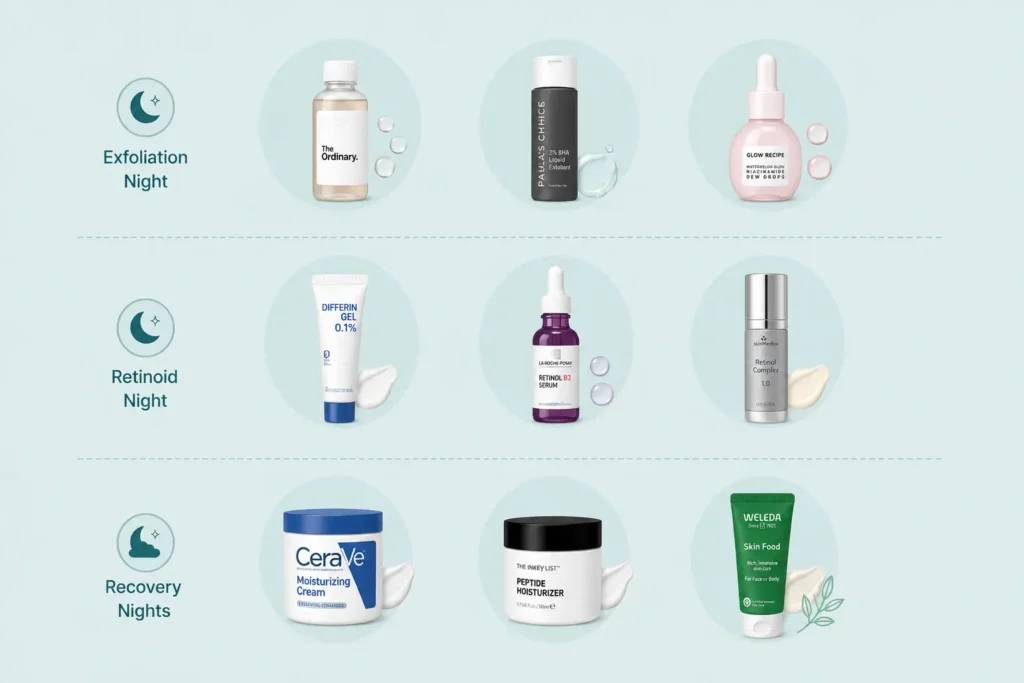
Here’s what to look for, organized by night. If you’re building this routine around budget-friendly staples, our beginner’s guide to The Ordinary pairs well with several of the picks below.
| Night | Product Type | Example Options |
|---|---|---|
| Exfoliation | Glycolic acid toner | The Ordinary Glycolic Acid 7% Toning Solution |
| Exfoliation | BHA liquid | Paula’s Choice Skin Perfecting 2% BHA Liquid |
| Exfoliation | Gentle multi-use option | Glow Recipe Watermelon Glow Niacinamide Dew Drops |
| Retinoid | OTC retinoid for beginners | Differin Adapalene Gel 0.1% |
| Retinoid | Mid-strength retinol serum | La Roche-Posay Retinol B3 Serum |
| Retinoid | Advanced retinol | SkinMedica Retinol Complex 1.0 |
| Recovery | Ceramide moisturizer | CeraVe Moisturizing Cream |
| Recovery | Peptide moisturizer | The Inkey List Peptide Moisturizer |
| Recovery | Rich occlusive for very dry skin | Weleda Skin Food |
A general rule when shopping for skin cycling products: buy fewer, better-formulated products rather than a different item for every possible concern. The whole philosophy of skin cycling is about restraint, and a crowded product shelf tends to undercut that even if every product on it is technically “good.”
Common Mistakes to Avoid When Skin Cycling
A structured routine still leaves room to get details wrong. These are the most frequent missteps:
- Mixing actives on the same night. Layering an exfoliant and a retinoid on the same evening defeats the entire purpose of the cycle. Keep them on separate, dedicated nights.
- Skipping SPF the morning after an active night. This is when skin is most vulnerable to UV damage, not the time to get lazy about sunscreen.
- Quitting after one or two cycles. Visible results generally take four to six weeks minimum. Judging the method after four days isn’t a fair test.
- Using expired or degraded retinoids. Retinol breaks down with light and air exposure. An old, oxidized retinol serum won’t just be less effective; it can also be more irritating.
- Treating recovery nights as optional. Some people skip recovery nights when their skin “looks fine” and go straight back to actives. This is exactly the habit skin cycling is designed to interrupt.
- Starting with the strongest products available. Jumping straight to a high-percentage glycolic acid or prescription-strength tretinoin before your skin has adjusted is a common cause of the “purging then quitting” cycle.
Who Should Be Cautious With Skin Cycling
Skin cycling is generally considered a gentler approach than daily active use, but it’s not automatically right for everyone.
- Pregnant or breastfeeding individuals should avoid retinoids entirely and speak with a doctor about which exfoliants are considered safe during this time.
- People currently using prescription treatments like tretinoin, isotretinoin, or other dermatologist-prescribed regimens should follow their provider’s specific instructions rather than layering skin cycling on top without guidance.
- Anyone with active eczema flares, severe rosacea, or a significantly compromised barrier may need to focus on recovery-only nights for a period before reintroducing any actives.
This article is educational and not a substitute for personalized advice from a board-certified dermatologist, particularly if you have an existing skin condition or are using prescription-strength products.
Do Dermatologists Recommend Skin Cycling?
Yes, and that’s a big part of why skin cycling gained such lasting credibility rather than fading as a passing trend. Dr. Whitney Bowe, who coined the term, is a board-certified dermatologist. Since the method’s rise to popularity, numerous other dermatologists have publicly endorsed it for its emphasis on skin barrier health and reduced irritation risk.
It’s not a gimmick. It’s essentially a simplified, structured version of what dermatologists have been advising privately for years: don’t use all your actives every single night.
How Long Is a Skin Cycle?
A single skin cycle takes four nights: one exfoliation night, one retinoid night, and two recovery nights before the cycle repeats. Some people extend theirs to five, six, or seven nights by adding additional recovery, especially when starting out or going through a period of heightened skin sensitivity.
How Long Should You Do Skin Cycling For?
This is where patience matters. Most people start to notice a difference after four to six weeks of consistent skin cycling. More significant transformation, better texture, reduced hyperpigmentation, and clearer breakouts tend to show up around the eight-to-twelve-week mark.
The good news: once it’s working for you, it’s meant to be a long-term routine rather than a temporary fix. It’s not something you drop once your skin improves. It’s a structure you live by, adjusting the specific products as your skin’s needs change over time.
Skin Cycling vs. a Traditional Skincare Routine
| Skin Cycling | Traditional Daily-Active Routine | |
|---|---|---|
| Active ingredient frequency | 2 nights per cycle | Often nightly |
| Risk of irritation | Lower | Higher, especially long-term |
| Decision fatigue | Minimal, follow the schedule | Higher, constant product choices |
| Best suited for | Beginners, sensitive skin, busy schedules | Experienced users with resilient, adjusted skin |
| Flexibility | Built-in rest days | Requires manual pacing |
Final Thoughts
There’s something genuinely good about a skincare routine that gives your skin permission to rest. Skin cycling isn’t about doing less; it’s about doing the right things at the right time, with intent.
If you’ve been frustrated with a complicated routine that isn’t delivering, this is the kind of structured reset worth trying. Slow down, stick to the schedule, and let the cycle do what it’s designed to do.
Your skin isn’t a problem that gets solved by more products stacked on top of each other. Sometimes, it just needs a rhythm to follow.
Frequently Asked Questions (FAQs)
Q. How do you do skin cycling?
A. Start with a four-night cycle: Night 1 exfoliation (chemical exfoliant), Night 2 retinoid, and Nights 3 and 4 recovery (hydrating and barrier-repairing products). The cycle repeats continuously, and it needs to be followed for at least four to six weeks to see meaningful results.
Q. What is the 4-2-4 rule in skincare?
A. The 4-2-4 rule refers to a cleansing method, not skin cycling directly. It involves a four-minute oil cleanse, a two-minute regular cleanse, and a four-minute rinse. It’s frequently recommended as a prep step before actives, and some people combine it with their skin cycling nights for a deeper cleanse.
Q. Do dermatologists recommend skin cycling?
A. Yes. The method was pioneered by a board-certified dermatologist and has been endorsed by many skincare professionals for its focus on barrier health, reduced irritation, and more effective use of active ingredients rather than overloading the skin nightly.
Q. How long is a skin cycle?
A. One full skin cycle is four nights: one exfoliation night, one retinoid night, and two recovery nights. Some people extend their cycles to five or seven nights with additional recovery days, particularly those with sensitive or reactive skin.
Q. How long can you do skin cycling for?
A. You can follow a skin cycling routine indefinitely; it’s meant to be a sustainable, long-term system rather than a short-term fix. Most people notice initial changes within four to six weeks, with more significant improvements in texture, tone, and clarity by the eight-to-twelve-week mark.
Q. Can beginners start skin cycling right away, or should they ease in first?
A. Beginners can start skin cycling immediately, but it’s worth starting with the gentlest versions of each active, a mild exfoliant like lactic acid and a low-strength retinoid like retinaldehyde, rather than jumping to the strongest options on the shelf. The 7-day cycle with extra recovery nights is often a smarter starting point than the traditional four-night version.
Q. Can you use vitamin C during a skin cycling routine?
A. Yes, but it belongs in your morning routine rather than layered into the night cycle. Vitamin C works well alongside skin cycling as a daytime antioxidant and doesn’t need to be worked around your exfoliation or retinoid nights.
Q. Is skin cycling effective for acne-prone skin?
A. Many people with acne-prone skin find it effective, since consistent exfoliation combined with retinoid use addresses both clogged pores and cell turnover, without the extra irritation caused by using both every night. That said, more severe or cystic acne often benefits from a dermatologist-guided plan alongside or instead of a general skin cycling schedule.
Q. Does skin cycling help with anti-aging, or is it mainly for acne and texture?
A. It helps with both. The retinoid night is doing much of the anti-aging work, supporting collagen production and cell turnover, while the recovery nights prevent the irritation that often makes people abandon retinoid use altogether. Consistency over months matters more here than any single product choice.
Q. Can you double up on recovery nights if your skin feels irritated?
A. Yes, and this is one of the more flexible parts of the method. If your skin looks reactive, dry, or inflamed, swapping a scheduled active night for an additional recovery night is a reasonable adjustment. The schedule is a helpful default, not a rule you need to force through discomfort.