Apparently, cheek fillers have become one of the most asked for cosmetic treatments in the US. not because people want dramatic transformations, but because they want subtle, sculpted, and refreshed versions of themselves. Think less “overdone” and more effortlessly lifted, like you’ve just come back from a well-rested vacation or discovered the perfect lighting except it’s your actual face.
In today’s beauty landscape, cheek fillers sit right at the intersection of science and aesthetics. Dermatologists and cosmetic injectors aren’t just adding volume anymore; they’re reshaping facial structure, restoring lost collagen, and enhancing natural bone contours. It’s why the phrase “high cheekbones” has become synonymous with youth, symmetry, and that coveted editorial look you see in fashion magazines.
But beyond the glossy results you see on social media, there’s a lot people don’t talk about. The swelling phase, the subtle settling period, the emotional rollercoaster of “Did I do too much?” and then finally, the moment when everything just clicks into place. Real patient experiences reveal that cheek fillers are as much about patience and trust as they are about the product itself.
This guide goes beyond surface-level information. You’ll learn what cheek fillers actually are, how they work, who should consider them, what they’re made of, and what real people experience before and after the procedure. We’ll also break down cost, longevity, and the best dermal fillers for cheeks, all in a style that’s informative yet easy to follow.
What Are Cheek Fillers and How Do They Work?
Cheek fillers are injectable treatments that are applied to or around the cheekbone to add volume, lift, and definition to the mid-face. They are among the most commonly performed non-surgical cosmetic procedures in the United States, and when done well, they leave no visible trace, only a more sculpted and youthful-looking face.
The fat pads below the skin thin and migrate down as we get older. The cheekbones lose their prominence, the mid-face deflates, and the whole structure of the face starts to sag. Cheek fillers reverse that process and restore the lost volume in targeted areas.
How the procedure works:
A trained injector (a board-certified dermatologist, plastic surgeon, or licensed aesthetic nurse practitioner) will map out the injection sites for you in advance of the procedure. Then, a topical numbing cream is applied on the day of treatment to minimize discomfort. The filler is then injected via a fine needle or blunt-tipped cannula at precise depths beneath the skin. The whole process usually takes 20-45 minutes.
The key to natural-looking cheek filler is placement, Dr. Shereene Idriss, a board-certified dermatologist, said: “Injecting too anteriorly or laterally can create an overfilled, unnatural look. ” The goal is to work with the bone structure, not against it.”
Effects are visible to clients almost immediately, with the full effect emerging over 2–4 weeks as the product settles and any initial swelling resolves.
Types of Cheek Fillers: Hyaluronic Acid vs. Other Materials
Not all cheek fillers are created equal. The material inside the syringe determines how the filler behaves, how long it lasts, and how reversible it is. Here are some common options: Hyaluronic acid (HA) fillers.
Hyaluronic Acid (HA) Fillers
Hyaluronic acid is naturally present in the skin; it attracts and retains moisture, keeping skin plump and hydrated. HA fillers are the most popular choice for cheek augmentation because they are temporary, predictable, and, crucially, reversible. If you don’t like the results, an enzyme called hyaluronidase can dissolve the filler almost instantly. This makes HA fillers particularly appealing to first-timers.
Top HA fillers for cheeks:
- Juvederm Voluma XC: FDA-approved for cheek augmentation; provides lift and contour; lasts up to 2 years.
- Restylane Lyft: Designed for deeper injection near the bone; offers structure and support.
Calcium Hydroxylapatite (CaHA) Fillers
- Radiesse: A thicker, firmer filler that also stimulates natural collagen production over time. Ideal for patients who want volume plus long-term skin improvement. Not reversible. Lasts 12–18 months.
Poly-L-Lactic Acid (PLLA) Fillers
- Sculptra: Works differently from traditional fillers. Rather than adding instant volume, it stimulates your own collagen production over a series of sessions. Results build gradually over 3–6 months but can last 2+ years. Best for patients seeking a natural, long-term improvement rather than an immediate result.
Which type is right for you?
Dr. Melissa Levin, a board-certified dermatologist and founder of Entière Dermatology, suggests starting with HA fillers for most patients: “HA fillers give us the most control. We can adjust, add, or dissolve, which is important because the face is dynamic and every patient’s anatomy is different.”
Cheek fillers before and after
Before you get into the procedure, a lot of people, for good reasons, look up Cheek fillers before and after, basically what they do and what difference they make to your face.
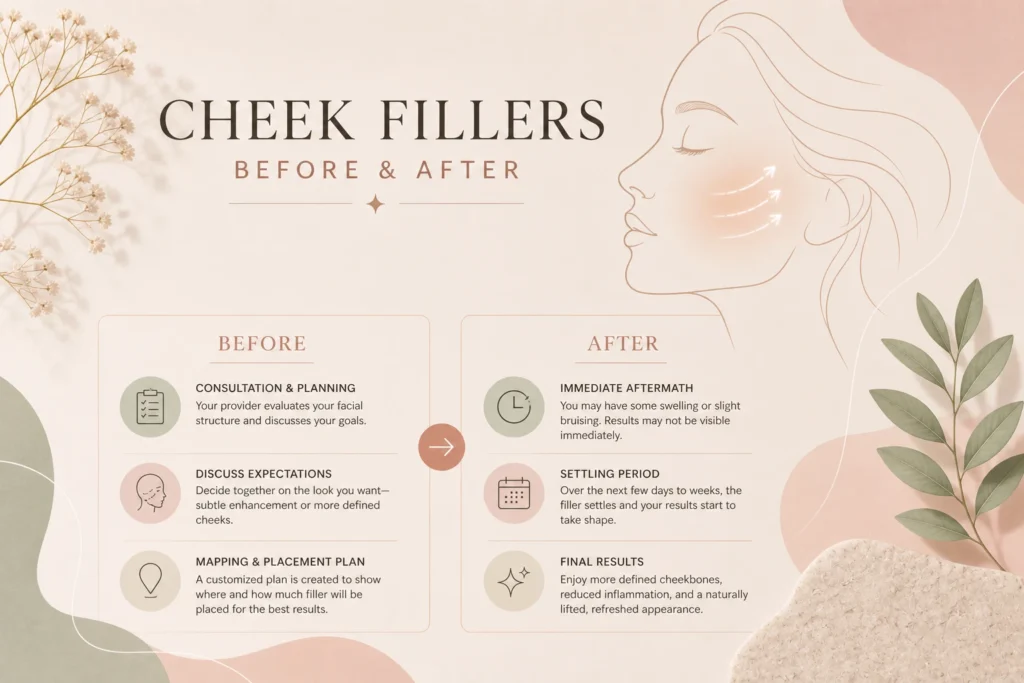
Before
- Everything begins with a consultation and the day of your procedure. You will get another briefing. So you are on the same page.
- The next step in the cheek fillers procedure is to discuss what you expect, and how you want your Cheek Fillers to look, subtle or well defined.
- Finally, you get to the main deal, which is to get a map and have placements all over your face. This might give you some clarity as to how your cheek fillers would look and what goes where.
After
- Right after you are done with the procedure. You might or might not see a difference. It looks nothing like your normal face, but it might take a few weeks to see the whole effect.
- HA fillers take 2–4 weeks to show up, and the full results are typically visible at the 4-week mark.
- Radiesse and Sculptra work differently — Sculptra results build over 3–6 months.
- Patients usually feel that it’s a little too much in the beginning, but it settles down.
- Except for some mild bruising, which again would go down.
- After a few weeks, you will start to see your cheek fillers doing their job. Well-defined cheekbones, no more inflammation, and a lifted look.
Cheek fillers cost
One of the most important factors while considering cheek fillers is to know the Cheek fillers cost. The cost of a cheek filler procedure greatly depends on the type of filler, who is doing it, and where you are getting it done. For someone who is an expert and does in-clinic treatments, the Cheek fillers cost is going to be higher. If you are consulting aestheticians who have less than 5 years of experience or are set up in smaller cities, then Cheek fillers cost will come down significantly.
In the United States, cheek fillers typically cost $500 to $2,000 per syringe, with most patients requiring 1–2 syringes per session. This places the average total treatment cost between $1,000 and $4,000, depending on several factors.
What Affects Cheek Filler Cost?
| Factor | Impact on Cost |
| Injector’s Expertise & Credentials | Board-certified dermatologists and plastic surgeons typically charge more than aestheticians due to their advanced training and experience. |
| Geographic Location | Major cities like New York, Los Angeles, and Miami generally have higher treatment costs than smaller cities or rural areas. |
| Type of Filler Used | Sculptra is usually priced per vial, while fillers such as Radiesse and Voluma are often priced per syringe, affecting overall treatment costs. |
| Number of Syringes or Vials Required | The total cost depends on the patient’s facial anatomy, treatment area, and desired results. More products increase the price. |
| Clinic Prestige & Overhead | Luxury cosmetic clinics and boutique medical spas often charge more due to higher operating costs, premium facilities, and enhanced patient experiences. |
How does this compare to other cosmetic procedures?
| Procedure | Average Cost (US) | Duration of Results |
| Cheek Fillers | $1,000–$4,000 | 12–24 months |
| Botox (Full Face) | $400–$1,200 | 3–4 months |
| Rhinoplasty (Surgical) | $5,000–$12,000 | Permanent |
| Facelift (Surgical) | $8,000–$20,000 | 5–10 years |
| Lip Fillers | $500–$1,000 | 6–12 months |
Cheek fillers fall squarely in the middle ground, more expensive than injectables like Botox or lip filler but a fraction of the cost of surgical alternatives.
Important: Cheek fillers are considered a cosmetic procedure and are not covered by health insurance. Always obtain a full cost breakdown before committing to treatment.
What you should look for in Good Cheek Fillers?
1. Natural Integration
The cheek filler should not sit or collect in your face but blend seamlessly into your facial structure.
2. Minimal Swelling
High-quality fillers settle more predictably and are best used for natural-looking cheek fillers.
3. Longevity
You don’t want to keep going in for cheek fillers, so getting Longer-lasting fillers reduces maintenance frequency.
4. Safety Profile
Make sure to go for only FDA-approved cheek fillers, which are always the safest choice.
5. Reversibility
Some cheek fillers are classified as temporary, like the Hylauronic cheek fillers, as they can be dissolved, making them ideal for beginners.
6. Smooth Texture
Smooth texture is what your practitioner should always aim for. This prevents lumps or uneven appearance, which would be anyone’s worst nightmare.
7. Customization
Good fillers allow layering and refinement over time, and that is key in Good cheek fillers.
How Long Do Cheek Fillers Last?
The longevity of cheek fillers depends largely on the type of filler used, the patient’s metabolism, and injection technique.
General longevity by filler type:
- Juvederm Voluma XC: Up to 24 months (FDA-approved for 2-year duration)
- Restylane Lyft: 12–18 months
- Radiesse: 12–18 months
- Sculptra: 2+ years
The American Society of Plastic Surgeons notes that fillers placed deeper in the tissue — as is the case with cheek augmentation — tend to last longer than those placed superficially, such as lip or under-eye filler.
Factors that can shorten filler longevity:
- High metabolism (the body breaks down filler faster)
- Vigorous exercise
- Sun exposure and UV damage
- Smoking
- Individual skin biology
Most patients return for a touch-up at the 12–18 month mark to maintain results. Rather than waiting until the filler is completely gone, many injectors recommend scheduling a follow-up before full dissolution, as smaller top-up amounts are more cost-effective and maintain a consistently natural look.
Best dermal fillers for cheeks
Coming to the most interesting part of getting cheek fillers is exploring the different fillers you can get injected. There is not one but many options to choose from, and that is why you should know about the Best dermal fillers for cheeks.
What are the Best dermal fillers for cheeks?
- Juvederm Voluma – Ideal for lifting and contouring, and super long-lasting.
- Restylane Lyft – Goes deeper in your skin and provides structure.
- Radiesse – Adds volume and stimulates collagen, but is slightly firmer.
- Sculptra – Gradual, natural results with long-term collagen stimulation.
Each filler has its own benefits, effects, and longevity. That is where consultation for cheek fillers comes in. To know what is best suited for your face and needs.
High Cheekbone Cheek Fillers
High cheekbone cheek fillers focus on lifting the mid-face upward, not outward.
What technique is used in High cheekbone cheek fillers ?
- Instead of an overall filling, it is injected higher along the cheekbone.
- High cheekbone cheek fillers create a sculpted, lifted look.
- It also avoids “puffy” or overfilled cheeks, as it is placed away from the apple of your cheeks.
Now, why are high cheekbone cheek fillers so popular?
- It mimics your natural bone structure but enhances it.
- Gives a more editorial, defined appearance like models with hollowed out cheeks, and lifted high cheek points.
- It also gives an appearance of an enhanced jawline, but not directly.
The idea is for patients to get a “snatched” look without surgery.
Risks and Side Effects of Cheek Fillers
Risks and side effects of Cheek Fillers. It’s important to understand the full spectrum of potential side effects before committing to any injectable procedure. According to the American Academy of Dermatology (AAD), cheek fillers are considered safe when performed by a qualified injector, but risks do exist.
Common Side Effects (usually resolve within 1–2 weeks)
- Swelling: Most pronounced in the first 24–48 hours; subsides within a few days to a week
- Bruising: Can occur around injection sites; typically fades within 5–10 days
- Tenderness or soreness: Normal at treatment sites; resolves within a few days
- Redness: Usually disappears within 24 hours
- Firmness or small lumps: Often felt before filler is fully integrated; softens over time.
Less Common but Serious Side Effects
- Infection: May present as persistent redness, warmth, pain, or swelling beyond the normal healing window. Requires prompt medical attention.
- Asymmetry: Subtle asymmetry can occur if filler is distributed unevenly; it is often correctable with additional treatment or dissolving.
- Filler migration: Though rare with modern cheek fillers, the product can shift from the injection site over time, particularly with repeated treatments.
- Allergic reaction: Rare with HA fillers, as hyaluronic acid is naturally found in the body; more possible with other filler types.
- Vascular occlusion: The most serious complication. Occurs when filler is inadvertently injected into or compresses a blood vessel, blocking blood flow. Symptoms include immediate blanching (whitening) of the skin, severe pain, or vision changes. This is a medical emergency requiring immediate treatment.
Dr. Shereene Idriss emphasizes the importance of choosing a qualified injector: “The anatomy of the face is complex, and the cheek area sits near major blood vessels. Your injector’s knowledge of facial anatomy is your most important safety net.”
Important: Always ensure your injector is trained in managing vascular complications and has hyaluronidase (the dissolving enzyme) readily available in the treatment room.
Before Your Appointment: Questions to Ask Your Injector
Walking into your appointment prepared will help you make a confident, informed decision. Here are the essential questions to ask:
About credentials and experience:
What are your qualifications and certifications for administering dermal fillers?
How many cheek filler procedures have you performed?
Do you have before-and-after photos of previous cheek filler patients I can review?
About the procedure:
What filler do you recommend for my anatomy, and why?
How many syringes do you anticipate I’ll need?
Will you use a needle or a cannula, and what is the difference?
About safety:
Do you have hyaluronidase available in case of an adverse reaction?
What are the signs of a vascular occlusion, and what is your protocol if it occurs?
What should I do if I experience unusual symptoms after leaving your clinic?
About results: What does the settling process look like, and when will I see the final result?
A skilled, ethical injector will welcome all of these questions. If an injector dismisses your concerns or rushes through the consultation, that is a red flag.
Cheek Filler Aftercare: What to Avoid for 24–48 Hours
Proper aftercare significantly impacts both your comfort during recovery and the quality of your final results. Here’s what to do, and avoid, in the first 48 hours:
Do:
- Apply ice gently: Wrap an ice pack in a cloth and apply for 10-minute intervals to reduce swelling.
- Keep your head elevated: Sleep on your back with your head slightly elevated to minimize swelling overnight.
- Stay hydrated: Especially important for HA fillers, which bind to water.
- Be gentle with your skin: Avoid touching, pressing, or massaging the treated area unless directed by your injector.
- Follow your injector’s specific instructions: They know your individual treatment and anatomy best.
Avoid for 24–48 hours:
- Strenuous exercise or anything that raises heart rate significantly
- Alcohol consumption (increases bruising and swelling)
- Blood-thinning medications like ibuprofen or aspirin (unless medically necessary — consult your doctor)
- Extreme heat: saunas, steam rooms, hot tubs, and direct sun exposure
- Makeup on the injection sites for at least 12–24 hours
- Facial massages or lying face down
Avoid for up to 2 weeks:
- Dental procedures (may displace facial filler)
- Intense facial treatments (chemical peels, laser, microneedling)
- Flying on long-haul flights (pressure and dehydration can affect results).
Summing up
Cheek fillers are an aesthetic procedure that can help with lifting, smoothing the skin, and giving that snatched look. Fillers are not just random injections around your face, but rather a well-calculated artistic expression to give you exactly what you need, keeping in mind the structure of your face.
The best outcomes come from restraint, expertise, and understanding your natural facial structure. Most people who love their results didn’t go for dramatic change—they went for refinement. If you’re considering cheek fillers, think of it as a collaboration between science and artistry. Done right, it doesn’t change your face; it enhances what’s already there.
Disclaimer: This blog is for informational purposes only. It does not intend to diagnose, treat, or provide medical advice. Always consult a qualified and licensed healthcare professional before undergoing any cosmetic procedure. References to dermatologist perspectives are based on publicly available expert commentary.
Sources consulted: American Academy of Dermatology (AAD), American Society of Plastic Surgeons (ASPS), and publicly available expert commentary from board-certified dermatologists, including Dr. Shereene Idriss and Dr. Melissa Levin.
Frequently Asked Questions (FAQs)
1. How long do cheek fillers last?
Ans. Depending on the type of cheek filler you are getting, it can last anywhere from 6 months to 2 years.
2. How much do cheek fillers cost?
Ans. Depending on your aesthetician and the city, it can cost anywhere between $600 to $1,500 per syringe.
3. How long for cheek fillers to settle?
Ans. Your fillers will start settling in 1 to 2 weeks
4. Are cheek fillers painful?
Most patients experience only mild pain. Many fillers contain numbing cream and lidocaine, and it has been found that this reduces pain in the fillers.
5. Can cheek fillers be reversed?
Yes, hyaluronic acid fillers can be dissolved with hyaluronidase. Sculptra and Radiesse cannot be reversed.
6. What is the difference between cheek fillers and Botox?
Botox softens muscles to reduce wrinkles, and cheek fillers add volume and contour to the face.
7. Do cheek fillers look natural?
Yes, if the injector is experienced, then the results are natural and balanced.
8. How soon can I wear makeup after cheek fillers?
Wait 12-24 hours before applying makeup to minimize the chance of infection.
9. Can I exercise after cheek fillers?
Avoid strenuous exercise for 24–48 hours to reduce swelling and bruising.
10. How many syringes of filler do I need for my cheeks?
Most patients will require at least 1–2 syringes, depending on their facial structure and desired outcome.