If your closet is filled with clothes but you still feel like you have “nothing to wear,” a minimalist wardrobe might be just what you need. And with the number of people moving from big, bulky closets to smaller, more intentional collections of clothing, it’s not just about aesthetics anymore. A minimal wardrobe is more efficient, easier to style every morning, and provides more sustainable fashion and lifestyle savings over time. In this guide you’ll learn how to get started, which pieces actually deserve a place in your closet, how to keep it organized, and what mistakes you’re going to be making along the way.
What is a Minimalist Wardrobe?
A minimalist wardrobe is a curated collection of clothing built around quality, versatility, and intention rather than sheer volume. Instead of filling your closet with whatever catches your eye at the mall, you choose pieces deliberately, items that fit well, match your lifestyle, and can be combined in multiple ways. The philosophy isn’t deprivation; it’s removing the noise so that what remains actually serves you.
This mindset is not just clothes hanging in a closet; it’s a whole shift in the way you view consumption. Instead of thinking of shopping as entertainment or a quick and easy reaction to a passing trend, minimalist dressing treats every purchase as a decision to make with weight. That doesn’t mean every outfit has to be boring and identical; it just means that there’s a place for each item, and it’s earned, not just because it was on sale or looked good to someone else.
At its core, minimalist fashion is based on the philosophy that owning fewer but better things is better than having many mediocre ones. In your closet, you know every single piece is there because it’s worn regularly, it’s worn perfectly, and it plays a specific and necessary role in your outfit. That is different from simply owning “not many clothes”; a minimalist closet can still have enough variety to dress for work, weekends, and special occasions, and it is the thought behind each purchase that determines its own meaning, not a number of items.
Key Principles of Minimalist Fashion
More than anything else, though, a few core principles guide a truly minimalist style of dressing:
- Quality over quantity: don’t buy cheap, ill-fitting clothes and wear them out as quickly as they do.
- Versatility: wear items in a variety of situations, contexts, and seasons.
- Personal style: tailor a wardrobe to you and your personality and what’s more appropriate for you, your body, lifestyle, and taste, not what is on the rise.
- Conscious shopping: do the right thing when buying things. Ask if it’s going to be worn regularly before buying it.
What Makes a Wardrobe Minimalist?
There’s no standard number of items that define a minimalist wardrobe. In the end, there are more important things than the number in the count:
- Number of pieces: typically smaller than a typical closet, but the exact number varies based on lifestyle and climate.
- Clothing usage: Everything in the closet is worn regularly; there’s not a lot of “dead space” of clothing.
- Organization: Things are easy to see, access, and pair together, as are similar items when they’re organized by color or type.
- Purpose-driven purchases: Every addition to the closet is made for a reason, whether that is to fill a real need or to replace an out-of-date item.
Benefits of Having a Minimalist Wardrobe
In other words, in reducing your closet space, you not only free up more space for hangers, but you also change your daily routine and how you dress.
A smaller, well-curated wardrobe saves time each morning because there are fewer (but better) choices to sort through. It also reduces decision fatigue: When all products complement one another, getting dressed becomes nothing but an everyday task. Over time it’s better to buy fewer but more expensive items because you’re going to need to replace durable clothing far less often than fast fashion.
And you’re going to have the ability to develop a more coherent, even a bit more minimalistic and consistent style when you are forced to get into what you actually like in your life and wear (to name just a few things) and not to look at the trends. And buying less naturally doesn’t waste textile trash, and that smaller closet is much easier to pack.
These benefits develop over time. Someone who diligently puts together a minimal wardrobe for a full year, for example, is often aware of clothing less and less than ever, not because they care less about what they look like, but because the guesswork is already done. The wardrobe becomes a tool, not a source of daily stress.
Less Clutter and More Organization
When a closet only has the pieces you actually wear, everything is easier to see and reach. You don’t have to go through all that stuff to find your favorite sweater, and laundry takes less time because everything has an obvious place.
Easier Everyday Styling
Because of a relatively small, flexible set of items, most of the pieces go well with many others. It’s so much easier to put together outfits quickly, because you’re selecting from a collection of combinations instead of a sea of options.
More Sustainable Fashion Choices
Buying fewer, longer-lasting pieces reduces demand on an industry that’s widely recognized as one of the most resource-intensive in the world. According to the United Nations Environment Programme, the fashion industry is responsible for a significant share of global carbon emissions and water use, driven largely by fast fashion’s cycle of cheap, disposable clothing.
Choosing quality over quantity means fewer garments end up discarded after only a handful of wears, which is better for your wallet and for the environment simultaneously. If you’re building this mindset into a broader lifestyle shift, our piece on the rise of sustainable fashion covers the wider context behind this shift.
Minimalist Wardrobe vs Capsule Wardrobe
These two terms are used interchangeably, but not quite the same. A capsule wardrobe is typically a small (or smaller) subset of clothing, usually designed for a specific period of time like a season or trip, so that each item mixes and matches. A minimalist wardrobe is part of a broader lifestyle philosophy of owning fewer, more intentional things, and it is not necessarily limited to a number of items and a seasonal rotation.
| Aspect | Minimalist Wardrobe | Capsule Wardrobe |
| Definition | An overall approach to owning fewer, higher-quality clothes | A specific, smaller collection of coordinated clothing pieces |
| Time Frame | Ongoing, long-term lifestyle | Often seasonal or short-term (e.g., 30–40 pieces per season) |
| Item Count | No fixed number; depends on personal needs | Typically follows a target range or maximum number of items |
| Flexibility | Can include occasion-specific or sentimental pieces | Focuses on versatile, mix-and-match essentials |
| Goal | Reduce consumption and maintain a simpler wardrobe | Make daily outfit selection easier with fewer, coordinated pieces |
In practice, many people build a capsule wardrobe as a tool in a larger minimalist lifestyle. You don’t have to choose one over the other; a rotating capsule can be a practical way to apply minimalist principles season by season.
How to Build a Minimalist Wardrobe Step-by-Step
Transitioning to a minimalist wardrobe doesn’t happen overnight, and trying it all in one weekend often backfires. Here’s a step-by-step process that makes the shift manageable.
Step 1: Evaluate Your Current Closet
Before you throw away anything, take inventory of what you have already got in your closet. Go through every piece and look over what you do and what you want to do and what you don’t want to do and what you will. You need to observe the pieces that you wear on a weekly basis and what you wear on a weekly basis; those are your real style and what you will wear as opposed to what you originally thought you’d wear when you bought it.
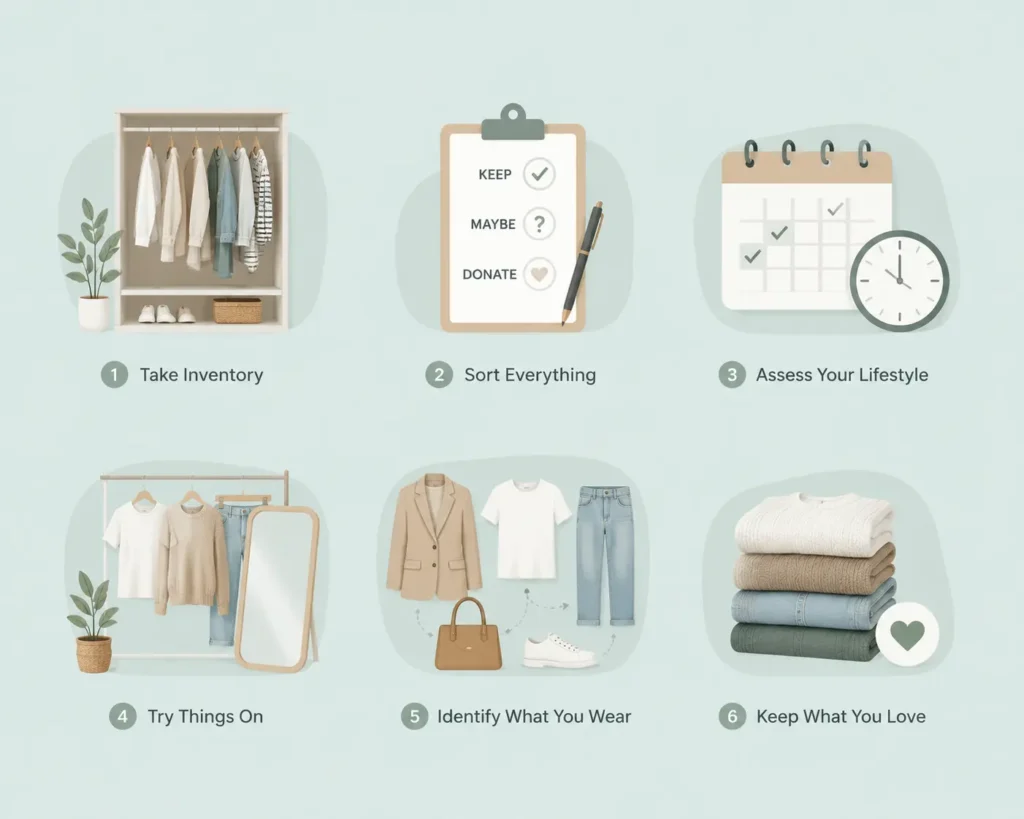
And at the same time, think about your life and be honest about your lifestyle: do you work from home, commute to an office, exercise regularly, or attend a lot of social events? Your attire should reflect your actual life, not a picture you have to think about.
At this stage, it helps to physically try on things rather than just see them on a hanger. A shirt might look good hanging up and fit but look weird and uncomfortable or not go with how you dress now. Trying pieces on also reveals gaps; you might discover you have five almost identical sweaters but nothing that goes well for a smart-casual dinner.
Step 2: Declutter Unnecessary Clothing
When you know what you own and how you live, then you can sort things into keep and remove categories.
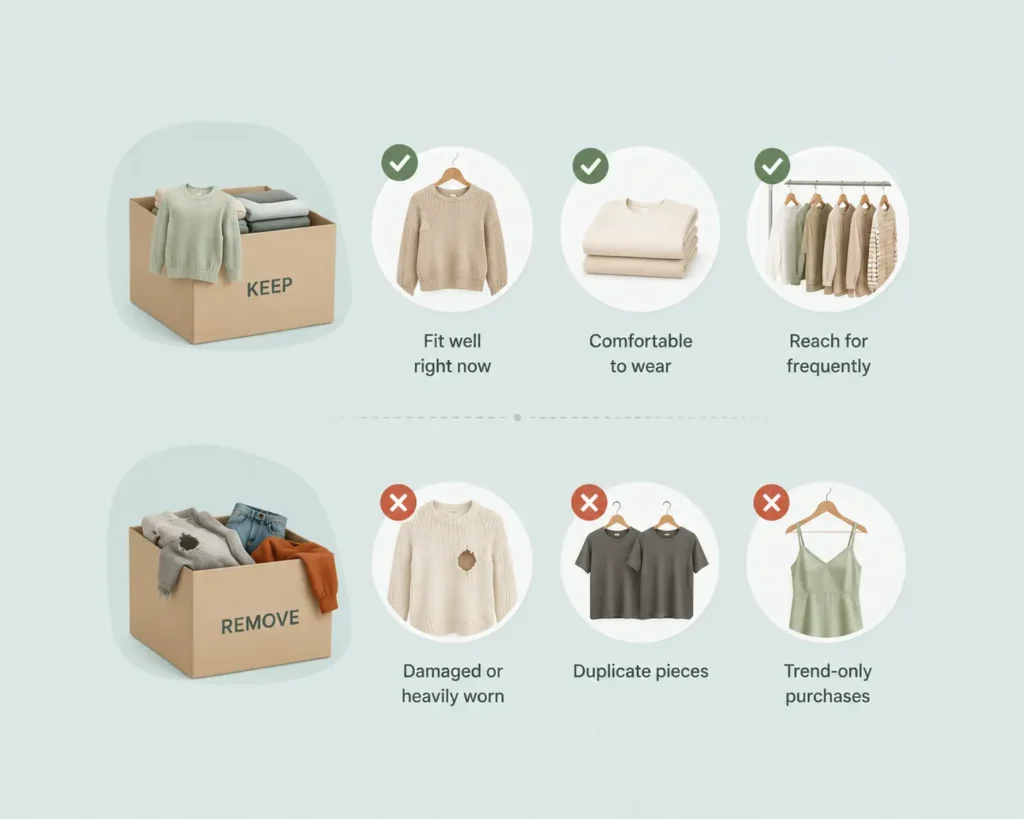
Keep:
- Clothes that fit well right now.
- Things that are actually comfortable to wear.
- Pieces you reach for frequently.
Remove:
- Damaged or heavily worn items that can’t be repaired.
- Duplicate pieces that serve the exact same purpose.
- Trend-only purchases that never quite became regular wear.
In this step, be honest with yourself. It will be easy to put something “just in case” on the list if you know that a piece hasn’t been worn in a year and doesn’t fit your lifestyle.
Step 3: Define Your Personal Style
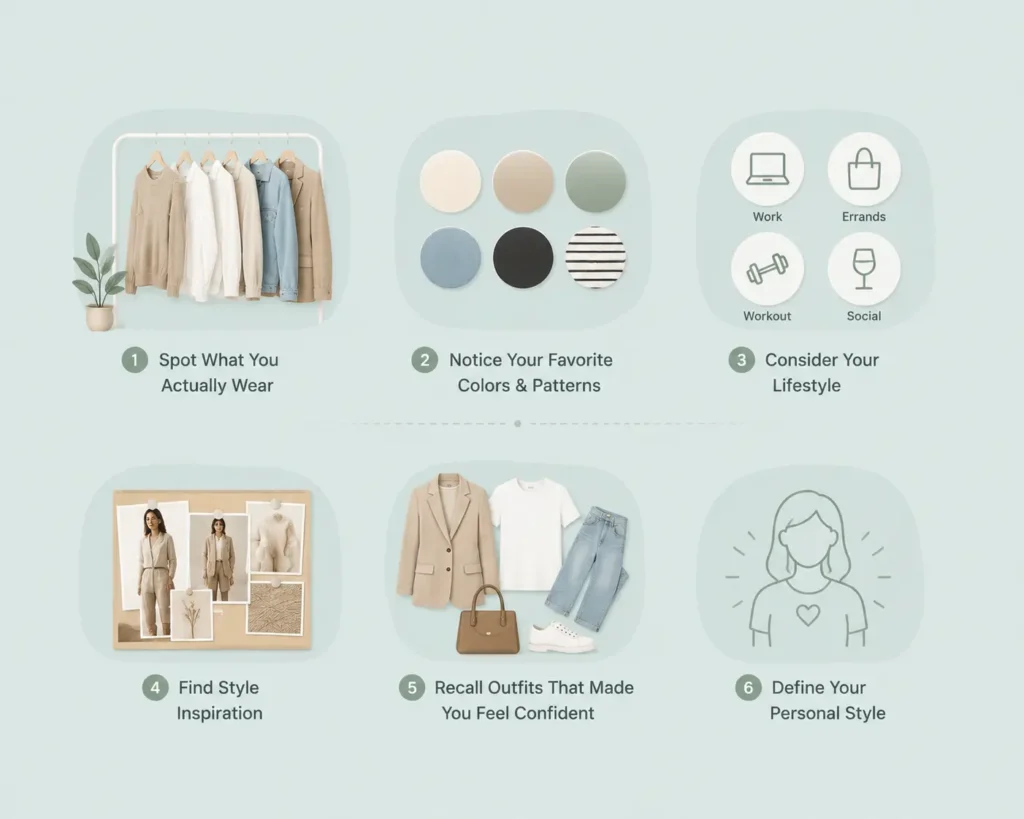
With a cleared closet, it’s much easier to see patterns in what you actually like to wear. You’re probably also going to notice the colors you like and what’s the most comfortable to wear and patterns in the pieces you’ve got. And think about your lifestyle requirements—someone in casual environments will have an entirely different look than someone who is always wearing formal attire. Look at who you admire, fashion inspiration boards, or simply outfits you’ve worn in the past that made you feel confident.
Step 4: Choose a Color Palette
A cohesive color palette is one of the fastest ways to make a wardrobe feel put-together and versatile.
- Black
- White
- Beige
- Navy
- Grey
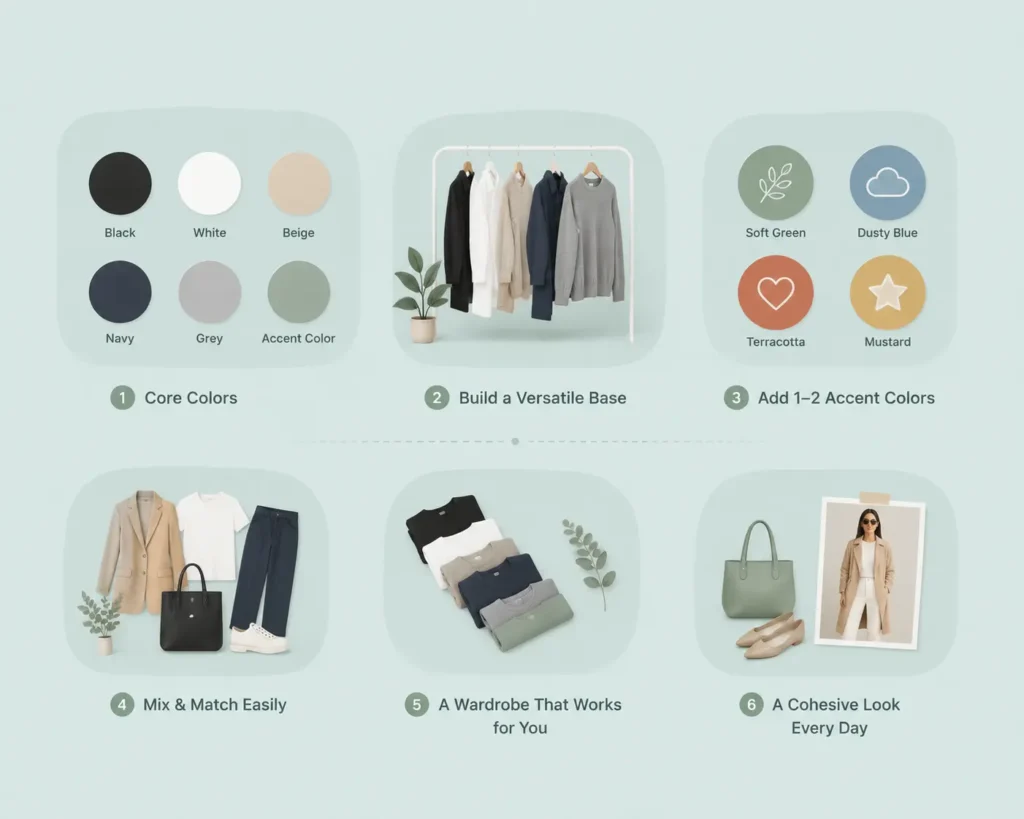
From there, add one or two accent colors that reflect your personal taste, layered in through accessories like shoes or bags. Keeping the palette focused makes mixing and matching far easier, since almost everything you own will naturally pair with several other pieces. If a more elevated, neutral-driven palette appeals to you specifically, it’s worth reading about quiet luxury fashion, which leans on a similar restrained color philosophy.
Step 5: Invest in Quality Basics
Once you know your personal style and palette, prioritize spending on foundational pieces that will last. Look for better fabrics; natural fibers like cotton, wool, and linen tend to hold up and feel better over time than cheaper synthetic blends. Focus on garments made with strong stitching and construction that can withstand regular wear and washing.
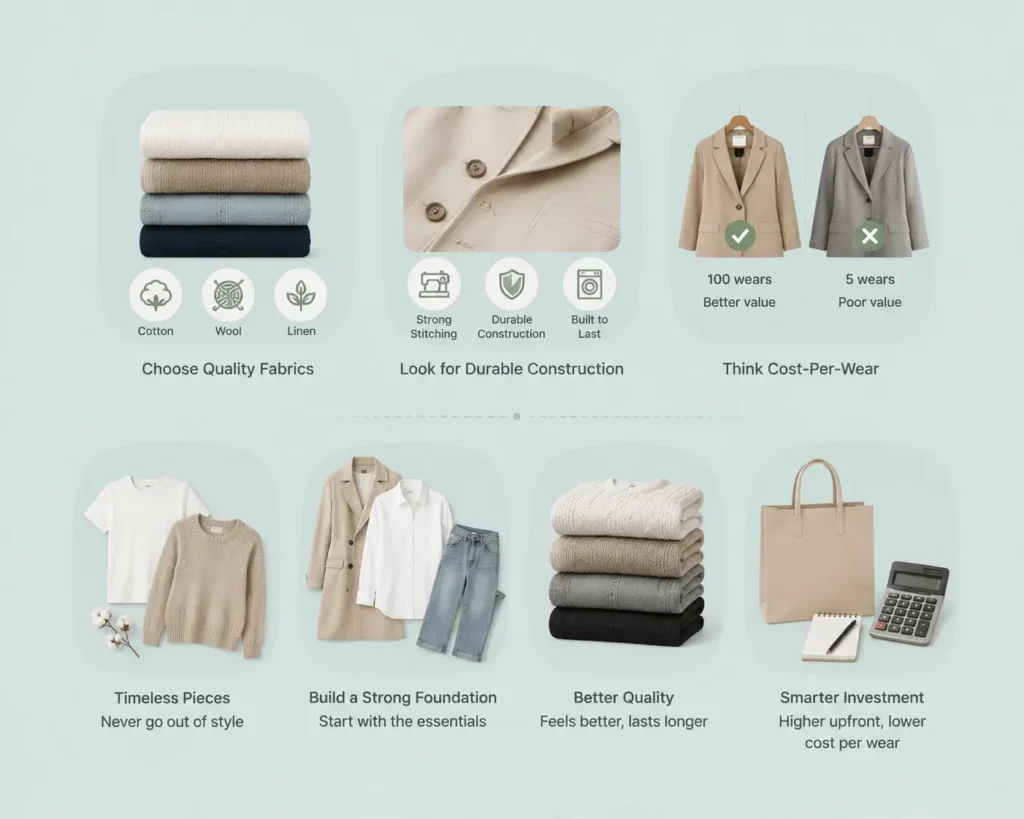
It helps to think in terms of cost-per-wear rather than sticker price. A well-made coat worn 100 times works out far cheaper over time than a cheap coat worn only a handful of times before it falls apart. Framing purchases this way makes it much easier to justify spending more on fewer, better pieces, the same logic covered in our guide to looking expensive and elegant on a budget.
Minimalist Wardrobe Essentials Checklist
While every minimalist wardrobe should be personalized, some foundational pieces appear again and again as a result of the versatility of these things.
Minimalist Wardrobe Essentials for Women
- White shirt
- Basic T-shirts
- Jeans
- Neutral trousers
- Blazer
- Sweater
- Little black dress
- Comfortable shoes
- Everyday jacket
Minimalist Wardrobe Essentials for Men:
- White shirt
- Oxford shirt
- Plain T-shirts
- Denim jeans
- Chinos
- Blazer
- Sneakers
- Formal shoes
- Outerwear
Minimalist Accessories
Accessories can fill a minimalist wardrobe without adding clutter as long as they are chosen with the same intent as clothing:
- Watch
- Belt
- Bag
- Sunglasses
- Jewelry
How to Create a Minimalist Wardrobe Based on Your Style
Not everyone needs the same wardrobe. How you build your minimalist collection should shift depending on how you actually live day to day.
Minimalist Casual Wardrobe
For everyday life, pick some of the most comfortable basics that can be worn on repeat and don’t get boring. Soft T-shirts, well-fitted jeans, and basic layering items make up the basis of an easy minimalist lifestyle, with a few important items (like a favorite jacket) to add personality.
Minimalist Professional Wardrobe
A professional minimalist wardrobe focuses on workwear that looks polished with little effort. Tailored trousers, blazers, and structured tops in neutral tones are simple to create formal or business-casual clothes with without resorting to a lot of clothes.
Minimalist Travel Wardrobe
Packing light is where minimalism really shows its importance. Clothing that can go from day to night, along with lightweight, easy-to-layer clothing, will cover a lot of outfits and occasions with only a fraction of the luggage.
Seasonal Minimalist Wardrobe Guide
Even a minimalist closet has to adjust over the years. So rather than keeping all of the clothing from one season at once, many people rotate clothing with the weather.
Minimalist Summer Wardrobe
Breathable, lightweight fabrics are key for warm weather. Focus on:
- Linen shirts
- Cotton basics
- Lightweight pants
Minimalist Winter Wardrobe
Cold-weather dressing has to rely heavily on layering and some investment pieces:
- Coats
- Sweaters
- Layering pieces
Transitional Season Essentials
Spring and fall can call for pieces that can accommodate temperatures as they change throughout the day:
- Jackets
- Cardigans
- Versatile layers
Common Minimalist Wardrobe Mistakes
Even with good intentions, it is not difficult to make mistakes in creating a minimalist closet. Pay attention to these common mistakes:
- Buying “basics” you never actually wear, just because they look like they should be in every minimalist closet.
- Copying someone else’s style and not building around your own preferences and lifestyle.
- Removing too many clothes before you’ve figured out what you really need.
- Ignoring your actual lifestyle and making a wardrobe around an idealized version of your life.
- Choosing quantity rather than quality to ensure that you have a certain number of items in your closet.
- Following trends unnecessarily, which undermines the long-term versatility a minimalist wardrobe is meant to provide.
How to Maintain a Minimalist Closet
Building a minimalist wardrobe is only half of the story, and it takes habits to keep it that way. Make a seasonal check of your closet to see what is still being worn and what is no longer serving you. Always shop smartly and pause before you buy things to ask if the item really fills a gap. Take care of your clothes properly as well; good maintenance extends the life of quality pieces. Following care labels, fixing small tears, and keeping them properly stored all add years to their usable life.
A simple one-in-one-out rule, where you remove an item when you bring in something new, helps keep the closet from slowly becoming cluttered again. Finally, make regular decluttering a routine and not just a one-time event, checking in every few months to keep your wardrobe aligned with your current life.
It’s also worth revisiting your wardrobe if your lifestyle changes significantly, such as with a new job, a change of climate, or a change in routine, so that your old pieces don’t work as well anymore. Thinking about your closet as a project you develop over time, rather than something you finish once, is what keeps a minimalist wardrobe sustainable for the long run.
Pros and Cons of a Minimalist Wardrobe
| Pros | Cons |
| Saves time getting dressed | Requires an upfront investment in quality pieces |
| Reduces decision fatigue | It takes effort and time to declutter and plan |
| Can save money long-term | Less variety for those who love frequent trend changes |
| More sustainable and less wasteful | Repairs or replacements can feel more urgent with fewer backups |
| Easier to keep organized | May require an adjustment period to find your true style |
| Encourages a clearer personal style | Not ideal for every profession or social expectation |
Conclusion
A minimalist wardrobe isn’t just about owning fewer clothes; it’s about making intentional choices that reflect how you actually live. By focusing on versatile, high-quality pieces suited to your lifestyle, you can build a closet that saves you time, saves you money, and reduces unnecessary consumption along the way. The process takes some patience, but the result is a wardrobe you can rely on every single day. Start small, stay intentional, and build a collection of clothing that genuinely reflects your personal style.
Frequently Asked Questions (FAQs)
1. What is a minimalist wardrobe?
A minimalist wardrobe is a curated collection of clothing built around quality, versatility, and intentional choices rather than owning a large volume of items.
2. How many clothes should a minimalist wardrobe have?
There’s no fixed number; it depends on your lifestyle, climate, and personal preferences. What matters more is that nearly everything you own gets worn regularly.
3. What are the essential pieces for a minimalist wardrobe?
Core essentials typically include neutral basics like a white shirt, well-fitting jeans, a blazer, comfortable shoes, and versatile outerwear, though exact pieces vary by gender and lifestyle.
4. Is a minimalist wardrobe the same as a capsule wardrobe?
Not exactly. A minimalist wardrobe is a broader, ongoing lifestyle approach, while a capsule wardrobe is usually a smaller, defined set of pieces built for a specific season or time frame.
5. How do I start creating a minimalist wardrobe?
Begin by evaluating your current closet, decluttering items you don’t wear, identifying your personal style and color palette, and then investing gradually in quality, versatile basics.
6. Is minimalist fashion expensive?
It can involve a higher upfront cost for quality pieces, but because those items last longer and get worn more often, the overall cost per wear, and often total spending over time, tends to be lower.