Disclosure: This post may contain affiliate links, and Nimble Journal may earn a commission on purchases made through them. Hears has not reviewed or endorsed this article.
There’s a kind of tired that has nothing to do with hours in bed. You collapse at eleven, close your eyes, and then you hear it: the neighbor’s TV through the wall, a partner snoring like a small outboard motor, and the delivery truck idling outside your window. Eight hours later you’re technically well-rested and functionally wrecked.
That gap between time asleep and quality of sleep is the exact one the Hears brand tried to fill, and it’s why so many people go searching for the best Hears sleep earplugs before they’ve even finished their morning coffee. I spent some time looking into what Hears sells, how much it costs, and whether the hype is real. Here’s the honest version, written the way I’d explain it to a friend who’s fed up with foam plugs falling out at 3 a.m.
Quick Verdict: Hears makes reusable, filtered earplugs that lower the volume without muffling the world. The Sleep line is the best for side sleepers, and the High Fidelity pair is the everyday hero for concerts, focus, and travel. The upfront cost is higher than foam, but you keep them for years. Call it 4.5 out of 5.
Key takeaways at a glance:
- Hears Sleep (~$39) is built for side sleepers and nights with snoring partners.
- Hears High Fidelity (~$43) protects your ears at gigs while keeping sound crystal clear.
- A patented acoustic filter is like a volume knob, not a wall; nothing sounds muffled.
- Reusable and washable, with a warranty and money-back guarantee, confirm current terms on Hears’ official site before buying, since policies can change.
- A portion of every order reportedly goes to the Hearing Health Foundation.
Who Are Hears, Anyway?
Hears markets itself as a European hearing-protection company, and the pitch is refreshingly simple. Most earplugs treat your ears like a problem to seal shut. You jam in foam, the world goes muffled, and you spend the night half-aware of a plug slowly working itself loose. Hears wanted protection you could forget you were wearing.
Two things stand out before you even open a box. The products are manufactured in Europe rather than mass-produced generically, and it shows in the finish and fit. Hears also states that it donates a percentage of each order to the Hearing Health Foundation, which funds research into hearing loss and tinnitus, so it’s worth confirming the current details of that program directly on the brand’s site if it factors into your decision. A company selling hearing protection that also funds hearing science is putting its money where its mouth is.
The brand reports a 4.9 out of 5 rating from more than 200,000 customers, with its flagship earplug alone showing over 4,500 reviews. Take any self-reported numbers with a pinch of salt, but the volume of feedback appears genuine, and the tone of it is unusually consistent: people buy Hears, then buy more for their friends.
Why Noise Is Never Neutral
Before the products, it’s worth naming why this category exploded. Noise isn’t just annoying; it strips your sleep cycle even when you’re not fully awake. That’s why you can “sleep” eight hours next to a snorer and still feel hollowed out. Daytime noise does its own damage too, raising stress and chipping away at focus. The National Institute on Deafness and Other Communication Disorders (NIDCD) notes that sounds at or above 85 decibels can cause hearing damage with long or repeated exposure and that concerts and loud sporting events commonly fall in the 94–110 dBA range, well above that threshold.
For years the only answers were disposable foam or expensive custom molds:
- Foam blocks everything and smothers the good sound with the bad.
- Custom molds cost a fortune and need a fitting.
- Hears earplugs aim to fill the gap between those extremes, and that idea runs through the whole line.
How Hears Earplugs Actually Work
Here’s the engineering that makes the brand tick. Inside the everyday Hear’s earplugs: a patented acoustic filter built around tiny microperforations that shape how sound passes through. Think volume knob, not wall. Instead of crushing everything, the filter lowers the overall level while keeping frequencies balanced, so voices and music still sound natural, just gentler.
That’s the difference people tend to notice right away. With cheap plugs, a conversation turns into a distant mumble, and music sounds like it’s playing in the flat next door. With the filtered Hears design, you hear your friend at the bar, you hear the band, and you hear your own instrument if you’re on stage; you just miss the part that damages your ears over time. Engineers refer to this as “flat attenuation,” and it’s part of why DJs, musicians, and noise-sensitive people gravitate toward the brand.
The materials back it up:
- Soft, hypoallergenic TPE that’s kind to sensitive skin
- Four ear-tip sizes in every set, so you can dial in a proper seal
- A design built to stay put, since a loose plug protects nothing
The Best Hears Products, Broken Down
Hears keeps its lineup intentionally manageable. There’s no scrolling through forty similar products, just three main products and a few accessories.
Hears High Fidelity: around $43
This is the everyday, do-everything earplug, and the product people mean when they say “Hears.” It comes in two strengths so you can match protection to your life:
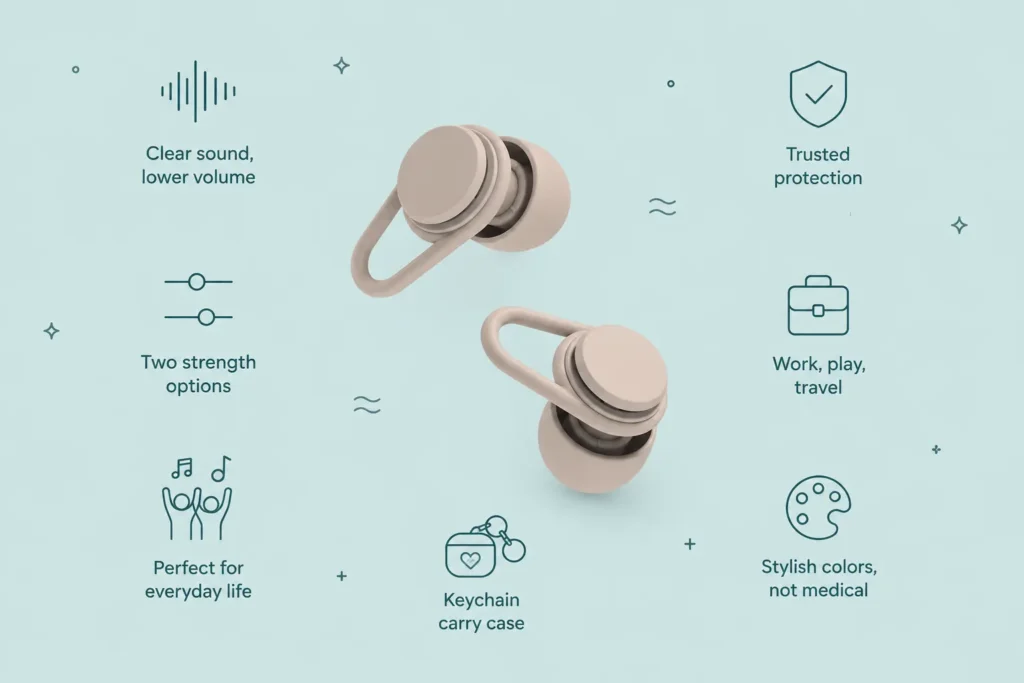
- Hears One (~20 dB): the gentler option for first-time users or anyone who wants to stay aware. Ideal for concerts, festivals, dinner parties, and the daily commute.
- Hears Plus (~25 dB): heavier duty for clubbing, motorsports, industrial settings, deep focus, and long-haul travel, especially in environments above 110 dB.
All of them share the same DNA: the patented filter, four-size tips, a keychain carry case, and the brand’s stated global certifications, warranty, and money-back guarantee (confirm exact current terms on the official site). Colors range from a discreet jet black to limited festival editions, positioning them as an accessory rather than a medical device.
Hears Sleep: around $39
If the search that brought you here was for the best Hears Sleep earplugs, this is the star. It’s a completely different design aimed at one thing: lying down.
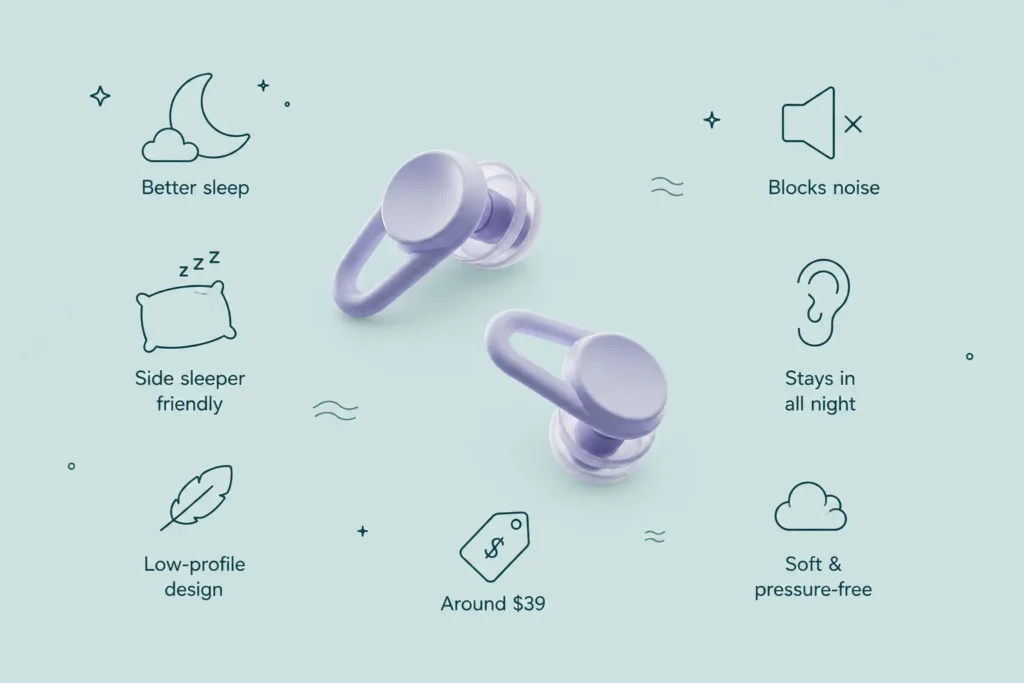
The body is low-profile and sits almost flush with your ear, the whole point for side sleepers. Anyone who’s tried to sleep on their side with a bulky plug knows the problem: it presses into the pillow, digs into the ear canal, and pops out by 3 a.m. Hears Sleep uses a soft silicone seal designed to stay put on your side, back, or stomach, built to be pressure-free all night.
Quick facts:
- Mutes snoring, traffic, and street noise but won’t completely block a harsh alarm (a feature, not a flaw)
- Washable and quick-drying, with four tip sizes and a carry case
- The brand states these carry CE and ANSI certification, which is worth confirming directly if regulatory certification specifically matters to your purchase
- Four colorways: Purple Moon, Midnight Black, Cloud Blue, and Milk and Honey
Hears Moto: price varies
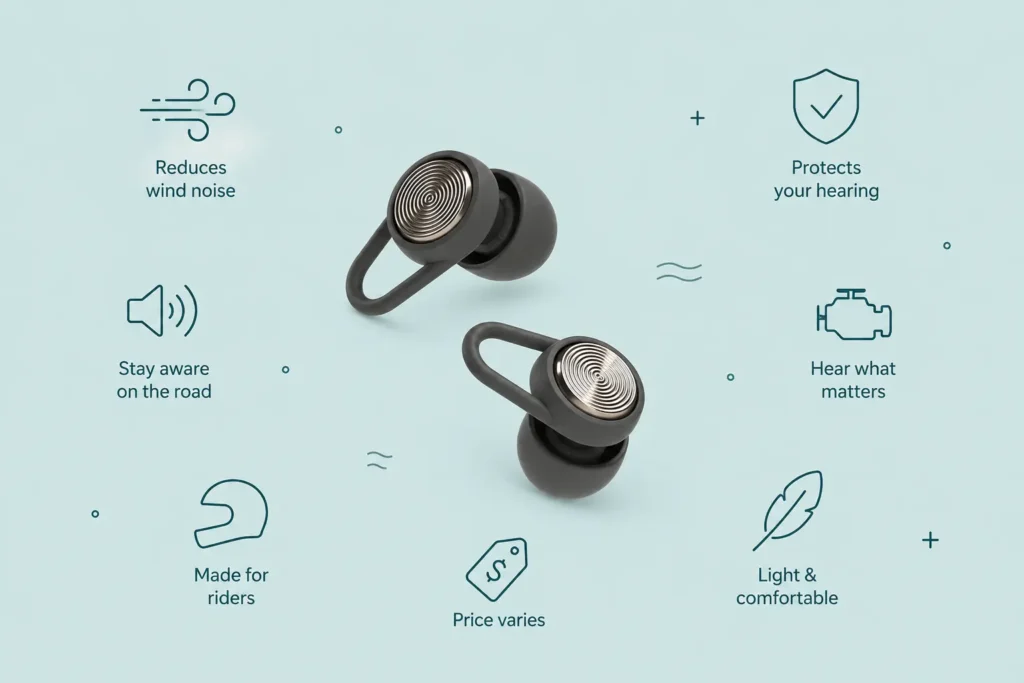
A quieter member of the lineup, the Hears Moto targets motorcyclists and their worst enemy: wind roar at speed. Constant wind at highway speed can be loud enough to cause real damage over time, but riders still need to hear engines, horns, and sirens. Moto is built to cut the harmful wind noise while keeping you aware of the road, a purpose-built addition rather than a simple rebadge.
Accessories and bundles: from around $9
Hears rounds out the lineup with a few sensible add-ons, including a cleaning kit, a carry pouch, spare cases and bumpers, and a sleep mask sold separately. (Note: if a specific co-branded product is listed on the official site, confirm the exact partner brand there rather than relying on this or any other secondhand summary.)
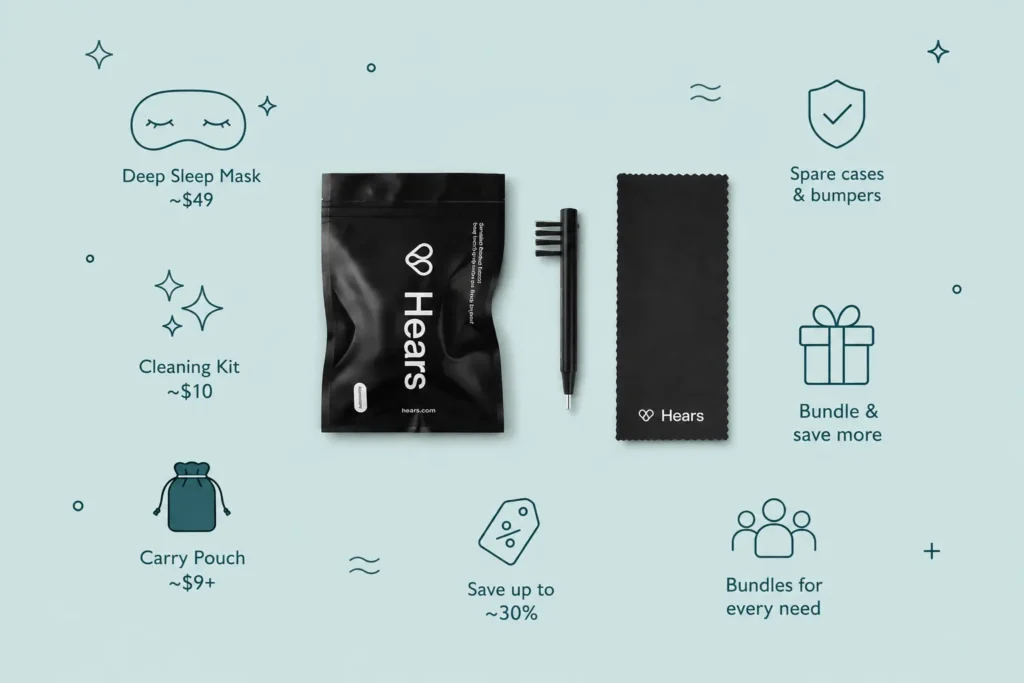
The best value tends to be in the bundles. Setups like the In and Out Bundle, Full Set, and Bulk Bundle reportedly save up to about 30% compared to buying pieces separately; it’s worth checking current bundle pricing directly.
Which Hears Is For You?
| Product | Price (Approx.) | Noise Reduction | Best For |
|---|---|---|---|
| Hears One | ~$43 | ~20 dB | First-timers, concerts, commuting |
| Hears Plus | ~$43 | ~25 dB | Clubbing, motorsports, focus, 110 dB+ environments |
| Hears Sleep | ~$39 | Sleep-tuned | Side sleepers, snoring partners, city noise |
| Hears Moto | Varies | Ride-tuned | Motorcyclists |
Prices reflect the Hears website at the time of writing and shift with sales, so check current pricing before you buy.
What Living With Hears Earplugs Is Actually Like
The spec sheet tells one story, and daily use tells another. The comfort argument gets a lot stronger once you factor in the fit system. Four tip sizes sound minor until you realize most ear-canal complaints come down to using the wrong size. Spend five minutes the first night finding the pair that seals without pushing, and the “they hurt after an hour” problem tends to disappear. The clarity is what people consistently enjoy.
Musicians and DJs report a similar pattern: they tried the big competitors, pulled them out because the sound went dull, then kept Hears in for a whole set and woke up without ringing ears. Because these are reusable and washable, the price reframes itself; a pair you keep for years is gentler on your ears and your wallet than an endless supply of foam.
How Hears Stacks Up Against Loop, Mack’s, and the Rest
vs. Mack’s (foam): Foam is cheap and blocks a lot, but it muffles everything, and you throw it out after a few uses. Hears wins on clarity, comfort, and reusability and loses on rock-bottom price.
vs. Loop and Eargasm (premium): The comparison is tighter here, and Hears’ edge is the filter and the fit. A common complaint about other premium brands is that sound still feels walled-off, or a plug won’t stay put all night. Hears is built to address both of those specific complaints directly.
The honest caveat most competitor articles skip: no earplug is one-size-fits-all, and the best brand for you is whichever one’s tips actually seal your particular ears. The four-size system and money-back guarantee make it relatively low-risk to find out.
Getting the Most From Your Hears Earplugs
- Begin with the tip sizes. Insert a plug, then gently pull it out. Slides free? Size up. Aches? Size down. A good seal feels snug, never painful.
- Insert into a clear ear canal. Pull your ear back and up so the canal straightens before inserting; this makes a real difference in how well the seal holds.
- Keep them clean. Rinse with warm water and mild soap, then dry fully before returning them to the case. Avoid harsh chemicals and heat; both can damage the filter.
- Match the product to the moment. The 25 dB Plus pair in a quiet office is overkill; the Sleep pair at a festival is underkill.
The Honest Pros and Cons
What’s great:
Clear, natural sound from the filter; a low-profile sleep design that actually works for side sleepers; soft, skin-friendly reusable materials; four tip sizes for a genuine fit; brand-stated warranty and money-back guarantee terms (confirm current details); and a brand that states it funds hearing research with every order.
What to weigh:
The upfront price is higher than a bag of foam, so the value only pays off if you’ll use them regularly; the Sleep pair won’t block every sound, including alarms, so heavy sleepers should test their own alarm setup before relying on them; and results depend heavily on getting the tip size right, so give the fitting process its full five minutes.
The Bottom Line
Most earplugs ask you to trade something away. Foam trades clarity for cheapness. Custom molds trade cost for a perfect fit. Hears has built a following by trying to avoid that trade-off entirely: quieter without muffling, protected without disconnecting, and a sleep design that accounts for the fact that most people don’t sleep flat on their backs.
Chasing deeper, quieter nights? The Hears Sleep earplugs are the natural starting point. Want one pair to protect your ears through concerts, commutes, and focus sessions? The High Fidelity range aims to do that with sound intact. If you’re already thinking about your whole nighttime setup, our guide to silk vs. bamboo pillowcases covers the other half of a genuinely undisturbed night. Either way, you’re buying a small, reusable object aimed at giving back something surprisingly large: rest, clarity, and a bit of peace in a world that keeps getting louder.
Frequently Asked Questions (FAQs)
Are Hears earplugs good for sleeping on my side?
Yes, side sleeping is specifically what the Hears Sleep line was designed for. The low-profile body sits almost flush with your ear, and the soft silicone seal is built to stay pressed against a pillow without jabbing you or falling out as you roll over.
How much do Hears earplugs cost?
At the time of writing, the flagship High Fidelity earplugs are priced around $43 and Hears Sleep around $39, with accessories in the $9–10 range and multi-pair bundles offering a discount. Prices shift with promotions, so check current pricing on the official Hears site before buying.
Will Hears earplugs make everything sound muffled like foam plugs?
No, and that’s the core selling point. The everyday plugs use a patented acoustic filter designed to lower volume evenly while keeping sound natural, so voices and music stay clear. It’s built to work like a volume knob rather than a wall, which is why musicians and noise-sensitive listeners tend to prefer it over foam.
Can I reuse and clean Hears earplugs?
Yes, they’re designed to be reusable, with warranty terms worth confirming directly on the brand’s site. Rinse with warm water and mild soap, dry fully, and store in the case. Avoid harsh chemicals and heat, which can damage the filter. The sleep pair is also washable and designed to dry quickly.
What Hears earplugs should I buy first?
Fighting nighttime noise or a snoring partner? Start with Hears Sleep. Need protection for concerts, travel, or focus? Consider High Fidelity One for gentler awareness or Plus for louder environments. Want both? A bundle is typically the cheapest way in, and the money-back guarantee (confirm current terms) makes it low-risk to test.