Disclosure: This post may contain affiliate links, and Nimble Journal may earn a commission on purchases made through them. Hears has not reviewed or endorsed this article.
There is one moment that completely changes the way you think about ear protection.
It may be leaving a concert with your ears ringing like a struck bell. Maybe it is a bartender who’s worked five nights a week next to a speaker stack for a decade. Or it is waking up next to a snoring partner for the four hundredth night in a row, pressing in a pair of cheap foam earplugs, and thinking, There has to be something better than this.
There is. And the answer usually comes down to one comparison: Hears Earplugs vs. foam earplugs.
If you’ve searched for “best earplugs for concerts,” “high-fidelity ear protection,” or “do foam earplugs actually work?” you’ve probably seen the internet littered with vague, recycled advice, with no real explanation of why any given pair of earplugs sounds or feels the way it does or which situation actually calls for it. So let’s fix that, in plain language, from someone who’s actually worn both through loud nights and long ones.
By the end of this guide, you’ll know exactly when foam earplugs are the right choice, when Hears Earplugs are worth the upgrade, and how to choose ear protection that fits your life instead of fighting against it.
The Difference Between Hears Earplugs and Foam Earplugs
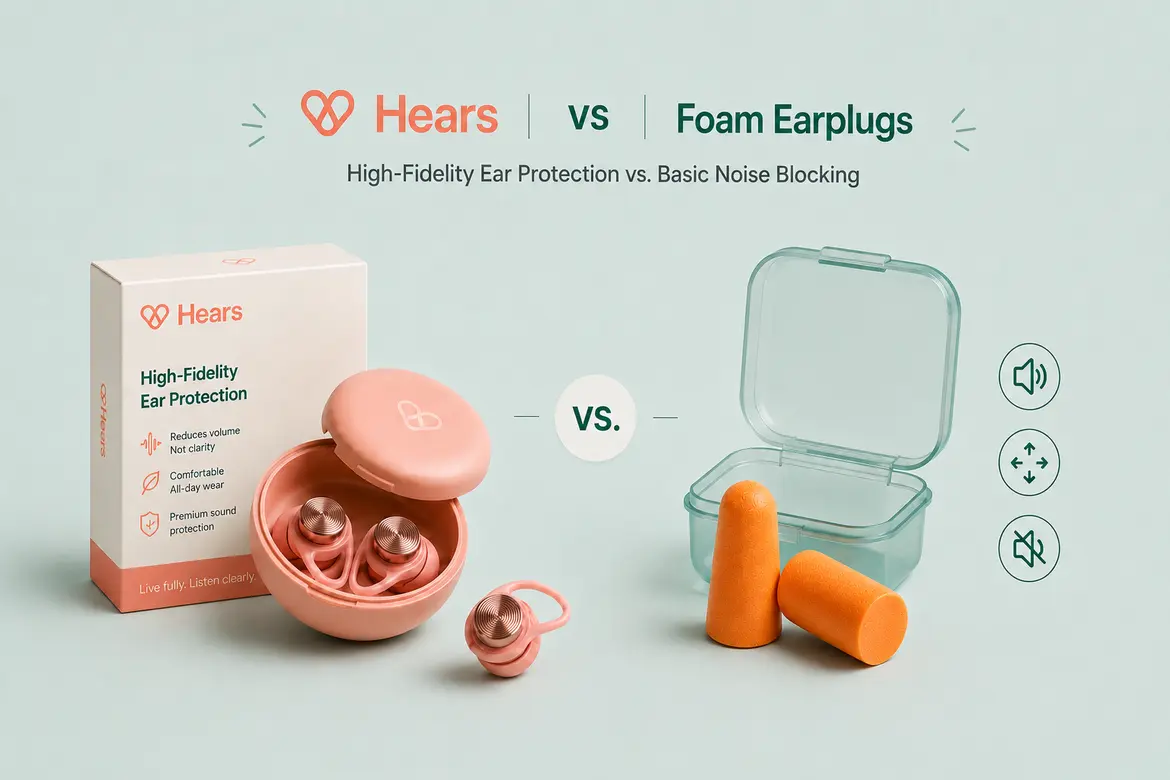
Here’s the short version, because you deserve one up front: Foam earplugs block sound. Hears Earplugs filter it.
That one distinction is the reason this comparison exists at all. Foam earplugs are designed for blunt-force noise reduction, cheap, disposable, and effective at muffling everything indiscriminately. Hears earplugs are built as high fidelity earplugs, meaning they lower volume across different frequencies rather than simply smothering all the noise at once. Music still sounds like music. Conversations still sound like conversations. You’re not putting a pillow over your head; you’re wearing protection engineered around how your ears actually process sound in the first place.
It sounds like a minor technical detail. It’s actually the difference between ear protection you can tolerate and ear protection you actually want to use.
Why This Comparison Matters More Than People Realize
A lot of people assume all earplugs are the same: squishy foam, a little noise reduction, done. That assumption is exactly why so many people give up on ear protection entirely. They try a cheap pair of foam earplugs, hate how muffled and unnatural everything sounds, and decide ear protection just “isn’t for them.”
That’s a real problem, because hearing damage from loud environments is cumulative and permanent. Concerts, motorcycles, power tools, nightclubs, and even loud gyms—the exposure adds up whether you notice it or not. The World Health Organization estimates that over 1 billion young adults are at risk of permanent, avoidable hearing loss due to unsafe recreational listening practices and runs a dedicated “Make Listening Safe” initiative specifically targeting this kind of exposure. Once that damage is done, there’s no reversing it.
So this isn’t really just a comfort debate between Hears Earplugs and foam earplugs. The real difference between someone who protects their hearing consistently and someone who’s given up on ear protection altogether often comes down to whether their first experience with it was comfortable enough to repeat.
Foam Earplugs: The Familiar Default
Foam earplugs deserve real credit for their utility; they’re not bad, they’re just built for a different job than Hears earplugs are.
What foam earplugs are actually good at:
- Blocking a broad range of noise cheaply and quickly
- Being disposable, so hygiene isn’t a lingering concern
- Fitting almost any ear canal thanks to their compressible design
- Being available literally everywhere: pharmacies, hardware stores, gas stations
Foam earplugs expand to seal the ear canal after being compressed and inserted. That seal is what gives them a high Noise Reduction Rating (NRR), usually in the 29–33 dB range. For pure noise-blocking situations, construction sites, loud machinery, or a partner who snores like a diesel engine, that kind of blunt reduction is genuinely useful.
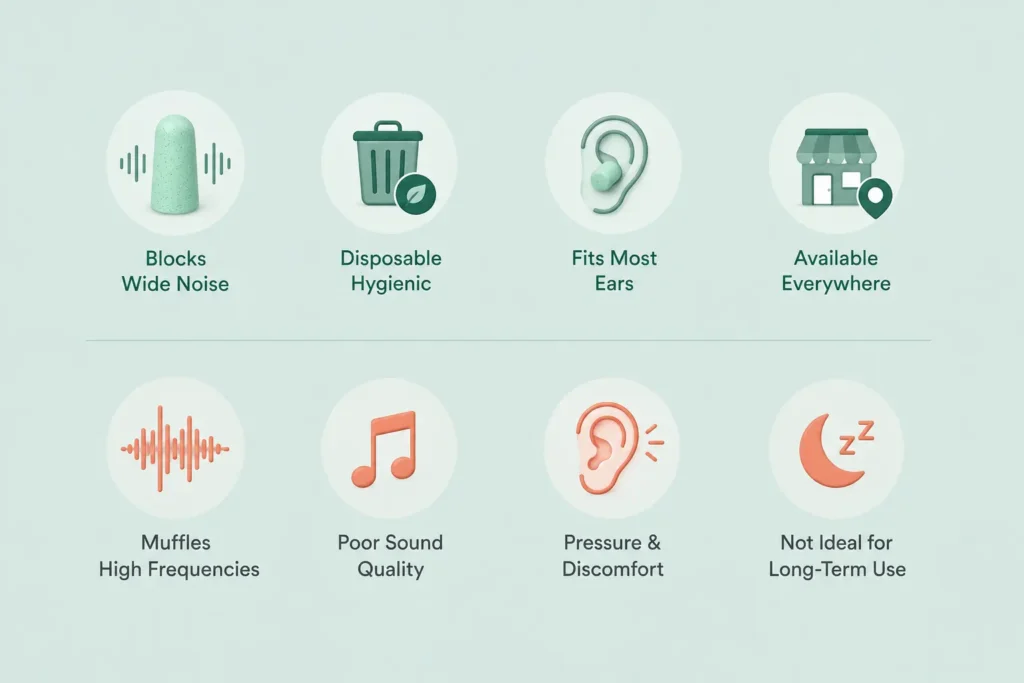
Where foam earplugs fall short: The same broad, indiscriminate seal that makes foam earplugs great for blocking a jackhammer makes them frustrating for anything involving sound quality. High frequencies get crushed disproportionately, which means music, voices, and ambient detail all come out sounding muddy, distant, and flat. Anyone who’s tried listening to a live band through foam earplugs knows the feeling; you can tell something is happening, but you can’t really hear the music.
There’s also the comfort factor. Foam earplugs expand inside the ear canal, and depending on your anatomy, that can lead to pressure, itchiness, or a “stuffed” feeling after a few hours. For a one-off use, that’s forgettable. For nightly use, it adds up quickly, which pairs with the same fit issues covered in our Hears Sleep earplugs review if snoring specifically is what’s driving you to earplugs in the first place.
Hears Earplugs: Built for People Who Don’t Want to Sacrifice Sound Quality
This is where Hears earplugs change the equation.
Hears Earplugs are built around a simple idea: protecting your hearing shouldn’t mean losing the experience you’re trying to protect it from. Instead of a soft, air-sealing foam plug, Hears Earplugs use acoustic filters that reduce volume evenly across the frequency spectrum. The result is quieter but still clear: vocals still sound like vocals, guitars still sound like guitars, and a friend’s voice across a bar still sounds like their voice.
What makes Hears Earplugs stand out:
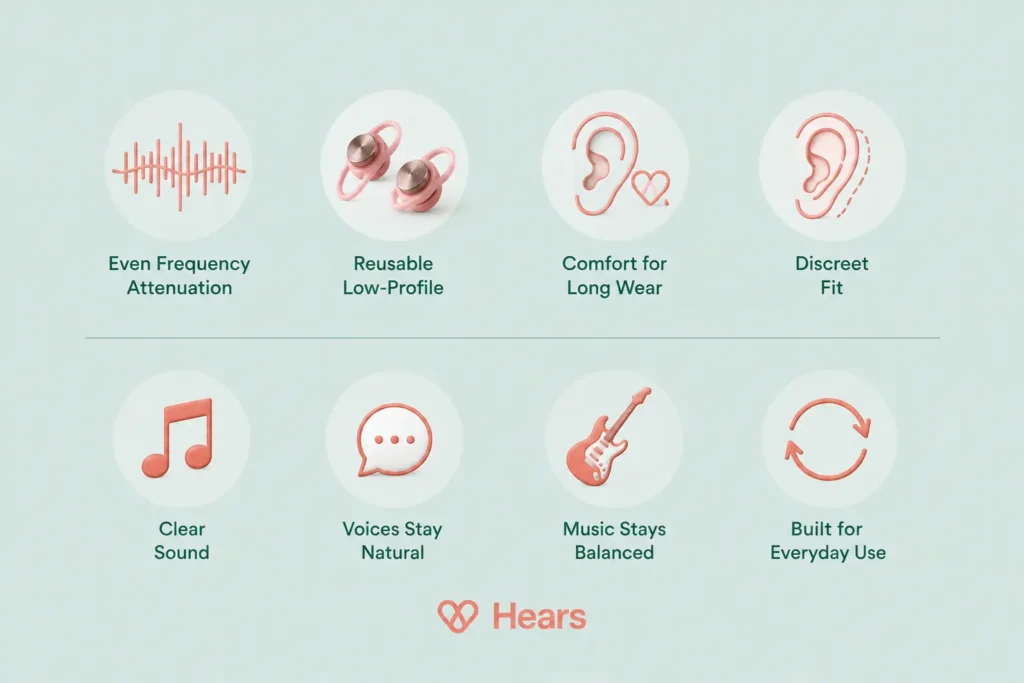
- Even frequency attenuation. Instead of smothering everything with one blunt reduction, Hears Earplugs are tuned so no single frequency range gets wiped out. That’s the real substance behind the term “high-fidelity earplugs.”
- Reusable, low-profile design. Unlike disposable foam, Hears earplugs are built to be worn again and again, useful whether you’re at concerts, working with power tools, or riding out a noisy daily commute.
- Comfort built for long wear. Because they don’t expand inside the canal, they tend to be more comfortable over extended use, an advantage for musicians, bartenders, motorcyclists, and frequent concertgoers.
- Discreet fit. Hears Earplugs generally sit closer to the ear’s natural shape rather than protruding, which matters if you’d rather your ear protection not be the first thing people notice.
If foam earplugs are the equivalent of shutting a door on noise, Hears earplugs are closer to turning down the volume knob deliberately and evenly without losing the mix.
Hears Earplugs vs. Foam Earplugs: Side-by-Side Comparison
| Feature | Hears Earplugs | Foam Earplugs |
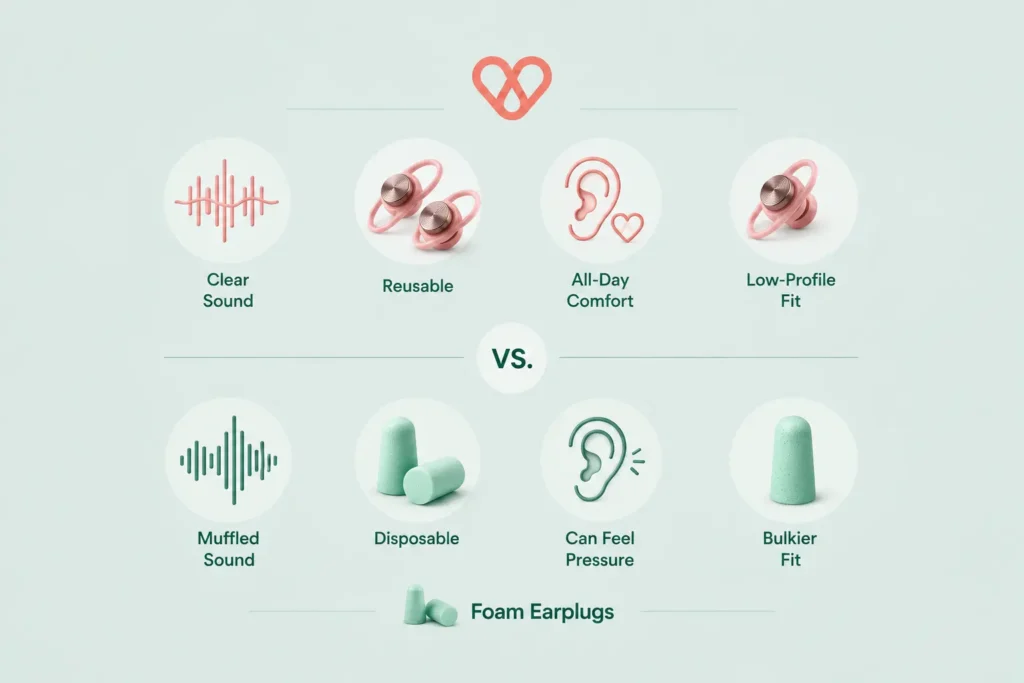
| Sound quality | Clear, balanced, high fidelity | Muffled, uneven, “underwater” feel |
| Noise reduction style | Even attenuation across frequencies | Broad, indiscriminate blocking |
| Reusability | Reusable, long-term use | Disposable, single or limited use |
| Comfort for long wear | Designed for extended comfort | Can feel pressurized after hours |
| Best for | Concerts, DJs, musicians, bartenders, motorcyclists, daily noise management | Construction, sleeping, one-off loud environments |
| Cost over time | Higher upfront, lower long-term cost | Lower upfront, ongoing repurchase cost |
| Discretion | Low-profile, subtle fit | Visible, bulkier in-ear presence |
Neither option is objectively wrong. The honest answer, which most articles won’t tell you directly, is that foam earplugs are still a good choice for pure noise-blocking situations where sound quality doesn’t matter much, like sleeping through a snoring household, tuning out a construction site, or getting through a loud flight. But for anything involving music, conversation, or an experience you actually want to enjoy while protecting your ears, Hears Earplugs are the more thoughtful choice.
Who Should Choose Foam Earplugs
Foam earplugs still make sense if:
- You want to block all kinds of noise (heavy machinery, snoring, loud neighbors)
- You want something disposable and don’t mind buying more
- You’re on a tight budget and only need protection occasionally
- Sound quality isn’t a factor; you just want quiet
Who Should Choose Hears Earplugs
Hears Earplugs are the better fit if:
- You go to concerts, festivals, or clubs and want to protect your hearing without losing the music
- You’re a musician, sound engineer, DJ, or bartender regularly exposed to loud environments
- You ride motorcycles and want engine and wind noise reduced without losing road awareness
- You want ear protection you can reuse instead of repurchasing
- Comfort during long wear genuinely matters to you
- You want ear protection that feels considered, not like a compromise
That’s really the heart of the Hears Earplugs vs. foam earplugs question. It’s not about which product is “better” in a vacuum; it’s about matching the tool to the moment. But for people specifically asking about high fidelity earplugs, the answer usually is Hears Earplugs, precisely because the muffled, lifeless sound of foam is the single most common complaint people have with it.
The Hearing Health Angle Nobody Talks About Enough
It’s worth sitting with this for a second: the biggest reason people skip ear protection usually isn’t laziness. Their only experience with earplugs was a foam pair that made everything sound terrible, so they stopped using them altogether.
That’s a dangerous pattern, because noise-induced hearing loss doesn’t announce itself. It creeps in gradually: a slight ringing after a show that used to fade by morning and now lingers into the afternoon, a friend who has to repeat themselves at dinner, and music that needs to be a little louder each year to feel the same. Hearing damage from loud noise exposure is considered one of the more preventable forms of hearing loss, but prevention only works if people actually wear protection consistently.
This is where Hears Earplugs enter the conversation. When ear protection doesn’t ruin the experience it’s protecting, people are far more likely to actually use it every show, every shift, every loud commute. Consistency is what protects hearing long-term, and comfort plus sound quality is what drives that consistency. Foam earplugs, useful as they are in narrow contexts, rarely inspire that kind of habitual use.
Mistakes People Make With Ear Protection
- Assuming discomfort means better protection. A tight, painful seal doesn’t necessarily protect better; it just feels worse.
- Reusing foam earplugs past their intended lifespan. Foam breaks down, its seal quality drops, and hygiene becomes a real concern.
- Not checking fit before a loud event. Whether it’s Hears Earplugs or foam, fit changes everything. Test in a quiet room first.
- Assuming all “high fidelity” products are equal. Not every product marketed as high fidelity earplugs actually delivers even frequency attenuation; look for real acoustic engineering behind the claim, not just the marketing language.
- Waiting for symptoms before taking hearing protection seriously. Ringing, muffled hearing after exposure, or needing to raise the volume more than you used to are early warning signs, not something to wait out.
How to Choose Between Hears Earplugs and Foam Earplugs in Practice
If you’re still deciding, ask yourself three quick questions:
- Do I need to hear detail, music, conversation, or nuance while protected? If yes, Hears Earplugs are the answer.
- Is this a one-time, purely noise-blocking situation? Foam earplugs will do the job well.
- Will I actually use this consistently, or will discomfort make me stop? If long-term consistency matters, Hears Earplugs tend to win by a wide margin.
Most people end up somewhere in the middle: foam earplugs for random loud moments and a good pair of Hears Earplugs for anything recurring, concerts, gigs, riding, or work environments. That combination covers most real-world scenarios without needing one single “always right” answer.
Final Verdict: Hears Earplugs vs. Foam Earplugs
If this comparison boiled down to one sentence, it would be this: foam earplugs protect your ears from noise, while Hears Earplugs protect your ears and the experience you came for.
Foam earplugs remain a reasonable, inexpensive option for purely functional situations, sleeping, construction, and a loud flight. But for anyone who regularly steps into loud environments they actually want to enjoy, like concerts, festivals, DJ booths, motorcycles, bars, or live shows, Hears Earplugs are the smarter long-term investment. They’re reusable, more comfortable over extended wear, and built around genuine high fidelity ear protection rather than blunt-force muffling.
The bigger takeaway: the right ear protection is the one you’ll actually keep using. For most people who’ve tried both, that’s Hears Earplugs. Protecting your hearing shouldn’t mean giving up the sound you love, and the best ear protection is the pair you’ll wear often and comfortably.
Frequently Asked Questions (FAQs)
Are Hears Earplugs better than foam earplugs for concerts?
Generally, yes. Hears Earplugs are designed as high fidelity earplugs that lower volume evenly, so music retains its clarity instead of sounding muffled, which is exactly what most concertgoers want from ear protection.
Can foam earplugs damage your hearing if used incorrectly?
Foam earplugs themselves don’t damage your ears, but an incorrect seal can create a false sense of protection. Insertion technique matters just as much as the product itself.
Are Hears Earplugs reusable, unlike foam earplugs?
Yes. Hears Earplugs are built for repeated use over time, while foam earplugs are disposable and break down after limited use.
Which is more comfortable for all-night wear: Hears Earplugs or foam earplugs?
Most users report Hears Earplugs as more comfortable for extended wear since they don’t rely on expanding pressure inside the ear canal the way foam does. Both reduce noise effectively, but the goal differs: high-fidelity earplugs prioritize even, natural sound reduction over the maximum raw blocking foam is built for. For most everyday and recreational use, that trade-off tends to be well worth it.