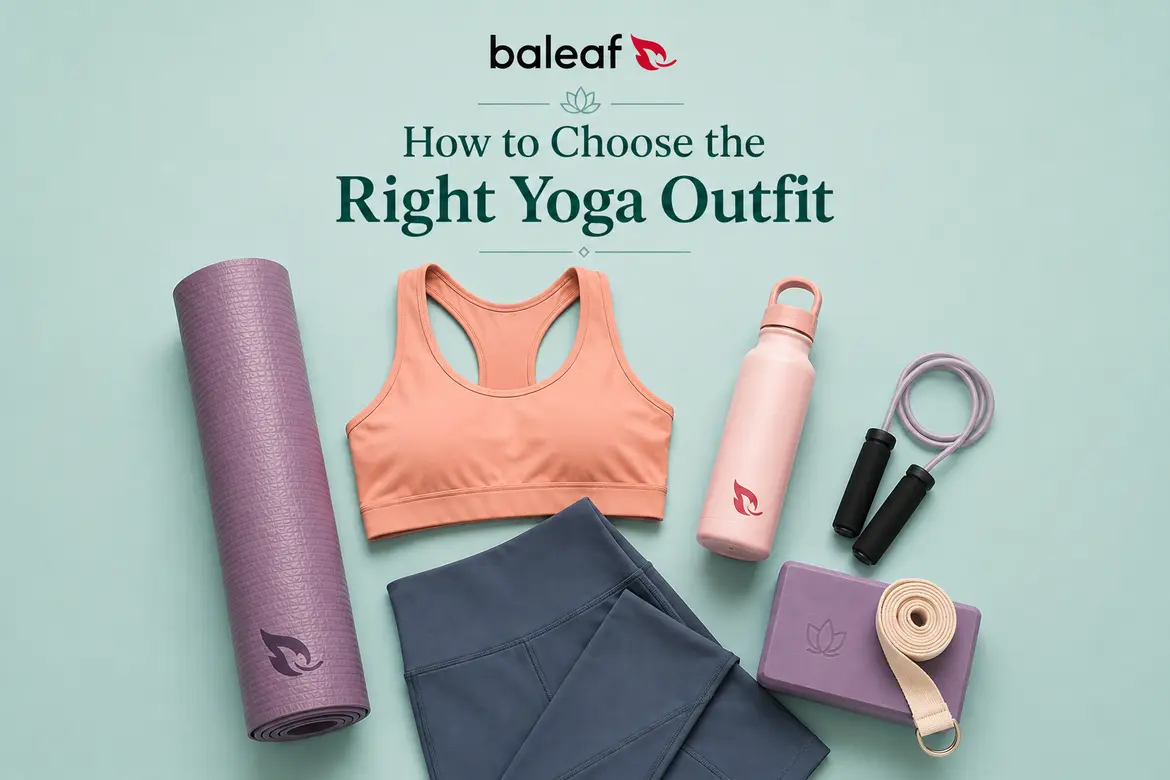
Your yoga outfit is more than just a covering. The right yoga outfit lets you fold, twist, and balance without a waistband digging in or a shirt sliding toward your chin. Find the wrong yoga clothes, and you spend half of class tugging fabric back into place instead of following your breath. What to wear for yoga: From scratch to your point of view: which fabric holds up to sweat, how leggings differ from yoga pants, what makes a sports bra worth buying, and where to get yoga clothing that lasts and doesn’t drain your budget. A good yoga outfit rewards a little planning.
Introduction
Everyone who has tried to hold a downward dog in a loose cotton tee knows the dilemma. The shirt starts to fall down onto your face, the seams itch all the time, and soon you’re thinking about your clothes instead of your work. Uncomfortable yoga clothes pull your attention away from the mat, which is the opposite of what you came for. The good news is that choosing what to wear to yoga is easier than you think.
What you should know is what a yoga outfit should be like: the fabric that is sweat-wicking and stretchy, and what the difference between leggings and yoga pants, which sports bra and top should you wear for inversions, what changes are in the clothing for hot yoga and some affordable activewear brands that are worth looking for, such as Baleaf. At the end you will know how to build a yoga outfit that disappears the moment you step on the mat.
Why What You Wear to Yoga Actually Matters
When deciding what to wear for yoga, it comes down to movement, sweat, and fit. Yoga asks you to bend, reach, lunge, and roll through a wide variety of motions, so a yoga outfit that tries to fight those movements works against you.
Fabric with enough stretch moves as you move so that a big lunge or a bind never seems to split a seam. Even small restrictions add up over an hour, and a waistband that pinches during a seated twist will take your focus away from what you would rather concentrate on: your breath.
Sweat management is the second reason your yoga clothes matter. Depending on the style, you might glow lightly or soak through. Moisture-wicking material pulls that sweat off your skin and dries faster, keeping you from feeling clammy when class slows down for savasana.
Then there is fit. Yoga clothing that is too tight cuts into your waist and shoulders and limits how far you can move. Clothes that are too loose bunch up, ride down, or flip over your head during forward folds. Both take your focus off the practice. A yoga outfit that fits snug without pinching allows you to forget it is there.
Comfort also fosters confidence. When your top stays down through every transition and your leggings never turn see-through in a squat, you stop bracing against wardrobe surprises. The right yoga outfit is as much a mental quiet as it is a physical freedom.
What Fabric Should Yoga Clothes Be Made Of?
The fabric determines how your yoga clothes feel after ten minutes of movement, so it is worth understanding a few properties before you buy the pieces of your yoga outfit.
Moisture-wicking matters most. Synthetic fibers like polyester and nylon pull sweat away from your skin and let it evaporate, so you stay drier in a sweaty flow. That is why most performance yoga clothing relies on these materials rather than natural fibers.
Stretch is the next priority. Look for a four-way stretch, which moves both lengthwise and sideways, so the fabric follows your body through every twist and fold. Spandex, sometimes called elastane or Lycra, is what makes that give. A mixture of at least 15 percent spandex is known to move well without losing its shape.
Breathability keeps you cool, which is even more important in hot yoga, where the room does the sweating for you. Lightweight knits, mesh panels, and open weaves let air reach your skin and help regulate your temperature during a heated session.
Cotton is the tricky one. It feels soft and breathes well in everyday life, but it soaks up sweat and holds it against your body. In a warm room a cotton shirt turns heavy and cold, and wet cotton chafes. A small amount blended with synthetics can work for gentle classes, but once you start sweating, pure cotton is a poor choice. For hot yoga especially, keep cotton out of your bag entirely and build your yoga outfit from synthetics.
Two other properties are easy to overlook when you assemble yoga clothing. Opacity determines whether your leggings stay decent in a deep squat, so check that the fabric does not go sheer when stretched. A quick test is to pull the waistband taut in good light and see if the color thins out. Weight and durability matter for the long haul as well. Denser knits resist pilling and hold their shape through repeated washes, while very thin fabric may feel airy but wear out faster and lose its wicking power sooner.
Fabric Comparison Table
| Fabric Type | Best For | Pros | Cons |
| Polyester | Sweaty and heated yoga classes | Moisture-wicking, quick-drying, and maintains shape and color well | Can retain odor over time; fully synthetic material |
| Nylon | Vigorous flow and hot yoga | Strong, soft feel, excellent moisture management, abrasion-resistant | Dries slower than polyester; usually needs spandex for added stretch |
| Spandex Blend | Almost any yoga style | Four-way stretch, squat-proof coverage, flexible fit, supportive feel | Can lose elasticity if washed with high heat; rarely used alone |
| Cotton | Gentle or restorative yoga sessions | Soft, breathable, affordable, and comfortable on skin | Absorbs sweat, stays damp longer, may cause chafing, feels heavy when wet |
Yoga Pants vs. Leggings: What’s the Difference?
People use the two words as if they mean the same thing, and often they overlap, but a few differences can guide the bottom half of your yoga outfit.
Leggings sit tight against the leg from waist to ankle. A high waistband provides real support across your core and stays put through inversions so nothing rides down when you flip into a downward dog. The compressive fit also means the fabric moves with you rather than shifting around, which suits vigorous styles like power vinyasa.
Yoga pants cover more ground as a category. Some are fitted like leggings, while others flare at the ankle or fall loose through the leg. Bootcut and flared pairs have a relaxed feel and additional airflow, and they hide the shape of your legs if you prefer more coverage. Looser pants shine in slower classes such as yin or restorative, where you are not moving fast enough for the fabric to get in the way.
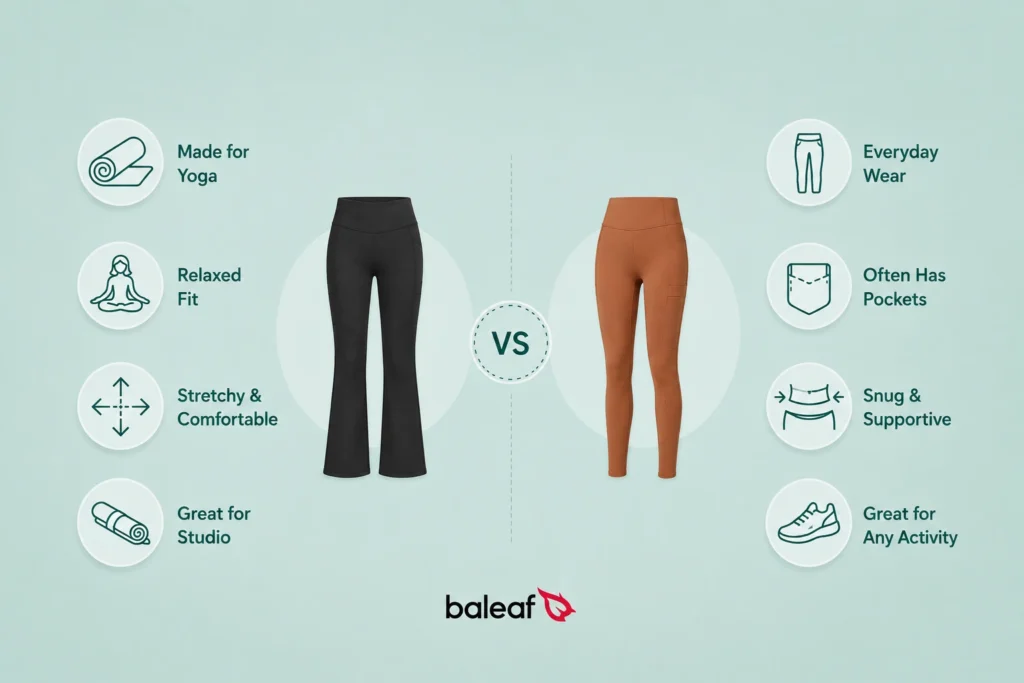
The details are what make the choice more clear. The waistband height affects how secure you feel: a high rise above the navel gives you the most coverage and hold, a mid rise is for gentler sessions, and a low rise is less stable during inversions. Length is another preference as well, from capri and seven-eighths cuts that end at the calf to full-length pairs that reach the ankle.
Flat or bonded seams are easier to hold against the skin than thick raised stitching that can rub during longer holds. Pockets are a bonus and not a necessity, though a hidden waistband pocket is handy for a key or card, and a side pocket that fits a phone lets your leggings double as everyday wear.
For fast, sweaty, upside-down practice, lean on high-waisted leggings or fitted pants. For a calm and grounded session, loose yoga pants feel very comfortable and easy. If you’re loose, get a pair that tapers or cinches at the ankle so the hem doesn’t catch your feet mid-pose. The bottoms anchor the rest of your yoga outfit.
What to Look for in a Yoga Sports Bra
A sports bra is the foundation of a supportive yoga outfit, so match its support to how hard you plan to move. Gentle styles like yin or restorative need only light support. Power vinyasa and other fast classes involve twisting and inverting, which demands medium to high support so everything stays in place.
Support usually comes in two forms. Compression bras press the bust against the chest and suit smaller frames and lighter sessions. Encapsulation styles cup each side separately and give more structure, which helps during vigorous flows or for a fuller bust.
Strap style affects fit and freedom. Racerback and cross-back designs pull the shoulders in and stay clear of your arms during big reaches. Adjustable straps allow you to adjust the fit.
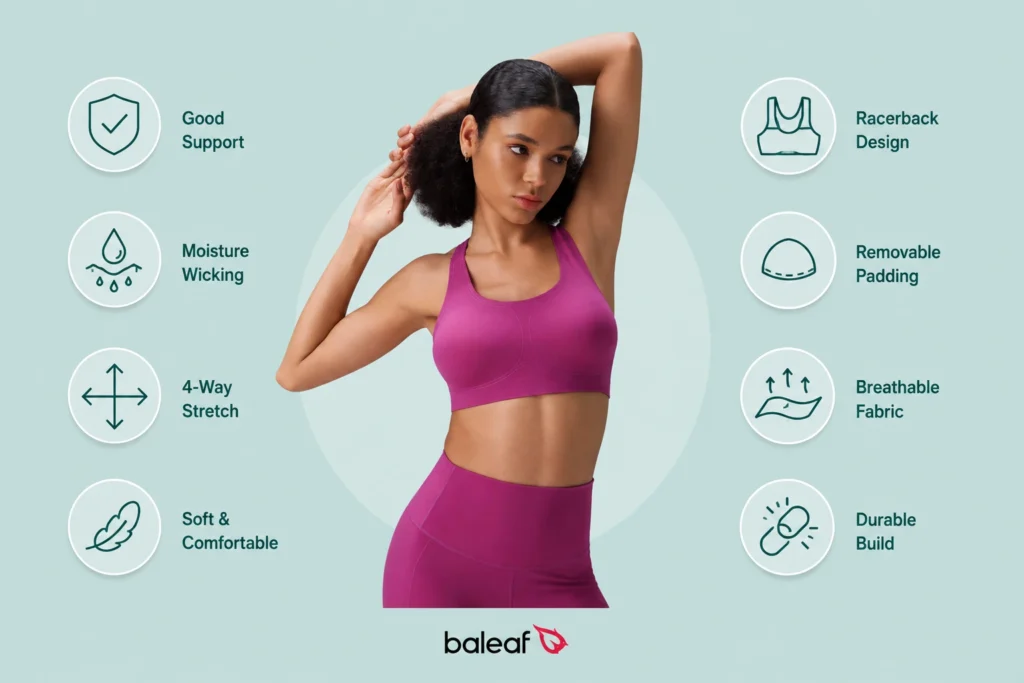
You can also pick between a built-in shelf bra sewn into a tank and a separate bra worn on its own. Built-in bras keep your yoga outfit simple. A separate bra allows you to set support and top independently, and it is worth having one piece of yoga clothing that does double duty this way, since many yogis wear a sports bra alone in warmer classes.
You are looking for moisture-wicking fabric and soft, flat seams that will not rub. If you are sizing, the band should feel snug without pinching, and the cups should hold you without spilling or gaping. Try a forward fold and a twist before you make a decision.
A well-fitted band does most of the support work, so if you can slide two fingers under it easily, it is probably too loose, and if it digs in or rides up in the back, it is too tight. Removable pads allow you to adjust coverage and dry faster if you take them out after class. Sports bras also wear out, and once the band stretches and the support fades, usually after a year or so of regular use, it is time to replace it. For hot yoga, a bra in quick-drying synthetic keeps you comfortable even when it is the only top you wear.
How to Choose Yoga Tops: Fit, Coverage, Style
The biggest part of what you wear for yoga is a top that’s a good thing to wear because that’s the part of your yoga outfit that is most likely to misbehave mid-pose. Your top has one job in yoga: stay where you put it. A fitted or narrow-cut shirt hugs the waist and hips, so it won’t slip and slide over your head when you fold forward or drop into a shoulder stand. Flowy tops look good and feel airy, but they tend to billow and flip during inversions, which can leave you exposed and distracted.
Hem length is worth a thought. A top long enough to tuck or reach the hip stays anchored during upside-down poses. A cropped cut goes well with high-waisted leggings and provides coolness, though it is less coverage.
Match coverage to your comfort. Some people like to be able to flow in a sports bra alone, while others prefer a tank or short-sleeve tee. They do work as long as the fit is snug through the torso and both fit well in a warm-weather yoga outfit.
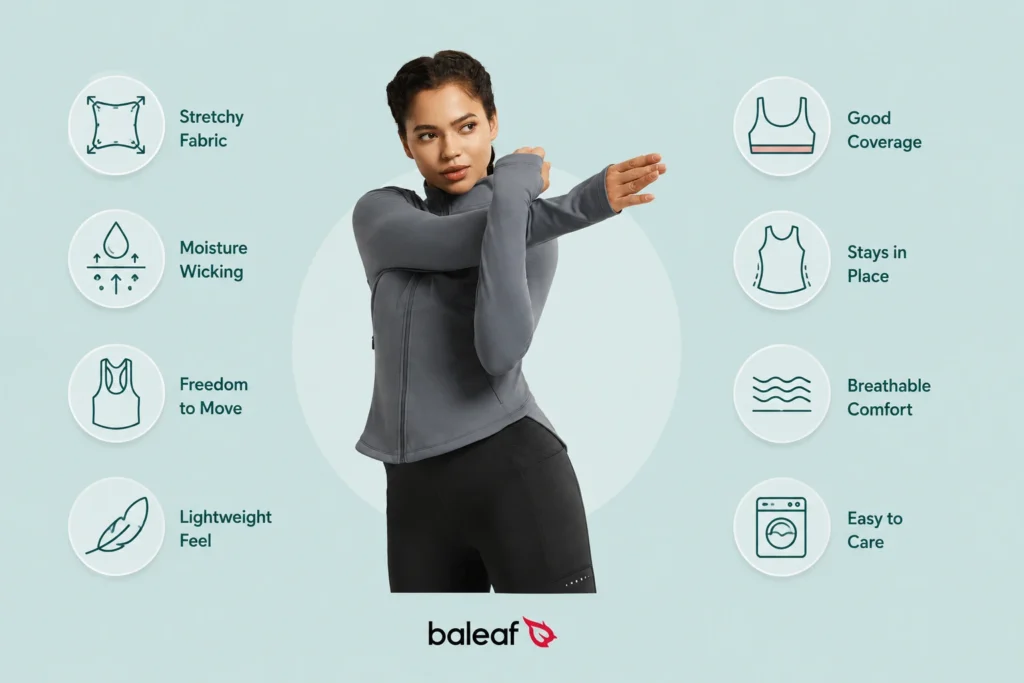
Here is a quick test borrowed from the fitting room: bend forward and touch your toes. If the shirt gaps at the chest or falls toward your face, size down or pick a tighter cut. For hot yoga, add a light layer you can peel off, and keep a warm top nearby for the cooldown so you don’t catch a chill after a sweaty class.
Hence, layering is a necessary part of hot yoga. In a room where temperatures are between 90 and 105 degrees, less fabric is going to be involved, so a simple yoga outfit with a sports bra and shorts and a thin fitted tank seems to be best. A loose cover-up on the way in and a dry shirt at home make the class bookends feel more comfortable.
Sleeves are a matter of taste: a fitted long sleeve for a cool studio or a cool savasana, while a tank or short sleeve keeps you cool in a vigorous flow. The same rule holds whatever length they may be, since a top that migrates during inversions is not going to be so good for anything.
Best Affordable Yoga Activewear Brands Worth Trying
Good yoga clothing doesn’t have to be expensive. Deciding what to wear for yoga without over-spending is easy when you know a few brands that offer wicking fabric, four-way stretch, and a squat-proof fit at a fraction of luxury prices, which makes assembling a full yoga outfit surprisingly cheap.
Baleaf is known for value. It’s products are priced around $20–40 and the high-waisted leggings have gained a reputation for moisture-wicking, squat-proof fabric and an anti-slip waistband that stays put through inversions. Many have a hidden pocket, and the sizing is from XS to 3XL, which is more inclusive than most competitors. Baleaf is often referred to as a budget alternative to premium labels, and there are pairs that last for years, the reviews say. Baleaf is eco-friendly in terms of materials and packaging, and therefore a Baleaf yoga outfit is less heavy on the planet.
CRZ Yoga is another wallet-friendly option and is known for buttery leggings that make for a lot of comparisons with pricier brands that are half the price. Colorfulkoala keeps prices low and shows up on best-budget lists for its soft, high-waisted leggings.
If you can stretch out the budget, Girlfriend Collective makes leggings from recycled materials with inclusive sizing, which go up in price but still maintain sustainability. Baleaf does provide the largest range for the least money, so it is easy to start a yoga outfit there.
When you shop any of them, read recent reviews for fit and opacity rather than trusting the size chart alone, as cuts vary between styles. Buying one piece of yoga clothing first and testing it in a real class beats ordering a full set unseen. If it wicks well, stays opaque in a squat, and holds its shape after a wash, order more.
Conclusion
The right yoga outfit fades into the background so you can focus on the practice itself. Deciding what to wear for yoga is a lot about habits, moisture-wicking fabric, four-way stretch fabric, a fit that is snug without squeezing, and a top that stays down when you fold. Match your support and coverage to the intensity of your class, dress lighter as the heat rises, and treat your yoga clothes well so they last. All this is not expensive in a big way, with affordable brands now delivering performance at a reasonable price. Try a few pieces, see how they move with you, and make a yoga outfit that fits both your body and the way you practice.
Frequently Asked Questions (FAQs)
Q. Can I wear leggings instead of yoga pants?
A. Yes. Leggings are one of the most popular yoga bottoms for almost every form of yoga, so they are usually the first answer when you are asked what to wear for yoga. High-waisted pairs are good for covering up during inversions and staying put during inversions and are a good fit for fast, sweaty classes and are a good fit for a versatile yoga outfit. Loose yoga pants are best suited for slow and restorative yoga only when you want to get that extra airflow.
Q. What clothes should I avoid for yoga?
A. Skip jeans, khakis, and anything without stretch, because stiff fabric limits your movement. Don’t wear cotton for hot yoga, sweaty, or heated classes: it soaks up moisture and stays wet, and so it’s just the quickest way to ruin a good yoga outfit. Very loose and baggy clothing can bunch up and flip in poses, and see-through leggings get awkward in a deep squat. Leave jewelry and heavy fragrance at home too.
Q. Do I need any special yoga socks?
A. Not always. Most people practice barefoot for a direct grip on the mat, so socks are a nice add-on to yoga as well and not an essential. If you don’t like bare feet or your studio floors feel slick, grip socks with rubber treads on the sole provide traction and keep you from sliding. A non-slip mat or a grippy mat towel does the same job.
Q. Is Baleaf good for yoga?
A. Baleaf is a good yoga attire for beginners to have in mind, especially for yoga, especially if you’re looking for performance without a high price point. Its high-waisted leggings wick sweat, resist see-through in squats, and hold their shape wash after wash, so Baleaf is a good fit for yoga. With prices under $40 and sizing up to 3XL, it is easy to see why it shows up on so many best-budget lists for beginners and regular users.
Q. How often should yoga clothes be washed?
A. Wash your yoga clothes after every session. Sweat and body oils break down technical fabric and lock in odor if they sit. Turn pieces inside out, use cold water and a gentle detergent, and skip fabric softener, which coats the fibers and kills their wicking ability. Hang to dry when you can, as high dryer heat wears out the stretch and shortens the life of your yoga clothing.