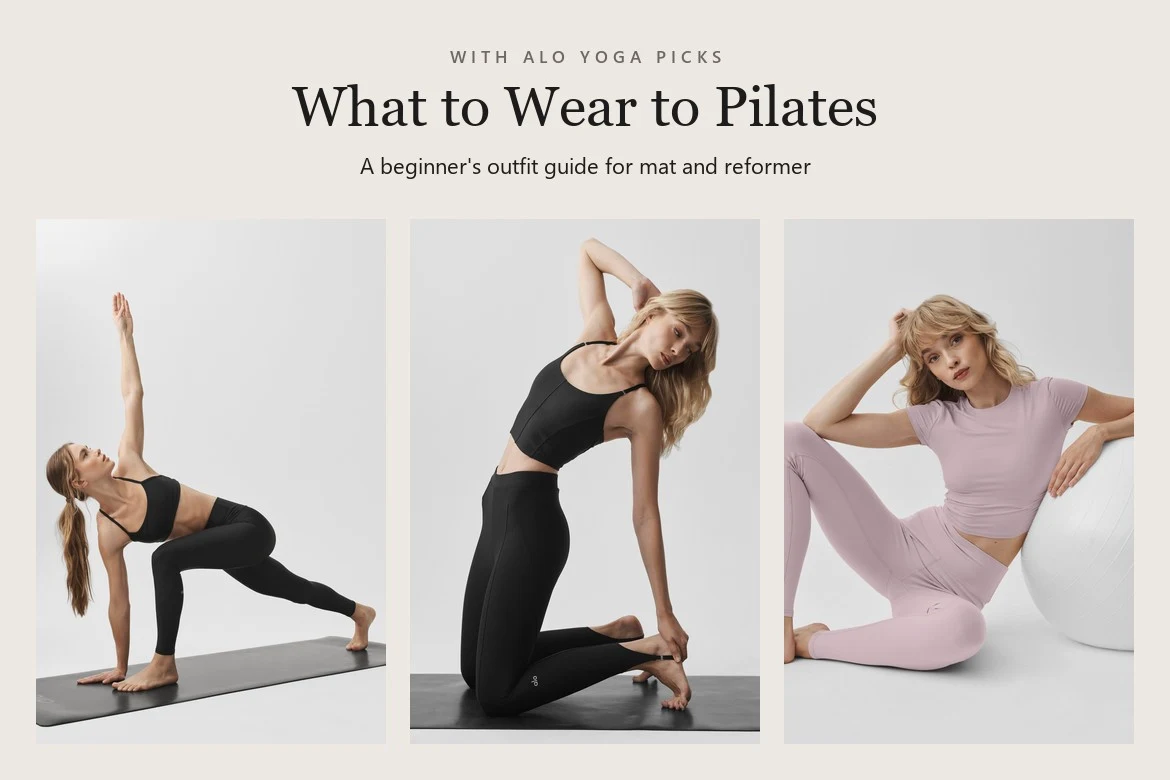
Quick answer: Wear fitted, stretchy clothes to Pilates: high-waisted leggings or bike shorts, a fitted tank or tee, and a low-to-medium-support sports bra. Skip zippers, buttons, loose layers, and jewelry. Reformer studios usually require grip socks, while mat classes are often barefoot.
You’ve booked your first class, the confirmation email is sitting in your inbox, and now you’re staring at your drawer wondering what everyone else will be wearing. If you’re figuring out what to wear to Pilates, the answer is simpler than the studio photos make it look: fitted, stretchy activewear that moves with you, plus a pair of grip socks for reformer classes.
Fitted clothes are the key here because your instructor needs to see your hips, spine, and knees to cue your alignment, and loose fabric can catch on reformer springs and straps. Everything else (color, matching sets, that cute cropped tank) is a bonus.
If you already know how to choose the right yoga outfit, you’re most of the way there, though Pilates, and reformer classes especially, has a few extra rules. This guide walks you through each piece, mat vs reformer, what to skip, and outfit ideas you’ll actually want to wear.
What to Wear to Pilates as a Beginner?
As a beginner, wear fitted, breathable, stretchy clothes with no zippers, buttons, or hardware, and bring grip socks if you’re taking a reformer class.
Fit does a lot of work in Pilates. You’ll roll like a ball, lie on your back with your legs in the air, and sometimes go upside down, so anything baggy slides toward your face or bunches under your back. Fitted pieces stay in place and let your instructor spot when your pelvis tips or your knees drift.
| Item | What to choose | Why it helps | Skip |
|---|---|---|---|
| Bottoms | High-waisted leggings or bike shorts | Stay put when you roll and lift your legs | Loose running shorts, skirts |
| Top | Fitted tank, tee or long-sleeve | Doesn’t ride up when you’re upside down | Baggy tees, open-back tops with knots |
| Sports bra | Low to medium support, flat straps | Comfortable lying on your back | Back clasps, thick padding at the spine |
| Feet | Grip socks (reformer) or bare feet (many mat classes) | Stability and hygiene | Outdoor shoes, regular socks |
| Hair | Low bun, braid or low ponytail | Lies flat on the mat or headrest | High buns, claw clips |
| Extras | Water bottle, small towel, hair tie | Keeps you comfortable | Jewelry, strong perfume |
Fabric-wise, look for soft, stretchy activewear that wicks sweat. A good rule: if you can do a deep squat in front of a mirror and nothing slides, pulls open, or turns see-through, it’s ready for class.
What Tops, Sports Bras and Bottoms Work Best for Pilates?
The best Pilates outfit is a fitted top, a comfortable low-to-medium-support bra, and high-waisted bottoms that stay in place when you bend, roll, and stretch. Here’s how to choose each piece.
Fitted Tanks and Tees That Stay Put
Pick a top that hugs your body enough to stay in place when you’re inverted. Fitted tanks, racerbacks and slim tees all work, and a cropped top that meets high-waisted leggings is a popular choice because there’s no extra fabric to tuck in.
Moisture-wicking fabric keeps you comfortable once you warm up. If the studio is chilly, owners in r/pilates say they wear a sports bra with a fitted long-sleeve top on top, then peel it off once class gets going.
Quick check: Raise your arms overhead and fold forward. If the top slides past your ribs, choose something more fitted.
Do You Need to Wear a Bra for Pilates?
Most women wear a sports bra, and low to medium support is usually plenty because Pilates involves very little bouncing. The details count more than the support level: you’ll spend a lot of time lying on your back, so choose flat straps and avoid back clasps, chunky knots, or thick padding along your spine.
Tanks with a built-in shelf bra are a comfy option if you have a smaller bust. If you prefer more support, a medium-support bra with a smooth, flat back works well for most classes.
Leggings, Bike Shorts and What to Wear Instead of Leggings
High-waisted leggings are the most popular Pilates bottom because they stay put through rolls and leg circles. Before your first class, do the bend test: squat in front of a mirror in good light. If you can see your underwear or skin through the fabric, save those leggings for errands. Many women love Alo leggings for this, but any squat-proof pair from your drawer works.
Bike shorts are great for warm studios and hot classes. Choose a length that won’t ride up when you lift your legs.
What to wear instead of leggings:
- Unitard or bodysuit: Smooth, fitted, and nothing to adjust.
- Capris or 7/8 leggings: Lighter on the legs.
- Fitted ankle joggers: Tapered, with a snug cuff.
- Lined fitted shorts: Best for men or anyone who prefers shorts.
If leggings make you self-conscious, you’re not alone. A first-timer on r/pilates asked about non-legging options, and an instructor replied that teachers are there to see your form and help you move well. Any fitted bottom you feel good in is the right choice.
Do You Go Barefoot to Pilates or Wear Grip Socks?
It depends on the class: many mat classes are done barefoot, while most reformer studios ask you to wear grip socks.
Why grip socks? Grip socks have rubber treads on the soles that stop your feet from slipping on the reformer’s footbar and moving carriage. Club Pilates, for example, requires them for every class, because they keep your feet stable and help keep shared equipment hygienic.
Mat classes: Many studios let you go barefoot, and some still prefer grip socks for hygiene. Check the studio’s booking page or ask at the front desk.
What to look for in grip socks:
- Grippy treads across the whole sole: Not just at the heel or toe.
- Snug fit: Loose socks twist on your foot.
- Style: Full socks give more warmth; toeless or open-top styles suit warm studios.
- A spare pair: Keep one in your gym bag so you never get caught out.
Forgot yours? Most studios sell grip socks at the front desk. Leave outdoor shoes at the door either way, since sneakers aren’t worn on the mat or reformer.
Caring for grip socks: Wash them inside out on a cool cycle and let them air-dry, since high dryer heat can wear down the rubber treads over time. Once the dots start peeling or flattening, it’s time for a new pair, because worn treads lose their grip on the footbar.
What to Wear to Reformer Pilates vs Mat Pilates
For reformer Pilates, wear fully fitted clothes with no hardware plus grip socks; for mat Pilates, fitted clothes still work best, but you’ll often go barefoot and can be a little more relaxed with layers.
The reformer is a sliding carriage with springs, ropes, and straps. Loose fabric, drawstrings and zippers can catch, scratch the upholstery or press into you when you lie down, so a streamlined outfit keeps you comfortable and safe as well as looking neat.
| Reformer Pilates | Mat Pilates | |
|---|---|---|
| Fit | Fully fitted, nothing loose | Fitted, a little more relaxed is fine |
| Footwear | Grip socks (usually required) | Often barefoot; some studios prefer grip socks |
| Hair | Low bun or braid, flat against the headrest | Low bun or ponytail, flat on the mat |
| Layers | Remove before the reformer work starts | A light layer for the warm-up is fine |
| Avoid | Zippers, buttons, drawstrings, loose shorts | Baggy tees that slide over your face |
Shorts or leggings for reformer? Either works as long as they’re fitted. Leggings protect your skin from the straps and carriage, while bike shorts keep you cool. Loose running shorts are the one to skip, since they can ride up during footwork and leg circles in the straps.
What Not to Wear to Pilates
Skip anything with hardware, anything loose, and anything that could catch, poke, or slide during class.
- Zippers, buttons, and metal details: They press into your back and can scratch equipment.
- Back knots and big straps: Lying on a twisted strap for an hour is no fun.
- Baggy tops: They fall toward your face when you’re upside down.
- Loose shorts and skirts: They ride up during leg work.
- Sheer leggings: Do the bend test at home first.
- Jewelry: Rings, bracelets, and dangly earrings can catch on straps or scratch the equipment.
- High ponytails and claw clips: They dig into the mat or headrest when you lie down.
- A jacket tied around your waist: Members in r/ClubPilates say it gets in the way fast on the reformer.
- Strong perfume: Studios are small, and classes are close together.
- Outdoor shoes: They stay by the door.
Is There a Dress Code for Pilates?
There’s no formal Pilates dress code, but most studios have a few house rules, mainly grip socks for reformer classes and no outdoor shoes on the equipment.
Beyond that, wear what makes you comfortable and lets you move. You’ll see everything from matching sets to an old tee and leggings, and nobody is checking labels. Before your first class, read the studio’s FAQ or new-client email for any specific rules, such as grip socks, towels, or arrival time.
Many studios ask beginners to arrive 10 to 15 minutes early so the instructor can set up your reformer, explain the springs, and ask about any injuries. Arriving dressed and ready, with your socks on, makes that check-in quick.
A few unwritten rules help, too. Wipe down your reformer or mat at the end if the studio asks, put springs and straps back where you found them, and keep your phone on silent in your bag. Instructors notice the new client who arrives ready and tidies up after far more than whatever she’s wearing.
Cute Pilates Outfit Ideas for the Studio and Beyond
The cutest Pilates outfits pair a fitted base with one fun detail, like a color, a cropped top, or a cozy layer for after class. Here are five easy formulas, no shopping list needed.
| Outfit | Pieces | Colors | Best for |
|---|---|---|---|
| All-black set | High-waisted leggings, cropped tank, black grip socks | Black on black | First classes; it’s easy and flattering |
| Ballet-inspired | Wrap-style fitted top (no back knot), leggings, a soft knit shrug for after | Blush, cream, soft pink | Mat classes and a feminine look |
| Bike shorts and long sleeves | Bike shorts, fitted long-sleeve top, grip socks | Earth tones like olive and mocha | Warm studios and spring classes |
| Unitard and oversized sweatshirt | Unitard for class, oversized sweatshirt on top before and after | Neutral unitard, bold sweatshirt | Reformer classes with a coffee after |
| Neutral matching set | Matching leggings and sports bra, light zip jacket to wear home | Oatmeal, stone, sage | Pilates-to-brunch days |
Color tip: Light neutrals look fresh but can turn sheer, so give them the bend test. If you know your color season, pick tops in your best shades, since your top is what’s closest to your face in the mirror.
What Should Men and Plus-Size Beginners Wear to Pilates?
Everyone follows the same basics: fitted, stretchy clothes that let the instructor see your form, plus grip socks for reformer classes. A few tweaks make the outfit more comfortable.
Pilates Clothes for Men
Men usually wear a fitted tee or tank, lined fitted shorts or tapered joggers, and grip socks. Choose shorts with a built-in liner so nothing rides up during leg work, or wear compression shorts under looser ones. A r/pilates thread on a cheap first-class outfit for men lands on the same answer: a fitted gym tee, lined shorts, and grip socks are all you need to start.
Pilates Outfits for Plus-Size Bodies
Comfort comes first. High-rise, squat-proof leggings with a wide waistband stay in place and don’t roll down when you bend. A supportive sports bra with wide, flat straps feels better when you lie on your back, and a longer fitted top gives coverage without loose fabric. Capris, fitted joggers, or a unitard are great options if you’d rather not wear full-length leggings. Wear whatever helps you feel confident enough to focus on the movement.
If you’re between sizes, size for comfort at the waist: a waistband that digs in will bother you more on your back than one that’s slightly roomy. And let your instructor know if you’d like modifications; they can adjust straps, springs, and positions so every exercise works for your body.
What Should You Take to Your First Pilates Class?
Bring grip socks, a water bottle, a small towel, a hair tie, and a light layer; most studios provide mats and all the equipment.
- Grip socks: Required at most reformer studios.
- Water bottle: Reformer classes get warmer than they look.
- Small towel: Handy for your hands and face.
- Hair tie: For a low bun or braid.
- Light layer: For the walk in and out.
- A small bag: Most studios have cubbies for your phone and keys, so the space around the reformer stays clear.
You usually don’t need your own mat; most studios provide them, though some mat-only classes ask you to bring one. Check the class description when you book.
Pack the night before: Put your grip socks in your bag as soon as you book, lay out your outfit, and fill your water bottle. Then all you need to do on the day is arrive 10 to 15 minutes early, introduce yourself to the instructor, and let them know it’s your first class.
Final Thoughts
Fitted, stretchy, and simple is the whole formula. Choose high-waisted leggings or bike shorts, a fitted top, a comfortable sports bra and grip socks for reformer, and leave the zippers, jewelry and baggy layers at home.
Every studio has its own house rules, so check the booking page before your first class. If you’re curious about where it all started, the Pilates method was developed by Joseph Pilates in the early 20th century, and the outfit rules all come back to the same idea: clothes that let you move freely and let your instructor see your form.
Frequently Asked Questions (FAQs)
Q1: What is the 10/20/30 rule in Pilates?
A: It’s a saying often credited to Joseph Pilates: “In 10 sessions you’ll feel the difference, in 20 you’ll see the difference, and in 30 you’ll have a whole new body.” It’s a motivational line about showing up consistently, and no study backs the exact numbers.
Q2: How difficult is Pilates for a beginner?
A: Beginner classes are designed to be approachable. Mat classes are an easy place to start, while reformer classes have a short learning curve with the springs and straps. Tell your instructor about any injuries, and check with your doctor if you have health concerns.
Q3: Can I wear yoga clothes to Pilates?
A: Yes, as long as they’re fitted. Leggings, tanks, and sports bras from yoga work perfectly. Skip loose, flowy pieces like wide yoga pants or long open tops, since they get in the way when you roll or lift your legs.
Q4: Is it better to wear shorts or leggings to reformer Pilates?
A: Either works if they’re fitted. Leggings protect your skin from the straps and carriage, and bike shorts keep you cool. Avoid loose running shorts, which can ride up during footwork and leg work in the straps.
Q5: What do you wear to hot Pilates?
A: Choose lightweight, moisture-wicking, fitted pieces. Bike shorts with a sports bra or a cropped tank are popular choices. Bring a towel and a full water bottle, and wear grip socks if the class uses a reformer.
Q6: Should I wear my hair up for Pilates?
A: Yes, but keep it low. A low bun, braid, or low ponytail lies flat when you’re on your back. High buns and claw clips press into the mat or headrest and get uncomfortable fast.
Q7: Do I need to buy special Pilates clothes?
A: No. Any fitted activewear you already own works. The only Pilates-specific item is grip socks for reformer studios. If you’d like new basics on a budget, Fabletics is a common pick for affordable leggings and matching sets.