Quick reference if you’re mid-scroll: side sleepers do best with a full-length or U-shaped pillow, the piece between your knees matters more than the piece under your bump, and the day to buy one is the day sleep first starts feeling like work.
Short answer on how to use a pregnancy pillow: don’t just put it next to you; build it around the three places pregnancy hurts. Slide the lower end between your knees so your top leg stops pulling your hip out of line, rest your bump against the length of it, and keep something behind your back so you don’t roll flat. Get those three points right, and a big awkward pillow crease turns into a full night of sleep. Get them wrong and it ends up on the floor by week two.
That’s the part most guides skip. They tell you a pregnancy pillow “provides support and comfort” and leave you to figure out the rest at 3 a.m. This one walks through exactly how to use a pregnancy pillow for each shape, when to start, how to pick the one that fits your bed and your sleep, and the small mistakes that make people give up on a pillow that would have worked.
Why sleep falls apart in pregnancy
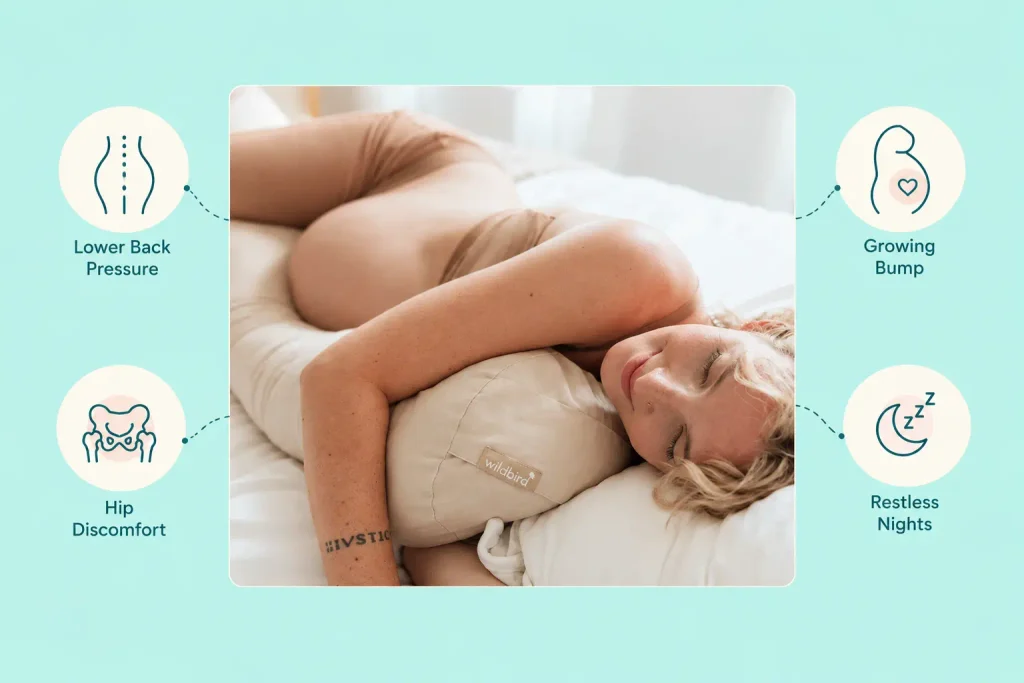
Your body reshapes itself fast. The bump grows, your center of gravity moves forward, the hormone relaxin loosens your hips and pelvis for birth, and your blood volume climbs. All of that pressure lands on the same few spots: your lower back, your hips, and whichever side you’re lying on. By the second trimester most doctors recommend sleeping on your side to keep blood flowing well to you and the baby, which rules out the back and stomach positions most people default to.
Holding a side position for a whole night is harder than it sounds. Your top leg drags your pelvis forward and twists your lower spine. Your bump has nothing to rest on. Your bottom shoulder goes numb. A maternity pillow fills those gaps so your spine stays in a neutral line and you stop waking up to readjust every twenty minutes. That is the real value of one, and it is why how to use a pregnancy pillow matters as much as which one you own. It isn’t luxury padding; it’s what protects the small amount of good sleep still available to you.
When should you start using one?
There’s no fixed week. Watch your body, not the calendar.
Some people want a pillow in the first trimester, before there’s much of a bump, because early pregnancy brings its own aches and a lot of restlessness. Most reach for one around week 20, when the belly gets heavy enough to strain the back and hips and side sleeping becomes the standing advice. If you already live with back or hip problems, starting earlier saves you weeks of rough nights.
The practical rule: the day sleep starts feeling like effort, get the pillow. Waiting to learn how to use a pregnancy pillow until you’re wrecked at 32 weeks only costs you a month of rest you didn’t have to lose. If the pain is sharp or one-sided rather than a general ache, that’s a conversation for your doctor, not something to cushion away.
The types of pregnancy pillow, and which fits your sleep
There are four common shapes. The right one comes down to how you sleep, how much bed you’re willing to surrender, and whether a partner also needs to fit.
| Type | Shape | Best for | The trade-off |
| Full-length body pillow | Long and straight | Side sleepers who like to hug and tuck, and who move around at night | Supports one side at a time, so you bring it with you when you turn |
| U-shaped pillow | A U that wraps front and back | Head-to-toe support without moving the pillow when you roll over | Takes up a lot of bed, awkward if you share |
| C-shaped pillow | A C that curves around one side | Back and bump support at once, with more room left in bed than a U | You reposition it when you switch sides |
| Wedge pillow | A small triangle | Targeted support under the bump or behind the back, and travel | Won’t support your whole body on its own |
For committed side sleepers, a full-length pillow is the one most people get along with long-term. It runs the length of your body, slides between the knees, and you can hug the top and drape a leg over it. When you flip over, you pull it with you instead of climbing over a giant U, and it doesn’t crowd a partner off the mattress or become impossible to store later.
A U-shape is the move if you want to be cradled front and back and don’t want to think about the pillow at all when you roll. Just measure your bed first, because they’re big. A C-shape splits the difference. A wedge is less a main pillow than a useful add-on for targeted support or a suitcase.
How to choose one you won’t regret
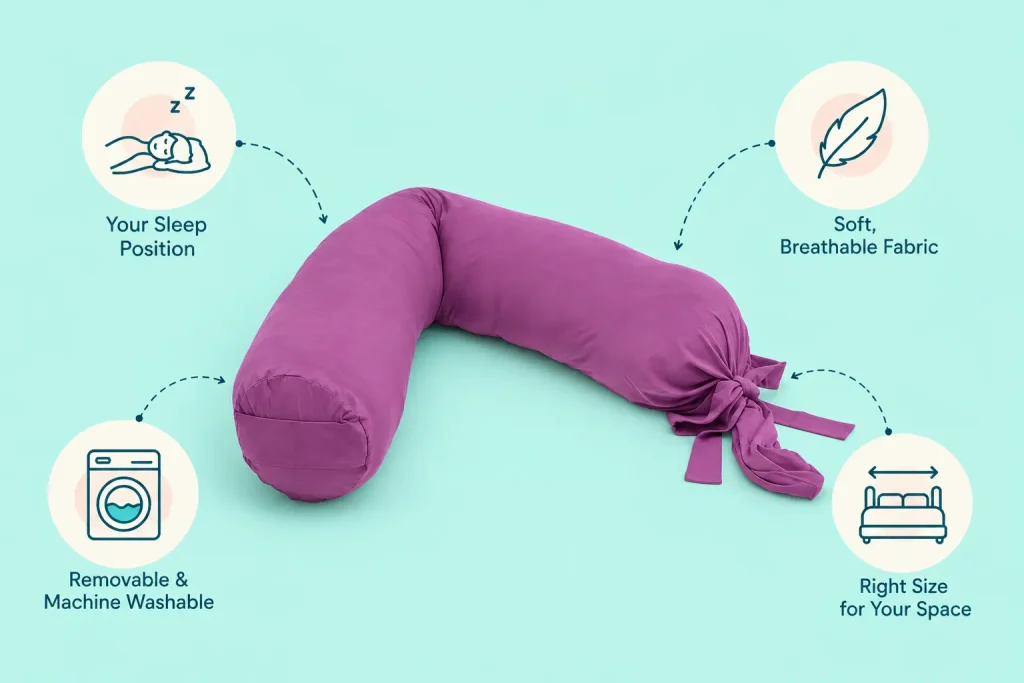
Shape is the headline decision. Four smaller ones decide whether you still like the pillow three months in.
Your sleep position comes first. If you’re a side sleeper, and by the second trimester most pregnant people are, you want a pillow that cradles the belly, back, and knees and helps you hold that position instead of drifting onto your back. If you know you thrash around, pick a shape you can drag with you rather than one you have to climb out of.
Then the fabric against your skin. Pregnancy runs hot, and a lot of budget pillows come wrapped in a stuffy cover that traps heat and leaves you damp by the small hours. Look for something breathable that moves air and feels soft, since skin gets more sensitive during pregnancy.
Check that the cover comes off and the machine washes. This sounds minor until you’re deep into pregnancy, sweating through the night, and realize the thing you sleep on every night can’t be cleaned. A zip-off, washable cover isn’t a quiet luxury feature. It’s the line between a hygienic pillow and one you quietly start to resent.
Weigh size against your bed and budget last. A giant U gives wraparound support but can push a partner to the edge. A full-length straight pillow gives consistent support for less bulk, less money, and easier storage. If you’re buying one pillow to carry you through pregnancy and into nursing, the straight, full-length shapes usually give you the most use for the money.
One brand worth looking at on this front is WildBird, which took the deliberately simple route: a single full-length pillow rather than a wall of shapes. Here’s the information you’d actually want before buying, laid out plainly.
WildBird pregnancy pillow at a glance
- Type: full-length body pillow (one size)
- Dimensions: 59 inches long by 8.46 inches wide
- Price: $88
- Cover: removable and machine washable, sold separately for around $48
- Cover fabrics: linen-cotton blend or a softer knit they call CloudBlend
- Doubles as a nursing and postpartum support pillow after birth
The single-pillow approach means you’re not paying for a shape that eats half the mattress, and because the covers are replaceable, you can swap a fresh one on instead of buying a new pillow when it needs a wash. That crossover into nursing is the part that tends to justify the price, which we’ll come back to.
How to Use a Pregnancy Pillow: The Correct Setup for Each Shape
Owning the pillow is step one. Setting it up so it holds your spine in line is where the sleep actually improves, and it changes by shape.
Full-length pillow Lie on your side and run the pillow down the front of your body. Slide the lower end between your knees so your top knee isn’t dragging your hip forward, which is the single change that takes the most strain off your lower back. Hug the upper half with your arm and let your bump rest against it. When you flip sides, bring the pillow with you and set it up again. Most side sleepers settle into this within a night or two.
U-shaped pillow: Sit yourself inside the curve so both arms of the U run down either side of you. Rest your bump on the front curve, slide one arm of the U between your knees, and lean your back against the other arm, with your head on the top of the U. You’re supported front and back at once, so rolling over doesn’t mean rebuilding the whole nest.
C-shaped pillow Put the curve of the C against your back for support, bring the bottom up between your knees, and rest your head on the top. Or turn it around and hug the C to support your bump instead. It’s the most flexible of the larger shapes.
Wedge pillow: Tuck it under your bump while you’re on your side to take the weight off, or slip it behind your back so you don’t roll flat in the night. It also works under your regular pillow for a little extra head lift if heartburn is keeping you awake.
Small things that make or break it
A few practical notes on how to use a pregnancy pillow that decide whether you love it or abandon it:
Support your head and neck at the right height. If the pillow tilts your neck up at an angle, you’ll wake stiff and blame the pregnancy. Adjust it.
Manage the heat. A big pillow wrapped around you holds warmth, and you’re already running hot. If you’re sweating, pull part of it away or reposition. A breathable, washable cover earns its place here.
Wash the cover often. You will sweat on it, and a cover you can unzip and throw in the machine keeps the whole thing fresh through months of nightly use.
Adjust as you grow. What works at 20 weeks won’t feel the same at 34. Move the pillow, change the angle, and add a wedge. The setup is meant to shift with your body.
Don’t retire it the day the baby arrives. A long body pillow earns its keep in the early feeding weeks, propping the baby to the right height so you’re not hunched over with a numb arm at 3 a.m. This is the reason a straight, full-length pillow tends to be the smarter long-term buy than a large U you’ll pack away once the bump is gone.
From a physiotherapy perspective
Nimble Journal publishes this kind of guidance with a named, credentialed contributor. The expertise below is accurate to write from; the first-person observations in brackets should be filled in by the actual contributor rather than invented, in line with our first-hand-experience standard.
There’s a useful way to think about how to use a pregnancy pillow that changes how you position it: treat it as a spinal alignment tool, not a comfort accessory. When you place it wherever feels nice in the moment, you tend to prop the bump and ignore everything else, then wonder why your back still aches. When you position it for alignment, you get a firm section between the knees so the top leg can’t rotate the pelvis, and you keep the hips and shoulders stacked. The bump support is for comfort. The knee support is what protects your spine, and it’s the piece people underuse most.
The other point worth making is about value over time. Once the baby comes, most people stop needing the bump support but keep the pillow for nursing, because getting the baby up to feeding height is far easier with a long pillow already on the bed. If you’re weighing whether a maternity pillow is worth the cost, think of it as a purchase that spans pregnancy and the newborn months, not nine months alone. The full-length shapes cross over best.
A caution that always belongs in this kind of piece: a pillow manages ordinary aches. Sharp or one-sided pain, numbness, or pain that wakes you and won’t settle when you reposition is a reason to call your doctor or a physiotherapist, not something to pad over.
The Takeaway
A maternity pillow only works if you use it as support, not decoration. That’s really the whole of how to use a pregnancy pillow well: get a length between your knees, something under the bump, and something behind your back, then keep adjusting as your body changes week to week. Start when sleep first gets hard rather than waiting until you’re desperate. If you’re choosing between shapes, a full-length body pillow is the one most side sleepers keep reaching for; it holds up after the baby comes, and it doesn’t cost you your side of the bed. Sleep is scarce for a while. A pillow set up properly buys some of it back.
Frequently asked questions
Q. How early can I start using a pregnancy pillow?
Ans. As soon as sleep starts, it feels uncomfortable. Some begin in the first trimester; most want the support around week 20, when side sleeping becomes the recommendation and the bump gets heavy. There’s no wrong time if it helps you rest.
Q. What shape is best?
Ans. It depends on how you sleep. Full-length straight pillows suit side sleepers who move around and don’t want to lose half the bed. U-shapes give front-and-back support at once but are large. C-shapes sit in between. Wedges are for targeted support or travel.
Q. When should I stop sleeping on my back?
Ans. Usually around week 20, into the second trimester. As the baby grows, lying flat on your back can press on major blood vessels and reduce circulation, sometimes causing dizziness. Side sleeping, especially the left side, is generally advised. A pillow behind your back helps you hold the position without thinking about it. Confirm the timing with your doctor.
Q. Are pregnancy pillows safe?
Ans. Yes, used sensibly. They’re built to support your body and keep you in a healthy sleep position. If a setup feels like it’s straining something, adjust it or switch shapes, and raise any real concerns with your doctor.
Q. Does the pillow still work after the baby arrives?
Ans. A good full-length one does. Many parents keep using theirs for nursing support and postpartum recovery, which is part of why the simpler straight shapes are the better long-term buy.
Q. How do I keep it clean?
Ans. Choose one with a removable, machine-washable cover and wash it regularly, because you will sweat on it. Being able to swap covers rather than replace the whole pillow makes the upkeep painless.