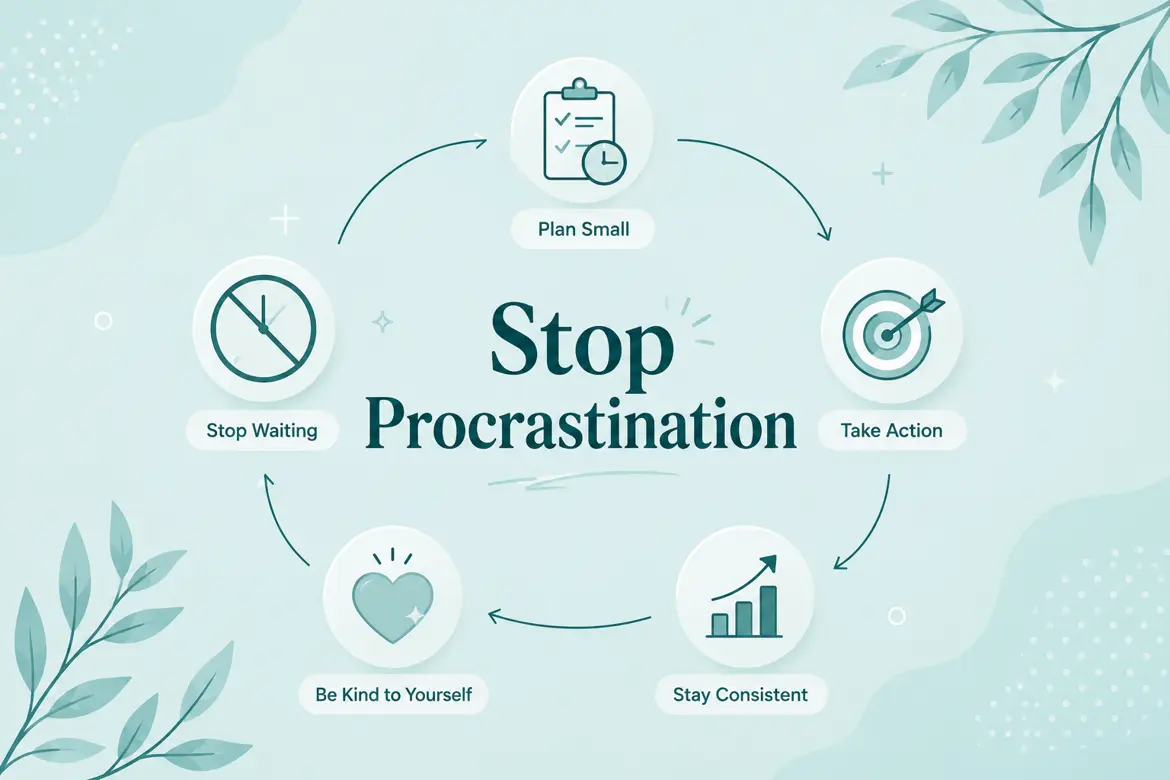
You know the feeling. A deadline sits three days out, and instead of working on it, you’re reorganizing your desk drawer or watching a stranger review kitchen knives.
Nobody plans to procrastinate. Yet it shows up on exactly the days you can least afford it, quietly stealing the hours you meant to spend on something else.
Most people respond by blaming their systems: a better planner, a new to-do app, or an earlier alarm. But procrastination isn’t really a scheduling problem. It’s an emotional one. A task feels too big, too boring, or too likely to fail, and your brain reaches for something easier instead.
The good news: this pattern isn’t permanent. Your brain adapts faster than you’d think, and small shifts in how you approach a task can break the cycle. This article covers what procrastination actually is, why people do it, and practical tips to stop procrastinating for good, at work, at home, and even in helping a child who’s stuck in the same habit.
Quick reference: the 10 tips at a glance
| Sno. | Tip | Core Idea |
| 1 | Stop waiting to feel motivated | Action creates motivation, not the reverse |
| 2 | Shrink the task | Make it too small to refuse |
| 3 | Aim for progress, not perfection | A rough draft beats no draft |
| 4 | Remove temptation | Design your environment; don’t fight willpower |
| 5 | Use the 5-4-3-2-1 rule | Interrupt hesitation with a countdown |
| 6 | Schedule instead of listing | Give the task a fixed time slot |
| 7 | Reward yourself immediately | Close the gap between effort and payoff |
| 8 | Learn your triggers | Match the fix to the actual cause |
| 9 | Practice self-compassion | Shame fuels avoidance; kindness doesn’t |
| 10 | Build a starter identity | Become someone who starts, by repetition |
What Is Procrastination?
Procrastination is choosing to delay a task you know you should be doing, even when you know the delay will cost you.
You’re aware of the deadline. You’re aware of the consequences. You do something else anyway, because putting it off buys you a small, immediate sense of relief.
That relief is the whole trap. The bill still needs to be paid. The application still needs to be submitted. The exam still needs studying for. Every hour spent postponing is an hour you don’t get back, and if the task was time-sensitive, an opportunity might close entirely.
So why keep doing it if the cost is so clear? Because the decision isn’t really about the task. It’s about the feeling the task produces:
- Stress
- Boredom
- Self-doubt
Your brain looks for an exit from that feeling, and your phone is usually the nearest one. Five minutes of scrolling turns into an hour before you notice.
There’s also a timing mismatch at play. Behavioral researchers call this present bias: your brain values immediate comfort far more than a future benefit, even when that future benefit is much larger. Skipping the workout today feels like a small, forgivable choice in the moment. Multiply that choice by weeks, and the cost becomes obvious in hindsight.
Not all delay is a problem, though. Here’s the difference:
| Occasional Procrastination | Chronic Procrastination | |
| Frequency | Now and then | Repeated, ongoing pattern |
| Impact | Minor, self-contained | Spills into work, finances, relationships |
| Fix | Usually resolves on its own | Needs a change in habits or support |
Chronic procrastination is rarely solved by trying harder. It’s solved by changing the conditions that make starting feel so difficult in the first place.
10 Practical Tips to Stop Procrastinating
1. Stop Waiting to Feel Motivated
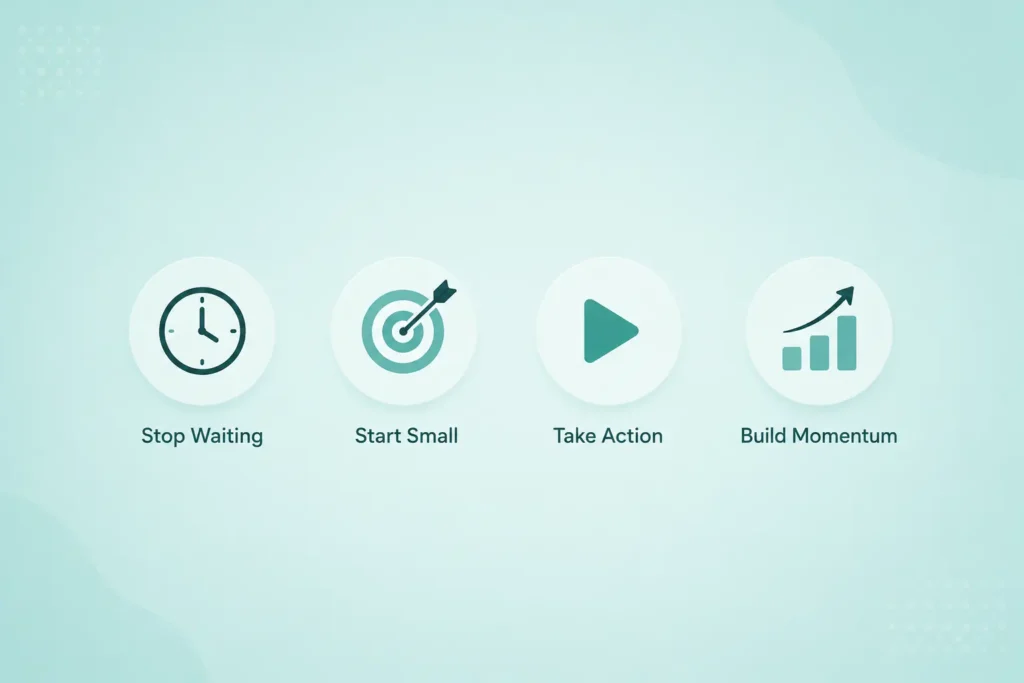
Motivation rarely arrives before you start something. It shows up after, once you’ve built a little momentum.
Think about the last time you dreaded a workout, went anyway, and felt better once you were a few minutes in. Moving is what generated the feeling, not the other way around.
Start first. Let the motivation catch up. If you’re waiting to feel ready before you begin, you’ll end up procrastinating far longer than you’d like.
2. Shrink the Task Until You Can’t Say No
Big tasks trigger avoidance. Small ones don’t.
- “Write the report” feels vague and intimidating
- “Open the document and write one sentence” doesn’t
Break the task down until skipping it takes more effort than doing it:
- “Clean the kitchen” → start with “clear the counter”
- “Study for the exam” → start with “read one page of notes”
Once you’re moving, the task tends to carry you further than the small first step suggested it would.
3. Aim for Progress, Not Perfection
Perfectionism is one of the most common reasons people delay starting at all. If the finished product has to be flawless, starting feels risky.
Permit yourself to produce something rough. A rough draft beats a perfect idea that never left your head.
Nobody sees your first attempt except you, and first attempts exist to be revised. Start messy. Fix it later.
4. Remove the Temptation Before It Removes Your Focus
Willpower is a limited resource. Testing it against your phone all day is a losing bet, especially against a device engineered to be hard to put down.
A few ways to lower the friction in your favor:
- Put your phone in another room
- Close the extra browser tabs
- Use a website blocker during work hours
- Keep your workspace free of anything that competes for attention
For a lot of people, the biggest daily leak is the same one habit: doomscrolling. If that’s your main distraction, it’s worth tackling on its own rather than lumping it in with general willpower advice. A broader digital detox can also help reset the habit if your phone has become the default response to any discomfort, not just procrastination specifically.
Small amounts of physical distance are often enough to break the automatic reach.
5. Try the 5-4-3-2-1 Rule
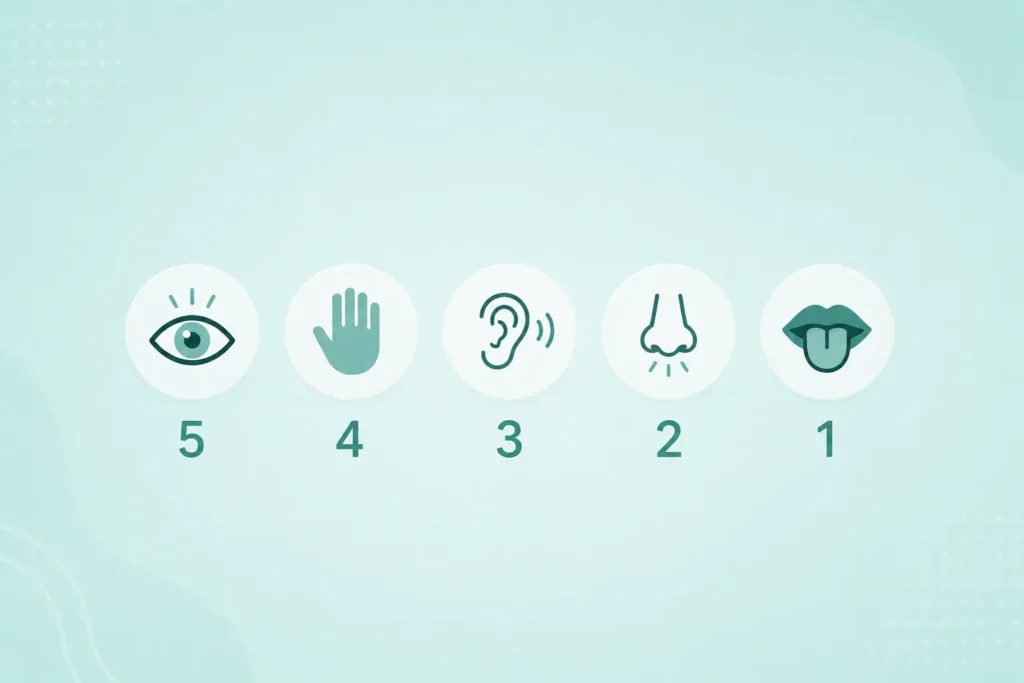
Popularized by Mel Robbins, this technique interrupts the moment of hesitation before your brain talks you out of starting.
Count backward: 5, 4, 3, 2, 1. Move the moment the count hits zero.
Most procrastination happens in a narrow window right before you’d otherwise begin, the moment your brain starts generating reasons to wait five more minutes. The countdown closes that window before your brain has time to talk you out of it.
6. Schedule Your Work Instead of Listing It
A long to-do list can be its own source of dread. Fifteen unfinished items doesn’t motivate most people; it overwhelms them.
Instead of listing everything you need to do, block specific time on your calendar for specific tasks. A scheduled hour on Tuesday from 2 to 3 p.m. feels more doable than an open-ended item sitting at the bottom of a list.
Calendar blocking also removes a decision you’d otherwise make repeatedly all day: when am I going to do this? If the answer is already set, you skip the mental negotiation that usually ends in “later,” which quietly becomes “never.”
7. Reward Yourself Right Away
Many tasks don’t pay off immediately, which makes them easy to avoid. Filing your taxes doesn’t feel good the moment you finish it. Neither does a hard workout.
Close that gap yourself:
- Finish the task
- Follow it with something you actually want: a snack, an episode, ten minutes outside, a call with a friend
Your brain learns to associate the task with the reward, not just the effort. That’s not bribery forever; it’s a bridge until the task itself feels less aversive.
8. Learn Your Own Triggers
Notice the moment you start to stall, and ask what’s actually going on:
- Are you bored?
- Nervous about doing it wrong?
- Not sure where to start?
- Overwhelmed by how many steps are involved?
Naming the trigger makes it easier to address directly. If you always stall on phone calls, the trigger might be fear of an awkward conversation, not the task itself. Once you know your pattern, you can match it to a specific fix.
9. Practice Self-Compassion Instead of Self-Criticism
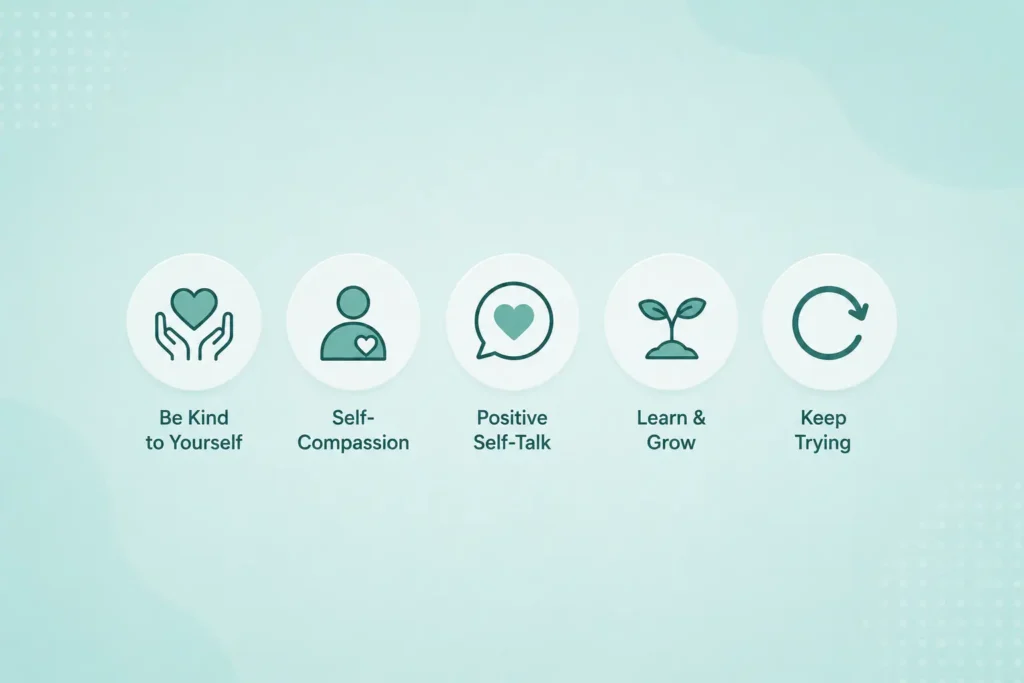
Psychologist Fuschia Sirois has researched the link between self-compassion and procrastination extensively, including in her book published by the American Psychological Association. Her findings: people who treat themselves kindly after a slip-up are less likely to procrastinate again.
That runs counter to how most people try to motivate themselves, usually through guilt. But beating yourself up tends to backfire. It adds shame to the task, which makes you want to avoid it even more next time.
Treat the slip as information, not a character flaw.
10. Build an Identity Around Being Someone Who Starts
James Clear, author of Atomic Habits, argues that lasting change comes from shifting how you see yourself, not just what you’re trying to achieve.
| Outcome-Based Goal | Identity-Based Reframe |
| “I need to finish this project.” | “I’m someone who starts things.” |
| “I need to exercise more.” | “I’m someone who shows up.” |
| “I need to stop procrastinating.” | “I’m someone who follows through.” |
Small, repeated actions reinforce that identity until it becomes true by default. Once it’s true, you no longer need to talk yourself into it every time. You stop thinking of yourself as someone who’s procrastinating and start thinking of yourself as someone who acts. This is the same idea behind main character energy: acting like the person you want to be, on purpose, until it stops feeling like acting.
How Procrastination Shows Up Differently at Work
Procrastination at work often looks less like doing nothing and more like doing the wrong thing very productively.
You clear your inbox. You tidy your files. You sit in on a meeting that could’ve been an email. Meanwhile, the one task that actually matters sits untouched. This is sometimes called “productive procrastination,” and it’s sneaky because it doesn’t feel like avoidance from the inside. It feels like work.
Two fixes that help specifically at work:
- Set your most important task before opening your inbox. If email is the first thing you check, you’re letting other people’s priorities set your schedule before you’ve set your own.
- Ask for clarity up front. Workplace procrastination spikes around unclear expectations. A five-minute conversation about what “good” looks like can save hours of stalling later.
- Batch similar tasks together. Switching between a creative task and an administrative one repeatedly throughout the day adds friction each time you switch. Grouping similar work reduces how often your brain has to reset.
- Protect your highest-focus hours. Most people have a window, often mid-morning, when concentration is naturally higher. Guard that window for the task you’re most likely to avoid, and save routine work for lower-energy stretches of the day.
If work and school responsibilities are both competing for the same hours, our guide on how to balance work and study goes deeper into structuring a week that doesn’t rely on procrastination-fueled cramming.
Procrastination, Anxiety, and Burnout
Procrastination and anxiety frequently feed each other. Avoiding a task provides short-term relief, but the task is still there, closer to its deadline and carrying more weight. That buildup often shows up as a low, constant hum of anxiety.
Left unaddressed, this cycle can tip into burnout, particularly when procrastination becomes chronic across most areas of life rather than around a single dreaded task.
If procrastination is consistently interfering with your work, relationships, or ability to function day to day, that’s worth treating as more than a productivity hiccup. A therapist or counselor can help untangle whether the avoidance is rooted in anxiety, perfectionism, ADHD, depression, or something else, since the right approach depends on the underlying cause. This article offers starting points, not a substitute for that kind of support.
How to Overcome Procrastination and Break the Cycle for Good
No single tip fixes procrastination on its own. What works is picking two or three that fit how you operate and building them into a daily habit.
A few anchors worth building into your routine:
- Plan tomorrow tonight. Spend ten minutes each night deciding what you’ll work on tomorrow, so your brain isn’t negotiating with itself in the morning.
- Favor consistency over intensity. A short, focused session every day adds up to more than an occasional marathon push, and it’s easier to sustain.
- Track small wins. Crossing a task off a list, or simply noticing “I started on time today,” reinforces the behavior you’re trying to build.
If you like the idea of a fixed weekly anchor rather than daily willpower, a Sunday reset routine does a lot of this planning in one sitting instead of every night.
You’re not just completing tasks. You’re teaching your brain that starting doesn’t have to be the ordeal it used to be.
Why Do People Procrastinate? The Neuroscience Behind It
Your brain isn’t malfunctioning when you procrastinate. It’s doing exactly what it’s built to do: avoid discomfort.
Here’s what’s happening beneath the surface:
| Brain Region | Role | What Happens When You Procrastinate |
| Amygdala | Threat detection | Reacts to a hard task as though it’s a danger |
| Prefrontal Cortex | Planning and self-control | Tries to override the threat response and keep you on track |
| Dopamine System | Reward processing | Rewards distractions (phone, TV) instantly, outcompeting the task |
When you’re tired, stressed, or already overwhelmed, the amygdala tends to win, and the prefrontal cortex doesn’t have the resources to argue back effectively. Neuroscience research on procrastination has even found that people who habitually procrastinate tend to have measurable differences in amygdala volume and connectivity compared to those who don’t. This is part of why procrastination gets worse during high-stress periods rather than better; the very system meant to keep you focused is the one running low on fuel. It’s also why willpower alone rarely stops you from procrastinating once stress is already high.
How to Get Out of the Habit of Procrastination
The upside is neuroplasticity: your brain changes based on what you repeat.
- Every time you start instead of avoid, you reinforce that pathway.
- Every time you avoid instead of start, you reinforce the opposite one.
Over time, starting gets easier, not because you’ve become a different person, but because you’ve practiced the behavior enough that your brain stops treating it as a threat. The goal isn’t to fix a permanent flaw. It’s to build enough repetitions in the right direction that the new pattern becomes automatic.
How to Reduce Procrastination in Kids
Homework battles are familiar to almost every parent. You ask your child to start their assignment, and suddenly they need a snack, their room needs cleaning, or their favorite show is on.
It’s tempting to read this as defiance. Usually, it’s the same emotional triggers driving adult procrastination, just with less vocabulary to explain them. If schoolwork itself is the source of the dread rather than just the start, our piece on how to reduce study stress in kids tackles that root cause directly.
| Strategy | Why It Helps |
| Break large assignments into smaller steps | Makes the task feel achievable instead of overwhelming |
| Build a consistent homework routine | Removes the daily decision of when to start |
| Teach basic time estimation | Builds awareness of how long tasks actually take |
| Build regular breaks in. | Matches realistic attention spans for the child’s age |
| Give age-appropriate independence | Prevents dependence on a parent to get started |
| Frame mistakes as part of learning | Reduces fear of getting it wrong |
| Keep expectations realistic | Adjusts pressure to what the child can actually handle |
It also helps to model the behavior you want to see. Kids notice when a parent procrastinates on their own tasks, and they notice even more when a parent handles a difficult one calmly and directly.
The Bottom Line
Procrastination isn’t a personality flaw, and it doesn’t mean you’re lazy. Most of the time, it’s your brain trying to protect you from discomfort, uncertainty, or the fear of failing.
Once you see it that way, the goal changes. You’re not trying to force more willpower. You’re building habits that make starting easier than avoiding, one small decision at a time.
Whether perfectionism, fear of failure, or plain distraction is your biggest obstacle, progress happens gradually. Every task you start today makes the next one a little easier to begin. Everyone will procrastinate sometimes; what matters most is how you respond the moment you catch yourself doing it.
Frequently Asked Questions (FAQ’s)
Q. Am I lazy, or am I procrastinating?
A. They’re not the same thing.
| Laziness | Procrastination | |
| Interest in the task | Genuine disinterest | Wants to complete it |
| Awareness | Doesn’t mind if it’s unfinished | Knows it matters |
| Feeling | Indifference | Guilt or stress |
If you feel guilty about not doing something, that guilt is usually a sign you’re procrastinating rather than being lazy.
Q. What is the 5-4-3-2-1 rule for procrastination?
A. Technique popularized by Mel Robbins. The moment you notice yourself hesitating, count backward: 5, 4, 3, 2, 1, then start the task immediately. The countdown interrupts the overthinking before it takes hold.
Some productivity writers describe recurring patterns:
Q. What are the different types of procrastinators?
- The Perfectionist—delays because the result has to be flawless
- The Dreamer – enjoys planning, struggles to act
- The Worrier – avoids the task out of fear of the outcome
- The Crisis Maker – waits until deadline pressure forces action
- The Overthinker—gets stuck analyzing instead of choosing
- The People Pleaser—prioritizes others’ work over their own
- The Busy Procrastinator – stays occupied with low-priority tasks
These categories aren’t a clinical diagnosis, just a useful way to recognize your own pattern. Most people see themselves in more than one, depending on the task.
Q. Can procrastination ever be a good thing?
A. Occasionally. Some people do their best creative thinking under a bit of time pressure, and a short delay can give a problem room to sit in the back of your mind. The distinction is between a brief, intentional pause and a repeated pattern of avoidance that causes stress or missed opportunities.
Q. Do productivity apps actually help with procrastination?
A. Only if they address the emotional root of the avoidance, not just add another place to track tasks. An app that breaks a project into small steps or blocks distracting sites can genuinely help. An app that just gives you another list to feel guilty about won’t.
Q. How long does it take to stop a procrastination habit?
A. There’s no fixed timeline, since it depends on how long the pattern has been in place and how many areas of life it touches. Small, consistent changes tend to show results within a few weeks. The key marker isn’t a specific number of days; it’s whether starting a task feels a little less effortful than it did last month. If you’re tracking wins as suggested earlier in this article, that record will usually show progress before it feels obvious day to day.