Well, if you’ve spent even five minutes in the wellness corner of the internet lately, you’ve probably noticed one supplement having a serious moment: creatine. Once reserved for bodybuilders and gym bros, it’s now being rebranded and rightly so as a powerful, science-backed supplement for women. Along with how creatine does wonders for you, it has now become an essential.
But here’s the real question:
Does creatine actually support hormonal health in women, or is this just another wellness trend dressed in lab-coated credibility?
Right off the bat, why is there even a question about if Creatine for Women is safe? Well, our bodies might not always react to supplements in the same way. But when it comes to bodybuilding and fitness, the effects are pretty well researched. For both men and women, creatine provides energy; more energy means better results and even better performance. So the effects are pretty straightforward. Now, coming to the main deal, does creatine affect hormones in females? Creatine does not directly affect female hormones; it does not alter their production, nor does it cause an imbalance.
There are a few myths surrounding the use of creatine in women, and this needs a deep dive. Creatine is the most commonly used supplement, from the gym to athletes; it is inevitable. It’s almost well researched with a wide range of students on humans, making it extremely safe.
Let’s break it down, no drama, no fluff, just facts and experiences. A deep dive into Creatine for Women, its benefits, myths, and effects on hormones-
What is creatine?
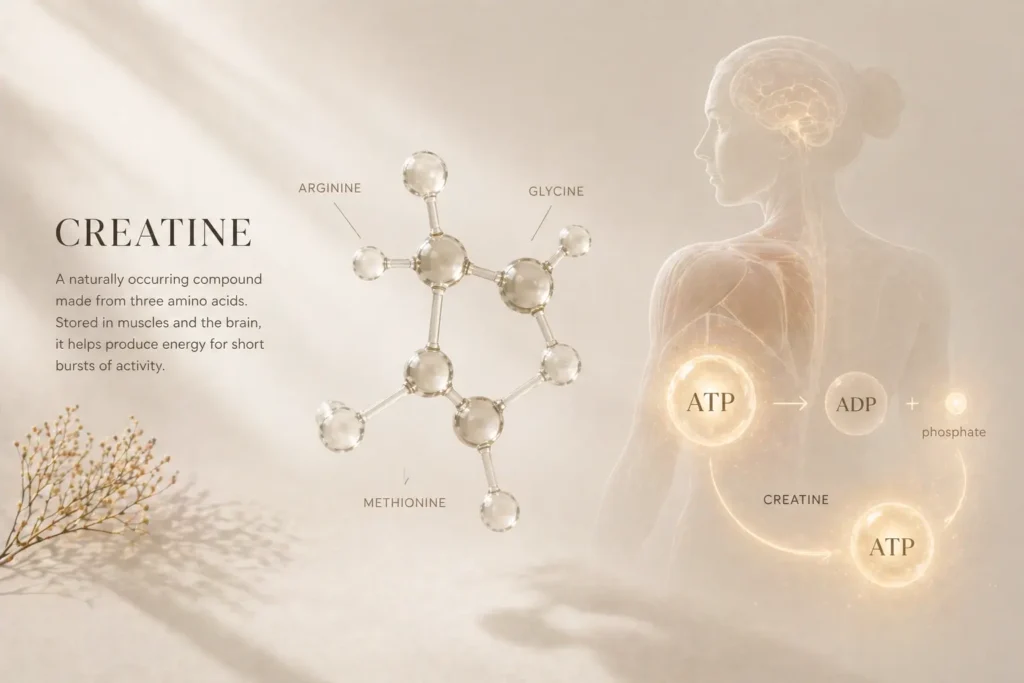
Let’s first get to the basics: What is this creatine anyway? Creatine is not an external supplement; it is what your body produces by itself. It is found in muscles and the brain, where it is stored. Scientifically speaking, it’s made from three amino acids – arginine, glycine, and methionin. This plays a key role in producing ATP, which is adenosine triphosphate, the energy currency your body uses for short bursts of activity. The thing with ATP is that it’s lost quickly, and you need to replenish it to keep fueling your workouts. So creatine does that for you; it’s like a recharge.
- ATP is the premium source of energy
- As energy is lost, ATP becomes ADP, which is a low-level energy source
- Enter creatine, which provides ADP with more power to get back into its premium energy phase
- As ADP loses its phosphate, it takes phosphate from the creatine you consume
How does creatine work?
Alright, let’s put all this into perspective: how, what, and when of creatine. Picture this: you consume creatine, and it enters your body. What happens then?
- You take creatine, and it goes straight to your bloodstream and from there to your muscles, where it is stored.
- You start working out, which is fueled by ATP
- ATP only lasts about 5-20 seconds. What happens after that?
- ATP turns into low-energy ADP
- Creatine steps in and provides the low-level energy with a boost
- Turning it back into ATP
- Your body gets an instant energy boost
Types of creatine
There is not just one thing labelled creatine, but various kinds of it. If you are looking for the best creatine for women, then you must know all the creatine compounds available in the market. Each has its own specifications meant for different goals. There are a bunch of marketing labels that you will find for creatine, but focus on these-
Creatine Monohydrate
This is the gold standard. It is extensively researched for its effects on the body, so you get consistent results. It increases your muscle stores of phosphocreatine effectively for both men and women alike. This is also pretty affordable and easy to find.
Creatine Hydrochloride
It’s the same thing but bound with hydrochloric acid. It’s just formulated in a way that helps with bloating and absorption with a low dosage. It works just as regular creatine, but with its added benefits. There’s not enough research to prove that it is better than Creatine monohydrate.
Creatine benefits for women
What is in creatine that everyone is suddenly obsessing over? Well, apart from proven results, its use has a visible effect, and there is no guesswork about whether it is doing anything or not.
Strength and Lean Muscle Support
Creatine gives you what you desire from working out: natural strength and endurance.
Most women could have less creatine stored in their muscles when compared to men, for obvious reasons, their muscles are usually not as prominent. So creatine compensates for that and provides optimum energy. All this supports lean muscle tone.
Brain Health and Cognitive Function
Here comes the interesting part: since your brain also has some creatine reserves, it could really use that extra power. It might improve your mental clarity, reduce brain fog, and also support memory. For women who need to juggle between so many things, from work to hormones, this could really prove beneficial. Women would love to have that extra energy.
Energy and Fatigue Reduction
Have you been fatigued lately, waking up tired, or just dont have the energy to even get out of bed? Then you should consider creating. It supports cellular energy, which gives you the power to move throughout the day. If you have long, tiring days, creatine can also help greatly with recovery, so you wake up feeling energized the next day. Also, if your body just gives up on you during cycles, then creatine gives you a safety net.
Bone Health Support
We all know how women most commonly suffer from calciuma nd vitamin D3 deficiency that directly affects bone health. Also, with age, your bone density starts to decline. Along with taking multivitamins, you could take creatine, as it may help with overall bone health improvement. It also supports aging-related muscle loss.
Mood and Mental Health
Even though it could be an aftereffect of taking creatine, where if you have high energy, you tend to feel better about yourself. But apart from that, creatine is linked to mood stability, depression support, and reduce stress . It can be used as a supportive tool and not as treatment itself.
Clean creatine for women
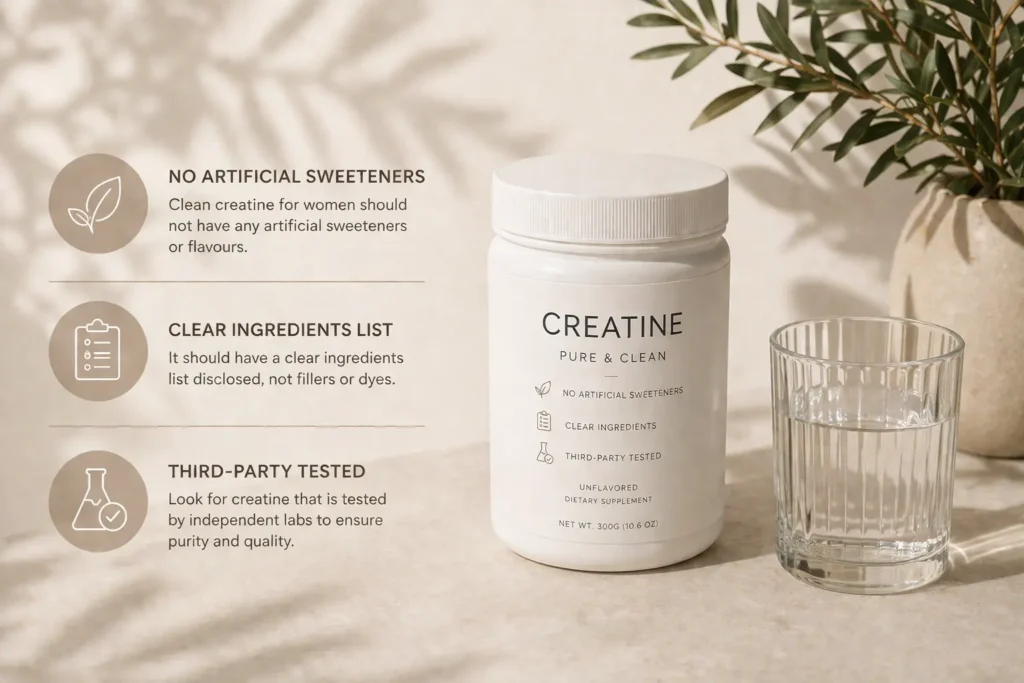
When you talk about having clean creatine, it is not a specific kind; it only means it’s prepared a certain way.
Clean creatine for women should not have any artificial sweeteners. That is a non-negotiable. Read your label; if it says artificial sweeteners or flavour, then that is not clean creatine for women.
It should have a clear ingredients list disclosed, not fillers or dyes.
The most important marker for clean creatine for women is that it is well tested. Yes, the creatine or any supplement for that matter is tested by independent labs, and that is what you also need to check. To see if their claims actually deliver.
How to take creatine for women
Taking reatine for women is not that complicated, but the time you consume it would really matter for performance.
Don’t overcomplicate – How to take creatine for women? Just take 3-5 grams per day.
Take it at the same time every day, and the best time is post-workout.
You can also do a loading, which simply put is taking creatine 20 grams for 5-7 days, but this is not necessary.
You can slowly integrate creatine for women into your diet and see when you need it the most.
Does creatine affect hormones in females?
The most wondered about thing- Does creatine affect hormones in females? When it comes to women taking creatine. Well, the answer is no. Creatine does not directly affect or change your hormones. Creatine is not a hormone supplement. It won’t magically balance estrogen or fix hormonal disorders. Nor is it made for that purpose, but taking creatine indirectly affects your hormones. Creatine is an energy-producing compound, not a hormone-enhancing drug.
It can help reduce stress by providing energy, which makes you feel good. It also aids in better sleep and recovery.
Best creatine for women
Here is a quick list of the Best creatine for women-
- Thorne Creatine
- Cellucor COR-Performance Creatine
- Momentous Creatine Monohydrate Powder
- Optimum Nutrition Micronized Creatine Powder
Busting some creatine myths
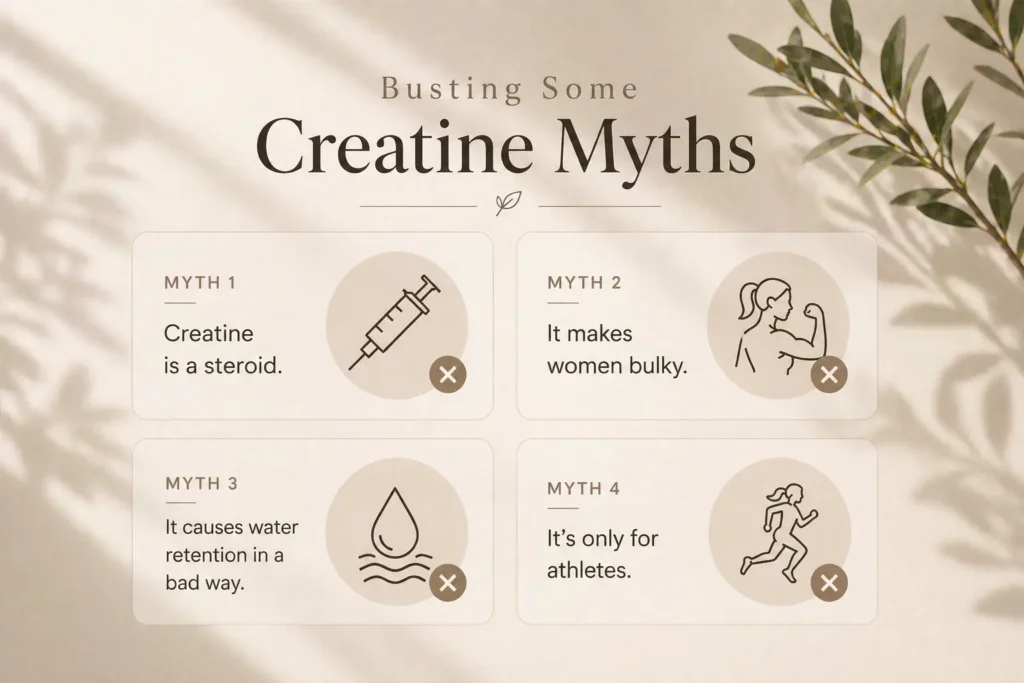
Myth 1: Creatine is a steroid
No. Creatine is not a steroid. It doesn’t alter your endocrine system like anabolic steroids do. It’s closer to something like protein powder – just more specialized.
Myth 2: It makes women bulky
Creatine helps with strength and muscle performance, not instant muscle growth. You won’t “bulk up” unless you’re intentionally training and eating for it.
Myth 3: It causes water retention in a bad way
Yes, creatine pulls water into muscle cells – but that’s actually a good thing. It supports hydration at a cellular level, not bloating in the way most people fear.
Myth 4: It’s only for athletes
Absolutely not. Creatine supports:
Brain function
Energy levels
Recovery
Even mood
Which makes it surprisingly relevant for everyday women – not just gym goers.
Summing up
No matter if you are a girl, a girl or an athlete, or just struggling with energy level while at work, then you should try creatine. Creatine is one of the most safe compound which aids body functions responsible for working out and high-intensity sports like weightlifting. Creatine is not a steroid, as many may have believed it to be that way. It is already present in your body; you can also naturally give your body the creatine it needs with red meat and fish.
FAQs
Q. What happens when females take creatine?
Ans. Women who take creatine report better strength and energy levels. Your muscles may appear prominent and not bulky, contrary to common myths.
Q. Should I take creatine while on GLP-1?
Ans. Technically, yes, you can, but you must be aware of how you are taking it, and taking advice from a medical professional is always recommended.
Q. Why do doctors say no to creatine?
Ans. If you have a kidney-related illness, then the doctor might suggest against creatine. Overall, creatine is perfectly safe to use even long-term.
Disclaimer: This blog is only for informational purposes. It does not intend to sell, advertise, diagnose, or claim health benefits. Always consider a trusted health care practitioner. This blog is based on personal opinion and general research.