Let’s be honest, when was the last time you sat through a meal without glancing at your phone? Or woke up without doom scrolling through notifications before your feet even hit the floor? You’re not alone. We’re living in an era of constant connectivity, and it’s quietly draining us. And that’s where a digital detox comes in, and it might be the reset your mind has been quietly begging for.
What is a Digital Detox? (And Why Everyone’s Talking About It)
The digital detox is actually about something that’s more subtle than it sounds: It is an intentional break from screens, smartphones, social media, tablets, laptops, and even TV. It’s not about throwing your phone into a lake. It’s about reclaiming your time, your attention, and your peace.
The term has gone from a niche wellness buzzword to a mainstream necessity. And that shift makes total sense. It is nearly 7 hours a day that our average adult spends looking at screens. For many of us, the first and last thing we see every day is a glowing rectangle. A digital detox challenges that default, and research shows it pays off.
And if you are burning out in your work life, not getting enough sleep, anxious for no clear reason, or simply need some quiet, a digital detox may be a lifestyle change that’s worth it.
Why Your Brain Needs a Break from Screens
Before we go into the how, let’s turn to the why, because knowing what’s really happening inside your brain makes the whole thing click.
When you get notifications via email, your brain releases a little dopamine. It is satisfying. So you check again. And again. And the cycle trains your brain to crave stimulation all the time, making it harder to concentrate and harder to rest and harder to just be.
What are the consequences of chronic screen overuse?
- Increased anxiety and depression
- Poor sleep quality (blue light suppresses melatonin)
- Shortened attention span
- Reduced empathy and real-world social skills
- Heightened cortisol (stress hormone) levels
- FOMO (fear of missing out)
A proper digital detox breaks this loop. And the benefits start showing up faster than most people expect.
Digital Detox Benefits: What Actually Changes
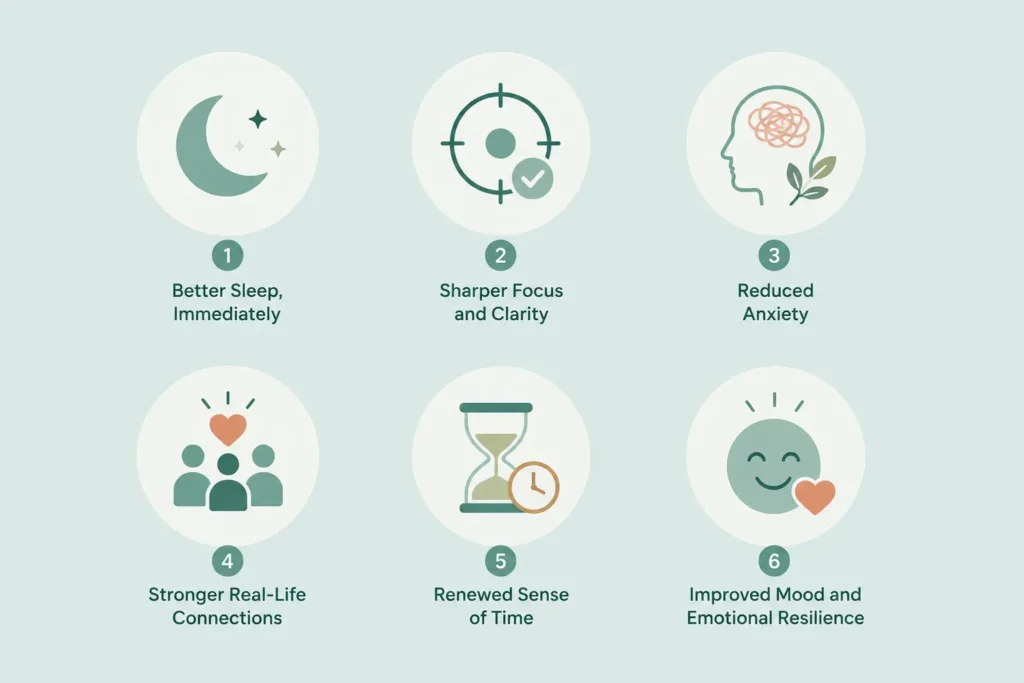
The digital detox benefits people most commonly report are not simply about being “less stressed” but are very specific and compelling.
1. Better Sleep, Immediately
One of the best wins. Even reducing screen time in the hour before bed makes a difference at night. And so much more melatonin is more effective if there is less blue light. More melatonin means a deeper, better sleep quality.
2. Sharper Focus and Clarity
Without continuous notifications fragmenting your thoughts, your brain begins to get back in its natural rhythm again. Deep work gets easier. Creative thinking returns. You start hearing of new ideas.
3. Reduced Anxiety
Social media is a comparison engine. There is no pressure in a digital detox, and a lot of people are surprised by how much their baseline anxiety and mood swings drop once they step away from feeds.
4. Stronger Real-Life Connections
When you are not half-present in every conversation, you actually show up. Eye contact, laughter, and real listening, these all come back when the phone goes away.
5. Renewed Sense of Time
One of the oddest (and most appreciated) benefits: time seems to expand. It seems like hours feel longer; the best possible way.
6. Improved Mood and Emotional Resilience
Less doomscrolling means less passive consumption of stressful news and negative things. If you have changed your emotional baseline, and you know what you are doing.
How to Do a Digital Detox
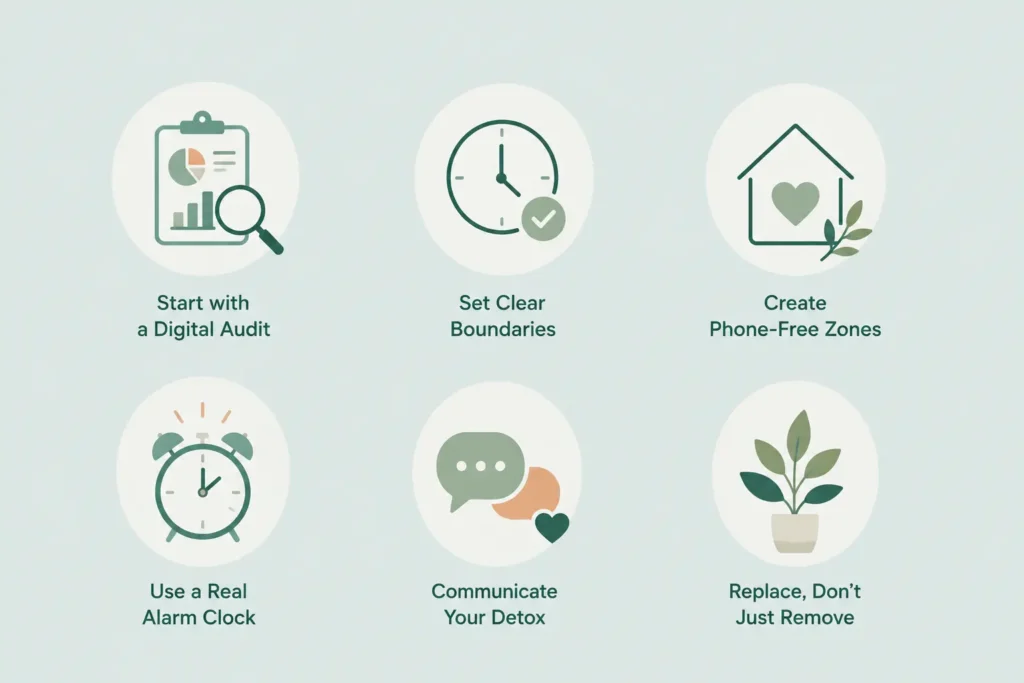
How do you do a digital detox in the real world? If your job or family requires you to be reachable, then, as you know now, it’s possible to do that and still not disappear. You have to be deliberate about it.
Start with a Digital Audit
Before you detox, take stock. Which apps are eating the most time? Instagram? TikTok? Email? Many smartphones indeed have screen time tracking. Look at your weekly report honestly, without judgment.
Set Clear Boundaries
Set a start and end time for screens every day. Many people start with the “no phone after 9 pm” rule. It sounds small. It changes everything.
Create Phone-Free Zones
Bedroom. Dining table. These two are the most significant places to start. When screens aren’t in the room, the temptation goes away.
Use a Real Alarm Clock
This one’s underrated. Your phone is your alarm clock, and that means it is the first thing you touch every morning. A $10 alarm clock breaks that habit overnight.
Communicate Your Detox
Tell your close contacts you’ll be less reachable. Most people are more supportive than you’d expect, and many will admit they’re envious.
Replace, Don’t Just Remove
Boredom is the biggest digital detox problem that most people face, and you have to work your way out of it. Have some idea to fill in the void: a book, a walk, a journal, a hobby. Screens fill a void, and you have to do something else.
Digital Detox Tips for Busy Adults
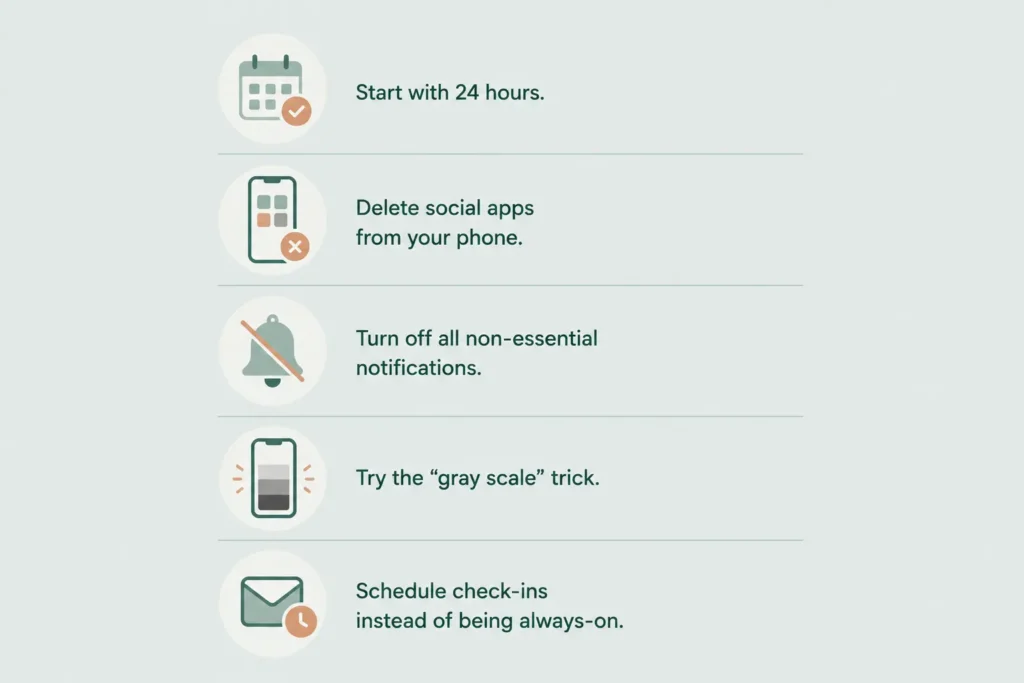
Digital detox tips vary based on your lifestyle, age, and how entrenched your screen habits are. What works across the board:
- Start with 24 hours. A weekend day offline is achievable and eye-opening.
- Delete social apps from your phone (not your account — just the app). The friction alone reduces use dramatically.
- Turn off all non-essential notifications. Only allow calls and texts from specific people.
- Try the “gray scale” trick. Switching your phone display to grayscale makes it visually boring, which reduces the urge to scroll.
- Schedule check-ins instead of being always-on. Check email twice a day, not constantly.
Digital Detox for Adult Women 68 Years and Older
A digital detox for adult women 68 years old looks a bit different, and that’s perfectly fine. For many women in this age group, phones and tablets have become primary social lifelines, especially post-pandemic. The goal is not to cut off the community but to be more intentional about how you connect.
Practical tips for this group include:
- Prioritizing phone calls over social media scrolling for a real connection.
- Setting a “sunset rule” screens off one hour before bed.
- Replace morning news feeds with a physical newspaper or a quiet walk.
- Using a basic phone for calls only on certain days.
Connection matters deeply. A digital detox should support that, not interfere with it.
The Digital Detox Challenge: Can You Try It This Week?
The digital detox challenge that is starting to gain popularity online is simple: Go for 72 hours with minimal screen use. No social media. No binge-watching. Limited email. Just like offline.
People who complete it consistently describe the first day as uncomfortable, the second as oddly peaceful, and the third as transformative.
You don’t have to go for 72 hours right away. Start with an evening. Then a full day. Build from there.
Some people take this further with structured digital detox retreats — actual locations designed for offline living. But the truth is, the most powerful version is often the one you design for yourself, in your own home, with your own rules.
When a Digital Detox Becomes a Lifestyle Shift
The real magic of a digital detox isn’t the break itself; it’s what you learn from it. Most people go back to their devices with a completely different relationship to them. They start getting to know when to interact rather than simply going on with the connection.
That change, from reactive to intentional, is what is so good for mental health over the long term. You stop letting the algorithm determine your mood. You begin to make conscious decisions about what you consume and when.
It’s not anti-tech. It’s pro-human.
Conclusion: Your Screen Can Wait. Your Mind Can’t.
The digital detox is not a trend. It is actually an answer to a real and increasing problem—the erosion of presence, peace, and mental clarity in an always-on world. You may need to go offline for a week or a night, but on the other hand, the benefits of disconnecting are well-documented and life-changing.
You do not need a retreat in Bali and a wellness guru. You just need to put your phone down and look at what’s already around you. When you get back, your screen will still be there. But you might not need it as much as you think.
Frequently Asked Questions (FAQs)
Q. How does a digital detox improve focus and mental health?
Ans. Digital detox reduces distractions, lowers stress, and helps your brain focus better. It can enhance attention, mood, and overall mental well-being.
Q. How long does a digital detox take?
Ans. Even 24 hours can make a difference. For deeper benefits, a digital detox of 3–7 days is often recommended.
Q. Can 3 days without a phone reset your brain?
Ans. Yes, reducing phone use for 72 hours can help in terms of concentration, decrease anxiety, and enhance sleep, though it isn’t a complete brain reset.
Q. What happens when you do a digital detox?
Ans. You may feel restless at first, but you will soon sleep better, have less stress, be more focused on things, and be more relaxed about things on a personal note, and you will be more comfortable doing offline activities.
Q. Do digital detoxes actually work?
Ans. Yes. Studies have shown that reducing screen time can decrease anxiety, depression, and loneliness, and ultimately mental health benefits from decreased screen time.