Dating advice has largely been centered on potential abuse and the negatives of being in a relationship, such as signs of manipulation, gaslighting, being inconsistent, and being emotionally unavailable. However, many people are now looking for healthy ways to ask what a healthy relationship looks like. Hence, in addition to identifying unhealthy relationship behaviors, understanding the importance of recognizing green flags in your relationship is essential.
When you are in a healthy love relationship, it rarely feels chaotic or confusing. You feel secure, respected, and steady emotionally. If you have been accustomed to unhealthy relationships filled with drama, feeling steady in a healthy relationship may feel new.
This guide will talk about the true meaning of green flags in a relationship context, the key traits of mature emotional relationships, and how to identify a partner who brings peace rather than causes stress.
What Does a Green Flag Mean in a Relationship?
A Green Flag is a positive action, attitude, or pattern of behavior that indicates the emotionally healthy, trustworthy, and long-term compatibility of the two people involved in the relationship.
Green flags are different from attraction or chemistry, which can be instantaneous; green flags demonstrate that the person you are interested in is capable of forming a long-term, stable, respectful bond.
Examples of green flags include:
- Open and honest communication
- Stable emotions in the relationship (not a heated argument one day, not a heated argument the next)
- Respect for one another’s personal boundaries
- Taking responsibility for one’s actions in a healthy manner
- Ability to resolve conflicts in a healthy manner
- Ability to support each other
Although many of these signs may be viewed as “small” in nature, they are the building blocks to developing long-term, healthy, loving relationships.
Difference Between Red Flags and Green Flags
In dating, we sometimes mistake intensity for being intimate.
- Red Flags can give you a rollercoaster ride of high highs and then crashing low lows.
- Green Flags create a calm, predictable, safe lake where the water is always still.
| Red Flags | Green Flags |
| Mixed signals | Clear communication |
| Love bombing | Consistent effort |
| Jealousy and control | Trust and independence |
| Silent treatment | Healthy conversations |
| Emotional manipulation | Emotional accountability |
| Unpredictable behavior | Stability and reliability |
With a healthy partner, there will be no guessing on Sunday night about how long it should take them to respond to your text message or if they appreciate you. You just know
15. Green Flags in a Relationship
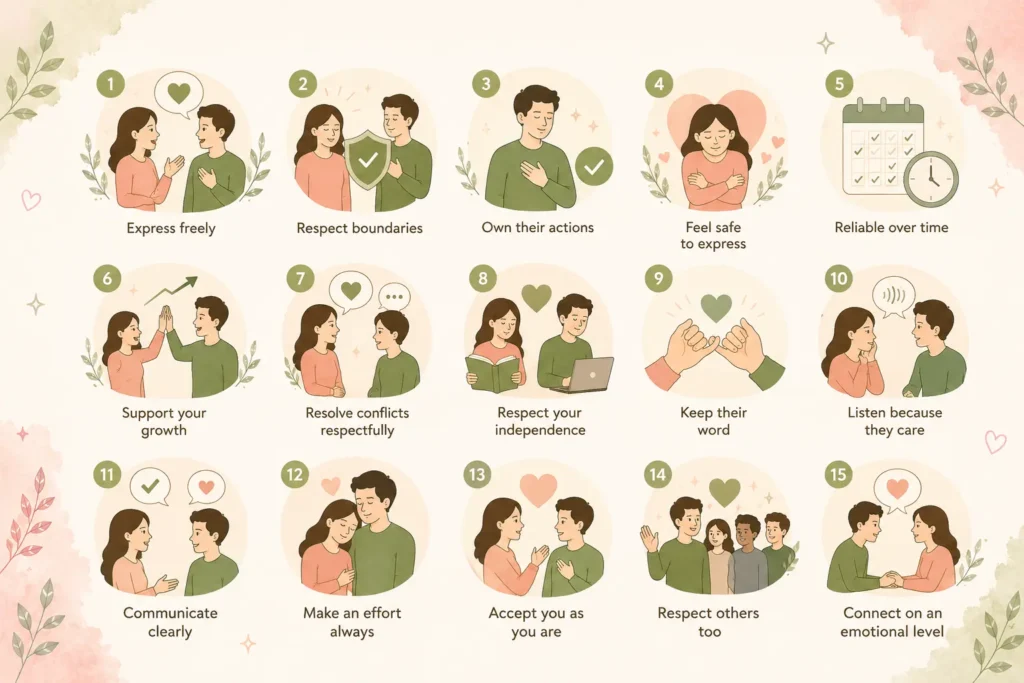
- They express themselves freely with no prompting.
Healthy partners will communicate with clarity as opposed to expecting that their partner can simply read their mind. In turn, the emotional connection you have with each other is clear, and you do not feel confused about any aspect of your relationship.
- They respect your personal boundaries without needing you to remind them.
A sign that someone is a green flag is that they respect your boundaries and listen to you when you say “no” and/or express discomfort. When they respect you, your time, privacy, emotions, and personal space, they create a safe environment for open communication.
- They will accept responsibility for their actions when they are wrong.
Emotionally mature individuals apologize when they are in the wrong and actively work to change the behaviors that they used to cause the conflict. They never shift blame, gaslight, or avoid taking ownership of responsibility for their actions during a conflict.
- They make you feel safe expressing your feelings
They have created an emotionally safe space for you to share your emotions without fear of ridicule, being ignored, or suffering emotional retribution for expressing your feelings. Healthy love promotes emotional safety, not anxiety.
- They are reliable in their actions and words over time.
A reliable partner’s words and actions will demonstrate consistency in their behavior, so you will never have to question the status of the relationship.
- They promote your personal growth and goals.
A reliable partner is supportive of your accomplishments or achievements without needing to compete against you. They are invested and motivated to help you in your quest.
- They work to resolve conflicts in a respectful manner.
Although conflicts are part of any relationship, a healthy partner will work to resolve the issues without insulting or manipulating you or giving you the silent treatment.
- They respect your independence
They allow you to have friends and interests outside of each other. Love is supportive, not possessive.
- They keep their word
When a partner calls when they say they will or is there for you when you need them, it builds trust over time.
- They listen because they care
You feel like you are listened to when conversing with your partner.
- They communicate clearly instead of sending mixed signals
In a healthy relationship, there are no mixed signals or confusion. You will feel like you understand what is going on and how they feel.
- They make an effort even after the honeymoon phase
After the initial excitement fades, love continues through simple acts of affection and kindness that are consistent over time.
- They don’t try to control or change you
In a supportive relationship, you are respected for who you are, your values, and your personality, and you are not pressured to become someone else.
- They respect other people, not just you
How you treat other people (servers, family, friends, co-workers, strangers, etc.) can tell a lot about who you are as a person and how emotionally mature you are.
- They can communicate on an emotional level
They can share how they are feeling, express their vulnerability, and connect with someone on an emotional basis, rather than running away from deeper issues in the relationship. They can communicate on an emotional level
Why Healthy Relationships Feel “Calm” Instead of Confusing
The greatest surprise to many in a loving, healthy relationship is that they feel calm.
You don’t spend time asking.
- “Do they still like me?”
- “Why haven’t they responded to my text?”
- “Did I say something wrong?”
Instead, you feel like the timing of communication is consistent, problems are faced and addressed directly, and you have no feeling of needing to survive emotionally in the relationship.
“Wait… Is This What Healthy Love Feels Like?”
Signs You’re Finally Experiencing Emotional Safety
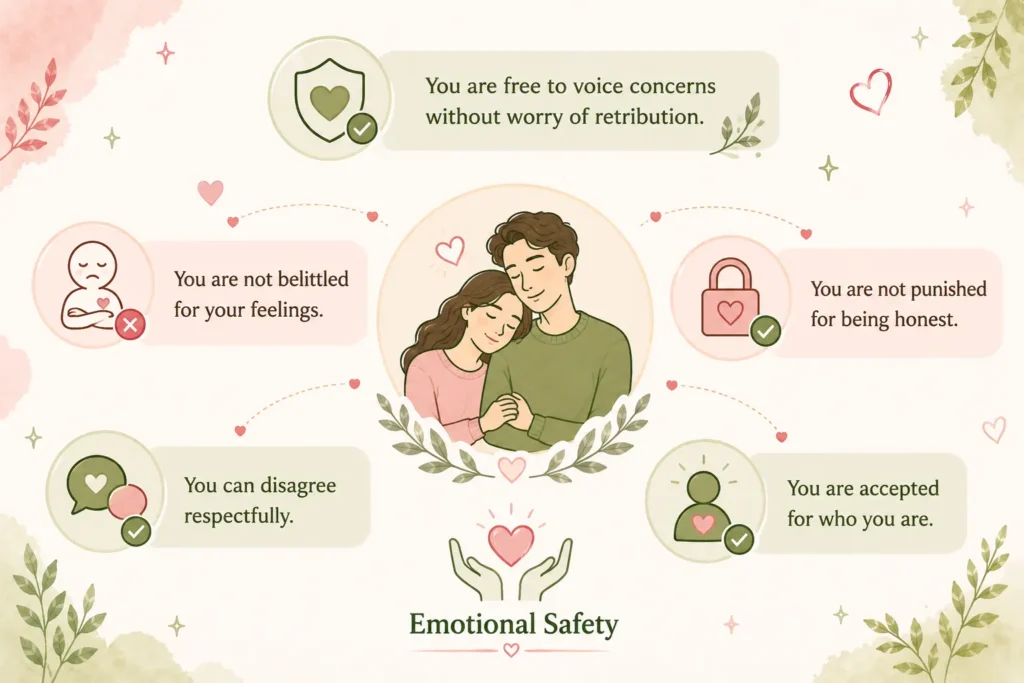
Emotional safety is one of the most important green flags in a relationship, as it encompasses all aspects of connection.
You will feel emotionally safe in a relationship if:
- You are free to voice concerns without worry of retribution.
- You are not belittled for your feelings.
- You are not punished for being honest.
- You can disagree respectfully.
- You are accepted for who you are.
A healthy partner will never use vulnerability to cause harm to someone else.
Why Consistency Feels Strange After Toxic Relationships
Consistency may feel “boring” when we’ve been in emotionally unavailable or unpredictable relationships.
But stable love is “boring”—it’s steady and dependable.
Some qualities of a healthy partner include:
- Following through with commitments.
- Being able to communicate directly.
- Showing an ongoing interest in you.
- Not disappearing in conflict.
That consistency will develop into trust over time.
The Comfort of Being Yourself Without Fear
An indication of a healthy relationship is the level of comfort you experience with one another. You do not find yourself rehearsing conversations; you can be yourself without fear of judgment. This type of comfort is much more important than putting on a show for others.
The “Bare Minimum” Trap: Don’t Confuse Effort With Green Flags
Good Morning Texts Aren’t the Standard of Love
Many people confuse attention with emotional maturity. Consistent texting is a nice gesture, but it does not necessarily mean that it is a good sign.
Real green flags would be:
- Respect.
- Reliable.
- Accountability.
- Emotional support.
- Healthy communication.
Healthy Relationships Are Built, Not Performed
Social media can create a picture of a romantic relationship. However, most successful relationships are created through:
- Everyday respect.
- Open and honest communication.
- Feeling safe to express yourself emotionally.
- Working together to create a loving relationship.
To have real love is more of a partnership than anything else.
Green Flags Across Different Stages of Dating
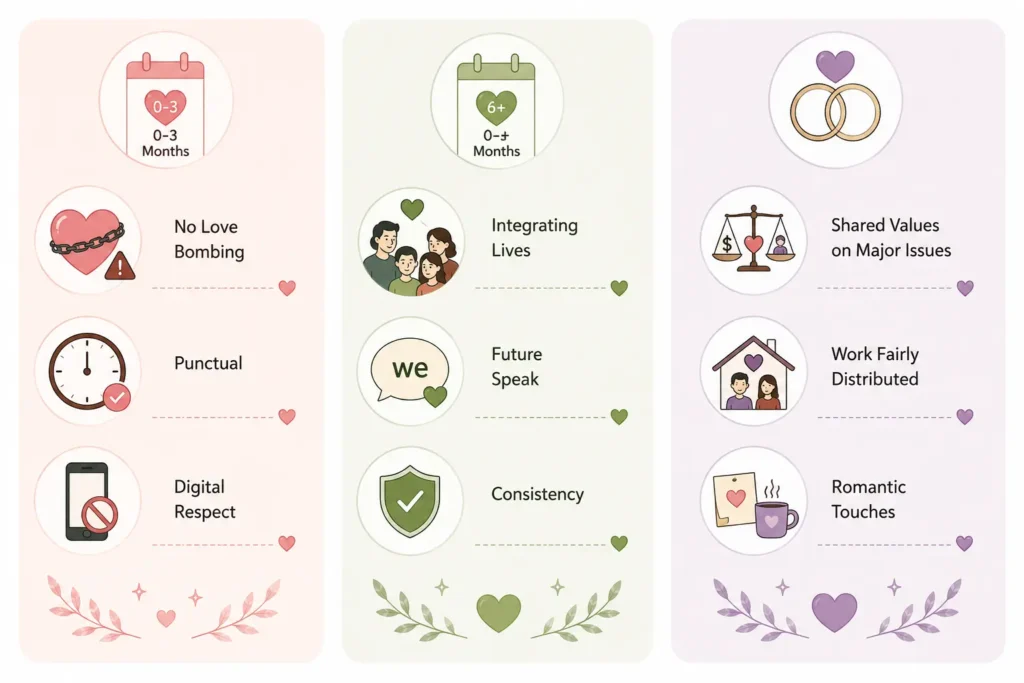
The signs that you are with someone who is truly caring and genuine can change as the relationship develops. You can think of the following items on your “relationship green flags checklist” for each phase:
Stage 1 (0-3 Months)
- No Love Bombing: If they are saying “I love you” by the second date, this has moved too quickly and can develop into something more natural as you grow together naturally.
- Punctual: They care about and value your time; they will always let you know if they will be late for a date, etc.
- Digital Respect: They will not be on their cell phone constantly while you are together.
Stage 2 (6+ Months)
- Integrating Lives: You have met each other’s family and friends, and have both taken time to meet each other’s family and friends.
- Future Speak: They talk about long-term plans and naturally use the word “we” with low effort.
- Consistency: The person you started dating is still the same person you are dating right now.
Stage 3 (Marriage/Lifetime Partner)
- Shared Values on Major Issues: You have both agreed upon the major issues: money, children, and careers.
- Work Fairly Distributed: Workload (both mental and physical) is equally divided—50/50.
- Romantic Touches: They continue to do little romantic things for you (i.e., make coffee for you, leave notes) even after being together for so long.
Social Media vs Real Relationship Green Flags
- Online vs Offline Relationship Experiences: Just because someone consistently posts online doesn’t necessarily mean they’re in a successful relationship. Consistency in how two people are together when they’re alone is more important than how they are together as a couple in front of others.
- What’s More Valuable: Private Respect or? Many times, the healthiest relationships are seen as plain or average due to their ability to foster emotional security.
- How Comparing Yourself to Other Couples Online Can Lead to Unreasonable Expectations: Expecting a relationship based on unrealistically high expectations may lead you to have less patience with your own relationship than you would otherwise; therefore, you’ll experience difficulties with your own.
Every healthy relationship appears unique; however, the elements of respect, trust, and communication are universal indicators of a healthy relationship.
Common Myths About Healthy Relationships
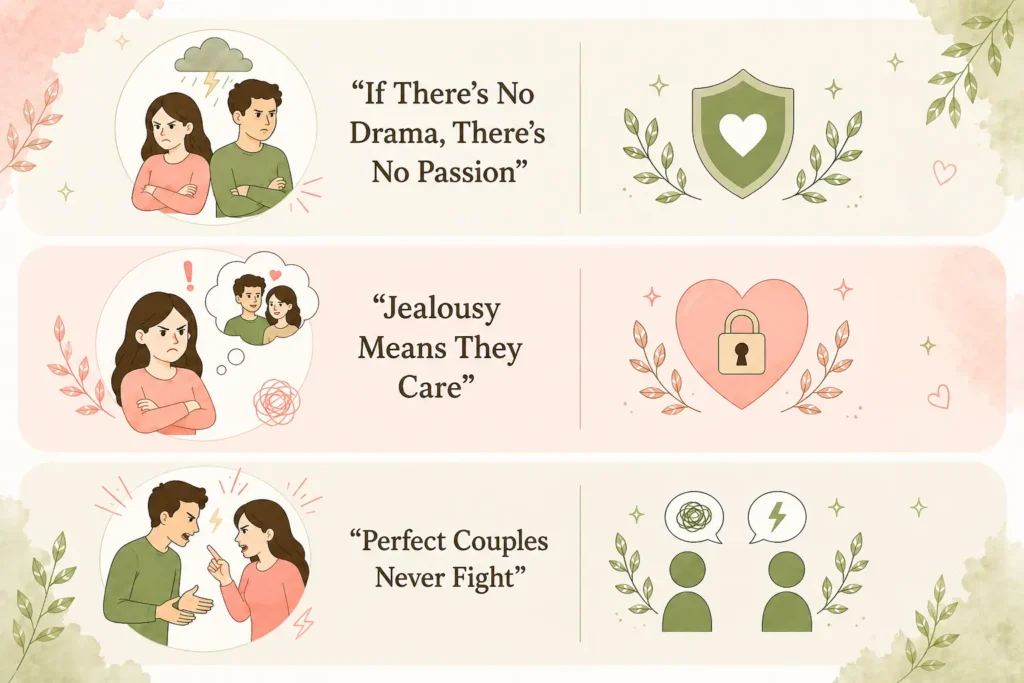
“If There’s No Drama, There’s No Passion”
This is a falsehood. Drama creates emotional upheaval, not closeness. Healthy love can be exciting without the chaos associated with drama and dramatic emotions.
“Jealousy Means They Care”
Jealousy stems from insecurity and not love. Trust is a better way to relate than possessiveness.
“Perfect Couples Never Fight”
Healthy couples absolutely disagree, but how they handle conflict is the difference between a relationship with passion and a relationship that is dull and lifeless.
Unexpected Green Flags Most People Ignore
Here are some signs of being with someone who has a high level of quality:
- They don’t have to “win”: They share the value of maintaining the quality of the relationship more than they value being “right” when they disagree.
- They cheer for your accomplishments: When you receive a promotion, they cheer for you, not compete against you.
- They can be “boring”: You can enjoy another person’s company while sitting in complete silence and feel absolutely comfortable.
- They pay attention to little details: They remember you don’t like cilantro or that your big presentation day is on Tuesday.
Don’t Forget: You Must Be a Green Flag, Too
Having a good relationship means more than just dating a person who is right for you; it also means that you are a good partner. Your highest indicator of readiness for a relationship is how self-aware you are. Evaluate yourself and consider:
- Do I communicate my needs clearly?
- Do I respect my partner’s personal space?
- Am I willing to take accountability when I’m wrong?
Final Thoughts: Choosing Peace
A relationship that is healthy will not generally feel like a constant state of confusion or emotional fatigue. A healthy relationship will give you a sense of emotional safety along with support and stability.
A healthy love will give you space to grow and have peace, honesty, and genuine connection, while not expecting you to be in survival mode.
Also, this is often one of the biggest green flags in a relationship.
FAQs
Q. Right Relationship – What’s the biggest green flag?
Ans. Emotional consistency is maybe the biggest green flag in a relationship. A healthy person will communicate well, have a good understanding of their boundaries, and show consistent behavior that is not confusing.
Q. Green Flag Meaning—What does “green flag” mean in relationships?
Ans. The green flag meaning in relationships means that you are exhibiting positive behaviors you would expect from a person who exhibits emotional maturity, is trustworthy, is respectful, and would be a good long-term match for you.
Q. Will you ever find a healthy relationship boring?
Ans. Sometimes, if you have been in an unhealthy or emotionally chaotic relationship, you may find a healthy relationship to be mild or boring. A healthy relationship will not be nearly as emotionally charged, will be calm and stable, and will provide a sense of emotional security.
Q. What are common red flags and green flags for a healthy relationship?
Ans. Common red flags in relationships include manipulation, inconsistency, jealousy, and poor communication. Common green flags are honesty, accountability, emotional safety, respect, and mutual effort.