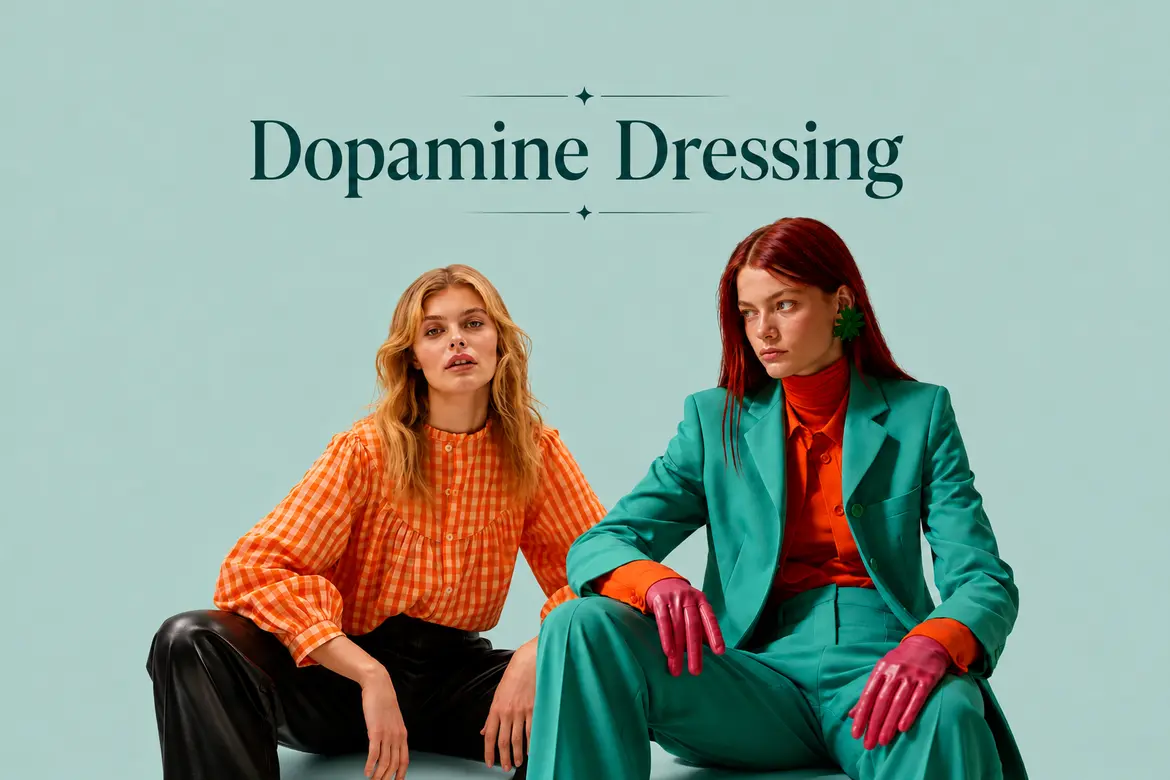
You know the feeling. You reach for the mustard-yellow sweater on a grey Tuesday, and something in your chest lifts before you have even left your house. That small internal shift has a name now. Dopamine dressing is the exercise of clothing choices and color choices in particular to control how you feel rather than to comply with a dress code or a trend cycle. It sounds like a wellness buzzword, and part of it does. And that is in addition to decades of color combination research and a growing body of fashion psychology, and once you understand how the two connect, your closet starts to feel less like a chore and more like a tool.
What dopamine dressing means, how color changes your mood, and how to get the palette that suits you most. You will get a step-by-step approach to color season analysis at home, a self-scoring color analysis quiz to point you to your season, and honest notes on the free color analysis tools floating around the internet. No consultant needed.
What Is Dopamine Dressing?
The term was coined by Dr. Dawnn Karen, the fashion psychologist and professor at the Fashion Institute of Technology who wrote the book Dress Your Best Life. She started using the word around 2020, when people in her community were losing their routines and support systems. She started to look at clothing as a form of healing: a way to find a good mood through the choice of what you put on your body. The New York Times dubbed her “The Dress Doctor.”
Here is the part that should be said clearly, because almost all blogs skip it. Your jeans don’t squirt dopamine into your blood. The name is a metaphor. What happens is quieter and more interesting. When you wear a color you associate with confidence or joy, the brain is able to lean into that association, and your behavior follows. You stand differently. You make eye contact. You expect the day to go well, so you act in ways that nudge it there.
Psychologists call this mechanism enclothed cognition. In a 2012 study, Hajo Adam and Adam Galinsky gave the subjects a lab coat that they were going to wear to study. When they told the participants that the coat belonged to a doctor, they performed better on attention tasks than when they were told that the coat belonged to a painter. The same fabric, different meaning, measurable differences in behavior. Dopamine dressing is based on this idea. The garment takes on a story, and you wear the story as much as the cloth.
The Psychology Behind Why Clothes Change How You Feel
There are two ideas that do most of the heavy lifting.
The first is color psychology, the study of mood and how hues affect emotion and behavior. The second is self-perception: how we read our actions and appearance and then feel about ourselves. Dr. Carolyn Mair, the behavioral psychologist who wrote The Psychology of Fashion, thinks of dopamine dressing as motivation rather than magic. Dopamine makes us want to get rewards, and so wearing an outfit that you think you’re sure will make you feel confident is a reward-seeking behavior. The clothes are a means to make an intention; the intention determines the day.
A 2012 study conducted by psychologist Karen Pine at the University of Hertfordshire reported a direct relationship between what people wear and how they feel, and particularly the opposite. When people were in a low mood, they would tend to wear drab, shapeless clothes that only reinforced the low mood. Dopamine dressing interrupts the loop. You dress for the mood you like, not the one you woke up in.
It’s all of this that makes clothing no substitute for rest, therapy, or that hard conversation you’ve been avoiding. It is a small lever, not a cure. What makes the small lever worth pulling is how often you get to pull it. You choose an outfit every single morning and a small boost in your mood over a year.
How Color Affects Your Mood
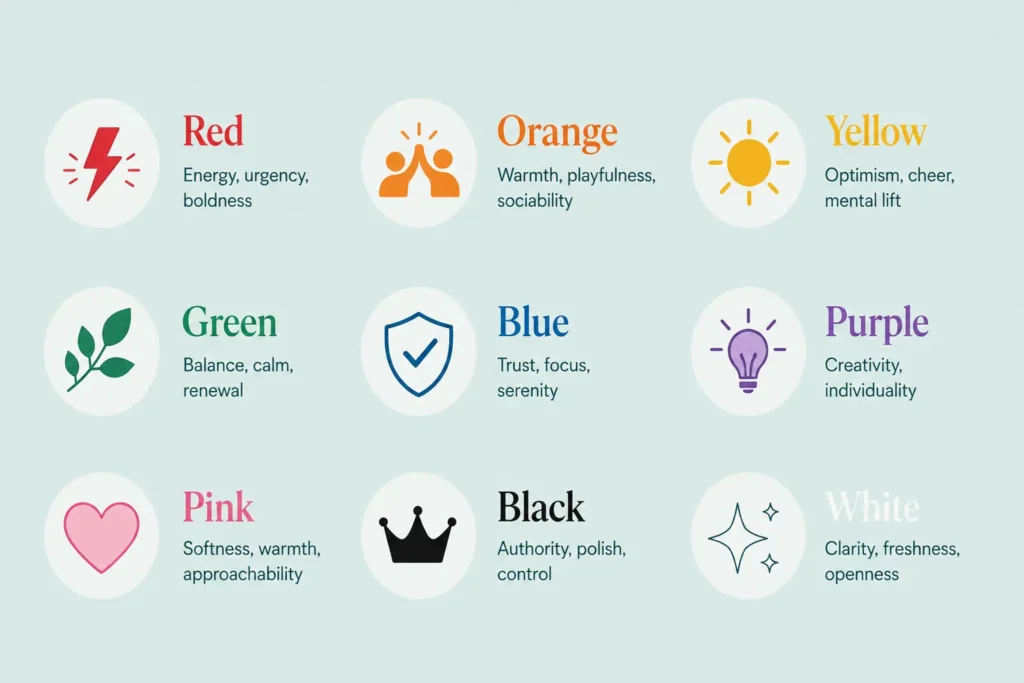
Color carries emotional weight, but the meaning is not universal. Culture, memory, and personal history all bend it. Red, one knows, is luck at a Chinese wedding and danger on a warning sign. But some broad tendencies show up often enough to be useful starting points.
| Color | Common Emotional Pull | When to Reach for It |
| Red | Energy, urgency, boldness | A day you want to feel powerful or visible |
| Orange | Warmth, playfulness, sociability | Creative work, gatherings, breaking the ice |
| Yellow | Optimism, cheer, mental lift | Grey weather, low-motivation mornings |
| Green | Balance, calm, renewal | Stressful stretches when you want to feel steady |
| Blue | Trust, focus, serenity | Meetings, deep work, hard conversations |
| Purple | Creativity, individuality | When you want to feel a little unconventional |
| Pink | Softness, warmth, approachability | Days you want ease rather than armor |
| Black | Authority, polish, control | High-stakes moments, when you want to disappear into competence |
| White | Clarity, freshness, openness | A mental reset, or a clean slate feeling |
As a menu, not a rulebook, read that table. The point of dopamine dressing is to learn to see your own associations. Green may come to mind for many people, but you’ve grown up in a hideous green school uniform in childhood summers, and the color makes your jaw tighten. Trust that. Your history overrides the chart.
As a quick way to make your own color map, think back to three outfits that made you feel unstoppable. Take note of which color dominates. That is your starting palette for when you need a lift.
Dopamine Dressing and the Colors That Suit You
Here is where a lot of enthusiasm hits a wall. You buy the cobalt blazer everyone online swears is joyful, put it on, and somehow look tired and washed out. The color lifted your mood in the shop mirror and drained your face at your desk.
The issue is not the color. It is the specific shade of that color against your natural coloring. A dusty, cool blue and an electric, warm-leaning blue are the same word, “blue,” but they do not match your skin. That is the gap dopamine dressing does not close, and it is why color season analysis is so important. Dopamine dressing stops being a gamble once you know your palette. At the same time you have the mood lift, and you look like you’re in a good mood, and you feel rested.
So the two ideas fit together. Dopamine dressing has the why: dress how you want to feel. Color season analysis gives you the which: the exact versions of each color that flatter you. Put them together, and your wardrobe finally works as hard as you do.
What Is Seasonal Color Analysis?
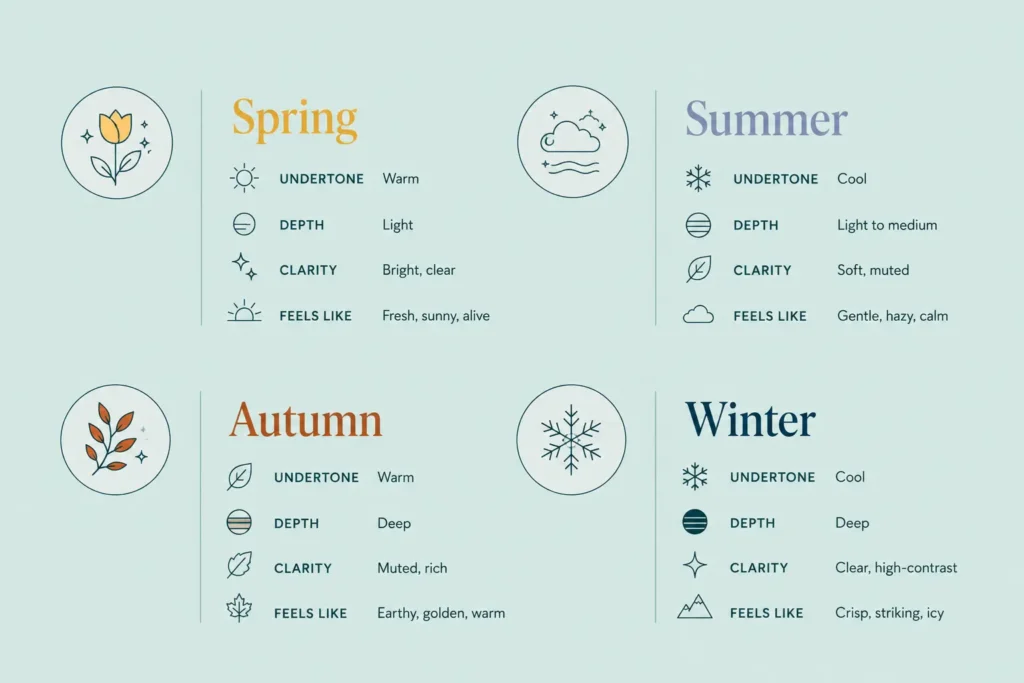
The color season analysis classifies people into color groups (called seasons) based on their natural colors: skin undertone, eye color, and hair. The idea dates back to color theory used by painters and was popularized in the wardrobe world by Carole Jackson’s 1980 book Color Me Beautiful. Match your clothes with the palette that matches your natural traits, and everything comes alive. Clash them and even a beautiful, expensive garment can look a bit off.
The old system includes the four seasons, which are all defined by three qualities.
| Season | Undertone | Depth | Clarity | Feels Like |
| Spring | Warm | Light | Bright, clear | Fresh, sunny, alive |
| Summer | Cool | Light to medium | Soft, muted | Gentle, hazy, calm |
| Autumn | Warm | Deep | Muted, rich | Earthy, golden, warm |
| Winter | Cool | Deep | Clear, high-contrast | Crisp, striking, icy |
Today’s color season analysis, by contrast, expands those four into twelve seasons and divides each season into three sub-seasons. For a winter, for example, Cool Winter, Deep Winter, and Bright Winter are the most easily discernible and distinct ones. The twelve-season version of it is the more accurate palette and is better suited to people with neutral undertones or mixed features that never quite fit the broad four well. But the majority of analysts advise beginners to hit the four first and work out what they need to improve. That is the smart order for a DIY approach too.
There is one thing you need to know before you start: your season doesn’t change. It rests on an undertone, which is the same across your life. Your surface skin can tan, age or change at a given age and you may come to have different favorites in your palette over the years, but the underlying season remains the same.
How to Find Your Color Season at Home (No Consultant Needed)
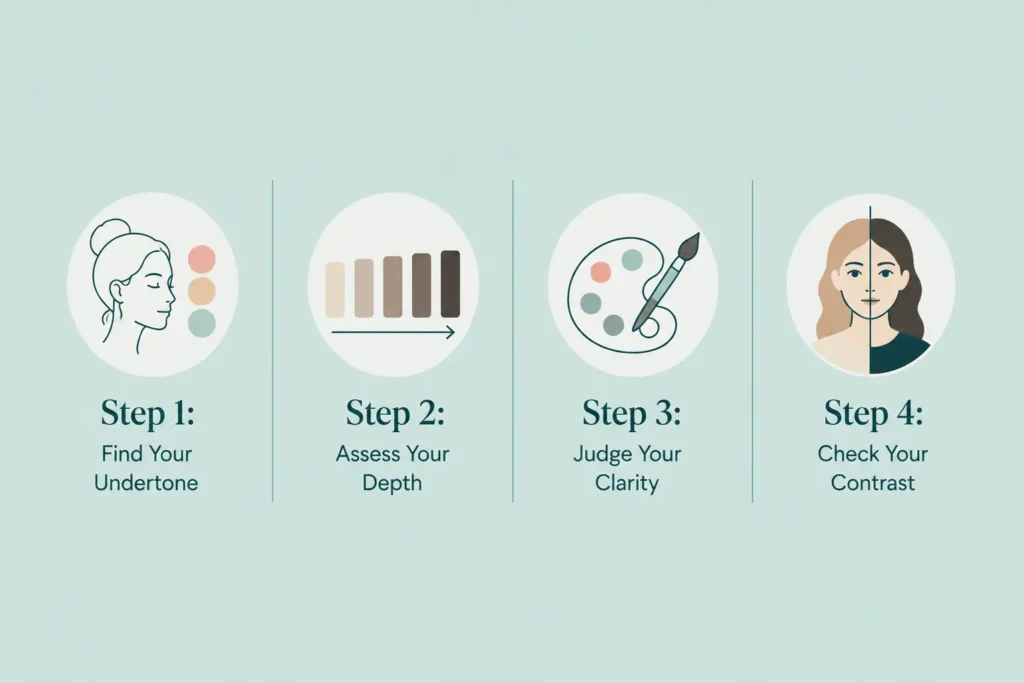
A professional draping session takes the guesswork out of it by comparing dozens of fabrics with your face in controlled light. You can get most of the way there on your own in about thirty minutes. Set yourself up right first, because the setup determines whether your results mean anything.
Your setup checklist:
- Stand near a window with plenty of daylight. Avoid warm indoor bulbs, which throw off every reading.
- Remove makeup so you’re working with your bare skin.
- Tie your hair back or cover it with a neutral grey or white towel.
- Use a plain, neutral background. No bright walls behind you.
- Have a white fabric and a cream fabric ready, with a few clearly warm and clearly cool items from your closet.
Now work through the three qualities in order. Each step narrows the field.
Step 1: Find Your Undertone
Undertone is the most important reading, and it splits the four seasons in half. Warm undertones point you toward spring or autumn. Cool undertones point you toward summer or winter.
So try these quick tests and look for a pattern across all of them rather than trusting any single one:
- The vein test. Look at the inside of your wrist in daylight. Veins that read green suggest a warm undertone. Veins that read blue or purple suggest cool.
- The jewelry test. Gold against your face, then silver. Gold that gives your skin a warm glow. Silver that makes you look brighter points cool.
- The white-versus-cream test. Drape pure white near your face, then cream. Whichever makes your skin appear clear and even, not sallow or grey, is your temperature.
- The tan test. Skin that tans easily and rarely burns tends to run warm. Skin that burns first and maybe tans tends to run cool.
If the answers are split evenly, you are likely to have a neutral undertone, which is common. Note it and move on. The next two steps will still narrow you down.
Step 2: Assess Your Depth
Depth, sometimes called value, is the examination of whether your overall coloring is light or dark. Look at your hair and eyes together. Pale hair and light eyes read light and lean spring or summer. Deep brown or black hair and dark eyes read deep and lean autumn or winter. Medium coloring is in between and needs the clarity test to break the tie.
Step 3: Judge Your Clarity
Clarity, or chroma, asks if your coloring is bright and clear or soft and muted. Put a vivid, saturated color like fuchsia next to your face, and then a dusty version of the same family, like rose. If the bright shade makes your features pop and look defined, you lean clear, which points to spring or winter. If the bright shade overwhelms you and the muted one looks more harmonious, you lean soft, which points to summer or autumn.
Step 4: Check Your Contrast
Contrast is the difference between your skin, hair, and eyes. Take a picture of your bare face in daylight and convert it into black and white. High contrast (where your features stand out sharply) leans toward winter. Low contrast (where everything is in a similar color) leans toward summer or soft autumn. In this grayscale trick, color disappears and the structure is revealed.
Add the four readings together, and one season should start to feel like home. Warm, plus light, plus clear points to spring. Cool, plus light, plus soft points to Summer. Warm, plus deep, plus muted points to autumn. Cool, plus deep, plus clear points to winter.
Try This At-Home Color Analysis Quiz
If the above steps seem like a lot, this short color analysis quiz gets you to a good first guess in less than two minutes. Answer each question, keep a tally of your letters, then read the result. This is the same logic a color season analysis follows, compressed into five questions.
1. In daylight, the veins on your wrist look:
A. Green or olive.
B. Blue or purple.
C. Honestly, a bit of both.
2. Which metal makes your skin look healthier?
A. Gold.
B. Silver.
C. Both look fine.
3. Your natural hair and eyes are:
A. Warm-toned (golden, chestnut, hazel, amber).
B. Cool-toned (ash, black, cool brown, grey-blue, cool green).
C. Somewhere in the middle.
4. When you wear a bright, saturated color, you look:
A. Refreshed and defined.
B. A little overwhelmed; soft colors suit me more.
C. Depends on the shade.
5. In a black-and-white photo of your face, your features look:
A. Sharp and high-contrast.
B. Soft and blended.
C. Medium.
Your result:
Mostly A: You lean warm and clear. Start with spring if your coloring is light, or autumn if it runs deep. Golden, fresh, and rich shades are your friends.
Mostly B: You lean cool and soft. Start with summer if your coloring is light and blended, or winter if it runs deep and high contrast. Cool, clear, or gently muted shades suit you.
Mostly C: You have neutral coloring, which is much more common than the internet says. If it comes to draping shades from two neighboring seasons, trust the mirror over any single test.
Using this color analysis quiz as a compass, not a verdict, is a good way to interpret it. It points you to the right neighborhood. The at-home draping in the section above leads you to the correct street.
Free Color Analysis: What Works Online
Type “free color analysis” into any search bar and you will drown in options. Some earn your time. Most do not. A good free color analysis falls into one of three categories, and each has a catch that is worth knowing before you trust the result.
Photo-upload apps. Several apps let you upload a selfie and get an instant season using AI that reads your skin, hair, and eye colors. My Color Palette and Vivaldi Color Lab are two of the most popular examples. The convenience is real. The accuracy depends entirely on your lighting. A picture shot under a warm lamp will be misread every time you upload it to the app, and the app will misinterpret your undertone. If you try one, you should use the same daylight, bare-face, neutral-background setup you would for manual draping.
Interactive web quizzes. A good color analysis quiz on a styling site asks about undertone, depth, and contrast, then hands you a season and a palette. These are only as good as the questions. Skip any that ask a single question and promise a definitive season.
Video tutorials. Free walkthroughs from image consultants on YouTube teach you the draping method itself, which is the skill that outlasts any single result. This is free color analysis that keeps paying off, because once you can read your own face against fabric, you never need the apps again.
A fair warning that most sites bury: no free color analysis can match a professional draping session for precision. Self-tools reliably get you within a season or two of your true type, which is close enough to transform how you shop. If you keep landing between two seasons and it drives you up the wall, that is where a paid session earns its cost.
Building a Dopamine Dressing Wardrobe Around Your Palette
Once you know your season, dopamine dress codes gets easier and cheaper, because you stop buying colors that will sit unworn in your closet. Here is how to bring the two ideas together in practice.
Find your palette’s version of each mood color. You want the optimism of yellow, but pure lemon might clash if you are a soft summer. Instead, go for a buttery, muted yellow. It adds to the emotional impact and is better on your skin. Every mood color has its own version inside your season.
Anchor with neutrals from your palette, and accent with joy. Build the base of your wardrobe in your season’s neutrals, then use your brightest, mood-lifting shades as accents: a scarf, a bag, or a knit. This keeps dopamine dressing affordable and prevents your closet from becoming a costume box.
Keep one guaranteed mood outfit ready. Everyone needs a single tested combination that reliably lifts them. Know yours, keep it clean and accessible, and reach for it on the days that fight you.
Notice, then adjust. Dopamine dressing is a feedback loop, not a formula. Pay attention to which outfits change your posture and energy, and let real evidence from your own week guide the next purchase.
Do not throw out the colors you love that fall outside your season. Wear them lower on your body, away from your face, where they lift your mood without draining your complexion. Your favorite off-season red still works as trousers or a skirt.
Dopamine Dressing Trends for 2026
The mood-driven approach has transcended its pandemic origins and settled into a lasting way of thinking about clothes. A few directions stand out this year.
Saturated single-color outfits, head to toe in one joyful shade, keep climbing on Pinterest and TikTok. Buttery yellow and soft rose show up across spring runways as the season’s optimism colors. Tactile fabrics matter more than before, because texture—not color—creates mood response; think brushed knits, corduroy, and anything that feels good against the skin. And personalization has become the whole game, with the color analysis quiz and free color analysis tools steering people toward palettes that make their dopamine dressing land instead of misfire.
The bottom line: people want clothes that do something for them, not simply clothes that look good. Dopamine dressing gave that instinct a name, and color season analysis gave it precision.
Dopamine Dressing vs. Color Season Analysis: Which Do You Need?
They answer different questions, so most people want both. This table shows when each one does the work.
| Dopamine Dressing | Color Season Analysis | |
| Core question | How do I want to feel today? | Which colors flatter me? |
| Based on | Color psychology, personal association | Undertone, depth, clarity, contrast |
| Changes over time | Yes, with your mood and life | No, your season stays constant |
| Best for | A daily mood lift | Smarter, less wasteful shopping |
| Cost to start | Free, use what you own | Free at home, or paid for precision |
Use color season analysis once to learn your palette. Use dopamine dressing every morning to choose within it.
The Bottom Line
Dopamine dressing turns a daily obligation into a small, repeatable act of agency. You decide how you want to feel, and then you dress toward it. Color season analysis makes that decision take place and pairs the mood lift with the specific shades that bring out the best of your face. You can start with the free color analysis that you can do at home, take the color analysis quiz, and guide yourself in the right direction and develop from there. Your closet is one of the few things you get to choose every single morning. Choose it on purpose.
Frequently Asked Questions (FAQs)
Q. Does dopamine dressing really work? Or is it just a trend?
Ans. It works within limits. Clothing does not release dopamine directly, but wearing colors and styles you associate with confidence changes your self-perception and behavior and your mood. Research on enclothed cognition and the relationship between clothes and mood backs that up. It’s a reliable small boost, not an alternative to real rest or support.
Q. How can I find my color season for free?
Ans. Do a color season analysis at home in daylight with a bare face and a neutral background. Work through undertone, depth, clarity, and contrast in that order using simple tests like the vein test and the gold-versus-silver jewelry test. A free color analysis quiz or a photo-upload app can give you a fast starting guess, but accuracy depends heavily on your lighting.
Q. What is the difference between the 4-season and 12-season color systems?
Ans. The four-season system divides you into spring, summer, autumn, or winter and provides good broad direction for the whole person. The twelve-season system splits each of those into three sub-seasons and has a more precise palette to work with for people with neutral undertones or mixed features. Beginners should first identify their main season and then move on to a sub-season.
Q. Can my color season change over time?
Ans. No. Your season is your undertone, which stays constant throughout your life. Your surface skin changes with sun exposure, age, and health, and your personal favorites in your palette can change, but the underlying color season does not.
Q. Do I need a professional for color analysis?
Ans. No. A professional draping session removes the guesswork and is worth it if you keep landing between two seasons, but most people get within a season or two of their true type by an at-home color season analysis and an honest mirror. That’s precise enough to change how you shop and dress.