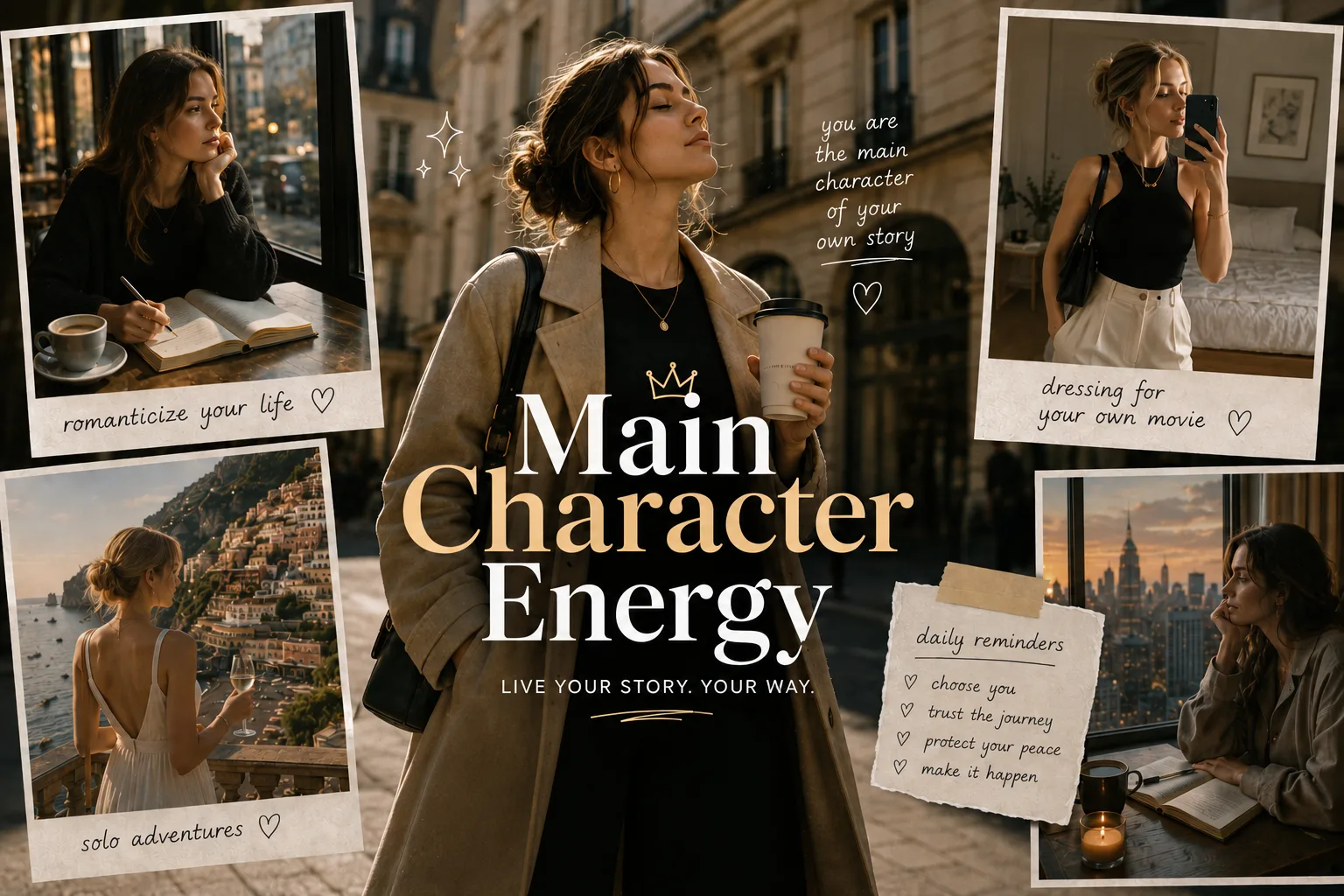
There’s a certain type of person you’ve likely encountered online. They stroll into a room as if the background music were newly introduced. They journal with the light hitting their face just right. They are solo travelers who make the pricey coffee arrangements and wear the statement coat—every Tuesday seems like it is an act out of a screen show rather than another major event.
That is the essence of the essence. Also, the main character energy. If you yourself have never experienced it, or at least it never entered your head until now, then this must be something you’re constantly looking down upon—just wish you had felt it.
The term may not seem like a very common one in today’s video chat, but it is something that comes with a whole lot of impact—and indeed has become the new social philosophy for what constitutes beauty in our generation of Gen Z and Millennials. But what is main character energy, really? From where did it originate? And why does it speak so deeply that even Merriam-Webster felt it was necessary to define it?
Let’s get into its definition.
What Is Main Character Energy?
At its heart, main character energy is the attitude of someone perceiving himself as the hero of his or her own life story—not a background figure just waiting for something to happen to him or her, but the star. The focus around which the entire story is situated. It’s not arrogance. It’s not narcissism (though there’s a thin, nuanced border).
It’s something more like a radical act of self-authorship: You believe that your life is worth telling, your choices are significant, and the way you show up in the world is something worth paying attention to.
Merriam-Webster defines it as the “attractive or admirable air of assurance someone is exhibiting or embodying.” That’s also the one used in the dictionary. The internet version is a bit more electric—it’s the girl running in the rain with earbuds plugged in. It’s the solo restaurant dinner with a glass of wine and a book. It’s ordering just what you want without ever checking if anyone else is okay with it.
As USA Today called it, it’s about “putting yourself first and taking control of your own story—not selfishly but in a self-affirming way that prioritizes self-care.”
Where Did Main Character Energy Come From?
It’s not that the term was a direct by-product. Like a lot of internet phenomena, it began in layers.
The TikTok Origin Story
The phrase “main character energy” became viral on TikTok in May 2020, famously triggered by a video by Ashley Ward, during the midst of pandemic lockdowns worldwide. Stuck at home, people had no way to give their lives any routine that might normally give structure and meaning to life. And into that vacuum was discovered the unexpected: that people began filming themselves living as if they were in a movie.
Coffee production became cinematic in effect. Walking alone turned into a montage. A window journal turned into a character moment. As their people began to couple regular life with dramatic soundtracks and to think of their own normal lives as having a right to a wide lens at their expense.
The message was quietly revolutionary: your ordinary life can seem extraordinary if you’d like to see it that way.
The Lineage Before the Trend
It did not develop in isolation. “Main character” had existed on the net since the late 2010s—typically as a mildly snarky label for someone who was making his way in the world like it was all their own. Prior to that, the similar term “main character syndrome” had appeared in online gaming forums as a condemnation of players monopolizing the stage.
But the tone shifted. What began as mild mockery turned into some real aspiration. And the arrival of big dick energy in 2018—a slang for quietly magnetic, self-assured confidence—likely paved the way for a phrase that would convey that same swagger but more cinematic poetics.
Why Does Main Character Energy Resonate So Deeply?
This is really where it gets interesting. This isn’t just a trend. This is a psychological need in aesthetics.
We Are Wired for Narrative
Humans do not just live lives; we tell them. For centuries psychologists have noted that people shape their sense of identity through the medium of storytelling. We construct a mental “life story” that informs our experiences, provides consistency, and provides meaning. Main character energy plays directly to that instinct.
And when an individual has a cinematic way of ordering his or her life, an intentional choice, a kind of aesthetic ritual, a feeling of agency, that’s not just acting for an audience. They’re making a meaning for themselves.
Post-Pandemic Hunger for Self-Authorship
A lot of the external definitions of self were rotted away by the pandemic: your job title, your social calendar, the travel plans you make, your forward movement. All that was left was a confronting question—who am I when all of that goes away?
The primary character energy developed as a single cultural response: you are whatever you want to be, wherever you are in this scene. It’s a micro-philosophy of self-determination that was at precisely the right time.
The Aesthetic Pull Is Real
Let’s be honest, part of the attraction is only visual. The content of the main character looks lovely. Cinematic color grading. Slow-motion moments. Intentional outfits. Cozy apartments. Dramatic weather. TikTok and Instagram were the ideal canvas for this sort of life aestheticization, and people could not take that much more. In real life, this kind of attitude of life is visible or invisible no matter what you’re doing.
Main Character Energy vs. Main Character Syndrome: What’s the Difference?
| Aspect | Main Character Energy | Main Character Syndrome |
| Orientation | Inward: about your own self-perception | Outward: about how you position yourself relative to others |
| Effect on others | Neutral to inspiring | Can feel dismissive or self-centered |
| Psychology | Confidence, intentionality, self-authorship | Can veer into entitlement or lack of empathy |
| Social media context | Aspiration and aesthetic | Sometimes used as a gentle critique |
| Healthiness | Generally positive when grounded | Can become maladaptive if used to avoid real growth |
What Does Main Character Energy Look Like in Real Life?
This isn’t just a cinematic backdrop or a TikTok following; it’s an emotional quality of somebody.
- They don’t merely walk out the door somewhere. They choose where to take a meal, what to dress, and what to eat, with intention rather than passivity.
- They romanticize the ordinary. A morning walk is not just exercise; it is ritual. A solo coffee isn’t lonely, but indulged time with themselves.
- They no longer wait for permission. The trip is made alone. They start things off and do it by themselves. On a random Wednesday, they put on the dress.
- They see setbacks as plot points. Not roadblocks—redirects. Not failures—chapters that build character (literally).
- They demand attention without asking for it. There’s something magnetic in people who are authentically there and self-possessed. Rooms pay attention to them, not because they’re acting but because they’re real.
Main Character Energy and Fashion: Dressing the Part
In the world of lifestyle and fashion, the main character’s energy is now an entire aesthetic language.
Consider dressing for yourself, but loudly, intentionally. It’s that trench coat that makes you feel as if you’re entering something important. The leather bag is nicely worn-in. The unexpected color choice. The look of a vintage piece dressed in contemporary fashion.
Main character fashion isn’t about slavishly following trends; it’s about wearing things that feel like a choice. Like the visual equivalent of a choice. The lines between it and luxury are very broad, and it intersects with quiet luxury aesthetics, old-money dressing, and the French girl philosophy of effortless intentionality. But it also appears in bold streetwear, maximalist layering, and striking silhouettes.
The common thread? Confidence in the edit. You chose this. And you know exactly why.
Pieces That Signal Main Character Energy in 2025
- A blazer perfectly fit and worn casually over everything
- Statement sunglasses that function as punctuation
- A single investment bag with worn-in character
- Monochrome dressing with textural contrast
- Any shoes that require dedication to walk in
How to Cultivate Main Character Energy
The good news: You don’t have to have a personality transplant. Main character energy is a technique, not a characterization. This is how to actually construct it.
1. Romanticize Your Routine
Begin making everyday moments feel like they should be there. While brewing coffee, put on music. Light a candle while you work. Take your time, slow down, and feel out the scene you’re in. This isn’t delusion; this is attention.
2. Make Deliberate Micro-Decisions
Main characters don’t drift. They choose. Begin with the small: pick your outfit purposefully. Order what you actually want. Do the longer route that feels better. These micro-decisions compound.
3. Go Places Alone
Solo dining. Solo travel. Solo cinema. And doing things without needing company is one of the most assertive things someone can communicate to others and to themselves. If you’ve never done it before, start solo with a cup of coffee at a place you’ve always wanted to try.
4. Stop Waiting for the Right Time
It’s not all perfect conditions, and no main characters wait for all of that to be prepared before they kick off an action. The inciting incident occurs now. What you’ve been putting off, the trip, the pivot, the creative project, starts before you feel ready.
5. Curate Your Environment
Curating your place matters, but your place is crucial. Main character energy thrives in environments that are deliberate: a tidy desk with one beautiful object on it, a capsule wardrobe rather than a messy closet, playlists tailored just for particular moods. Your environment tells you the story of who you are. Make it work. Give it a boost, and that will lead you through much more.
6. Own Your Narrative — Including the Difficult Parts
But don’t skip the hard chapters; real main characters don’t. They don’t go through toxic positivity in all ways through grief or failure. They sense it, they name it, they continue. Authenticity is the difference between a legitimate main character energy and a performance of it.
The Cultural Critique: When Main Character Energy Goes Wrong
No powerful cultural phenomenon is above criticism. And honestly? The criticisms are welcome.
Some critics connect the trend to hyper-individualism, the notion that shaping your life into a movie can quietly condition you to view real people around you as either props or supporting cast. Others, however, point to the fact that the look and feel of main-character energy is frequently white, thin, and financially well-to-do: the content that went viral included a very particular type of “protagonist” whose life situation made the cinematic lifestyle easy to photograph.
There is also the psychological issue: When main character energy becomes a way of performing growth rather than doing the work of it, and healing looks pretty but isn’t substantive, it can function as what researchers call maladaptive daydreaming. The protagonist of the film never gets to sit with his or her distress. In real life, though, that becomes impossible.
The most healthful version of this mind-set holds the protagonist accountable. Real main characters change. They’re challenged. They listen. They lose sometimes. It’s the energy being real because you fully engage with all that — not only the good lighting moments.
Main Character Energy in 2025: Where the Trend Is Going
The main character energy isn’t waning; it is maturing.
The trend is well beyond its TikTok beginnings. It’s now ingrained in wellness culture (self-care as self-authorship), in fashion’s editorial language, its brand marketing strategy, and even its design for events. Today, companies are intentionally creating experiences that frame attendees as protagonists, not passengers.
What shifts in 2025 is the conversation’s depth. The earlier version was largely the aesthetic—looking the part, recording the moment. The latest version is more philosophical. People are becoming keener responders to the harder questions: What story am I really telling with my life? Am I living it or just reporting it? Does my protagonist have more values than vibes?
That’s a kind of meaningful evolution. And it has the implication of saying that main character energy, whenever it is at its most high-powered, isn’t about social media in the slightest. It’s how you relate to who you are and who you will become.
Final Thoughts: You’re Already the Main Character
Something no one tells you: you always were the main character. You’ve been the star of your own story from the very opening scene.
Main character energy is not something you acquire; it’s something you remember. The name was established when an internet trend appeared. The TikToks made it aspirational. The fashion made it visible. But the actual shift? That happens quietly, privately, when you stop waiting for someone else to tell you that you are worthy of showing up for your life.
So order the good coffee. Take the scenic route. Wear the coat that makes you feel like something’s about to happen.
Because something is.
Frequently Asked Questions (FAQs)
Q1: What is main character energy?
A. “Main character energy” means being self-assured and intentional, being the centerpiece and the lead of your own life.
Q2: Where did main character energy come from?
A. The phrase became popular on TikTok in 2020 during lockdowns, inspired by cinematic-style everyday videos.
Q3: What is the difference between main character energy and main character syndrome?
A. Main character energy is healthy self-confidence; main character syndrome can make other people feel ignored or unimportant.
Q4: How do I develop main character energy?
A. Make intentional choices, enjoy your own company, and stop waiting for perfect timing or approval.
Q5: Is main character energy healthy?
A. Yes, when balanced and authentic, it can improve confidence and self-growth.